Independent comparisons. We may earn from shop links. More info

Quiet fan buying guide

Updated: 21 October 2026

A hot evening in a small British flat usually means one reachable socket and a listing that says silent in the title. This quiet fan buying guide is the order of checks before that word is worth anything: the plug, then the second decibel line, then the shape you actually need. The prices and star lines for the twelve amazon.co.uk fans we kept are on the [quiet fan comparison](/hub/cooling/quiet-fan). This page is from Peter F., updated 19 October 2026, from those listings and public UK sources. We did not measure the fans in a lab. If you buy through our amazon.co.uk links, we may earn a commission at no extra cost to you.

A hot evening in a small British flat usually means one reachable socket and a listing that says silent in the title.

Our top picks

On this page

Read the plug and the voltage first

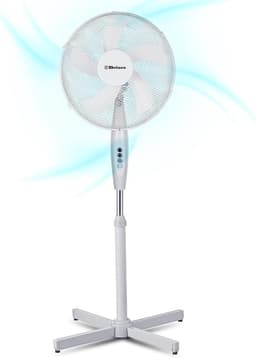
UK mains are 230 V, and a domestic fan meant for a wall socket needs a correct BS 1363 arrangement. That is regulation 35 of the Electrical Equipment (Safety) Regulations 2016. In August 2026 the Office for Product Safety and Standards rejected a T-SUN floor fan because the live pin was too short for that standard. A price in pounds does not prove the plug in the box is British. In this set, only two listings state that plug. The Belaco BLSF-40 at £29.99 says BS 1363, with 220–240 V in the bullet. The Dr. Prepare desk tower at £35.99 says a standard UK plug at 240 V. The black DREO DR-HTF007 at £79.99 puts 220–240 V in the title and then names an EEC 7/7 connector, which is a Schuko-style plug, not a fused 13 A British plug. The DREO DR-HTF017 at £74.99 says 240 V and names NEMA 5-15. Three other DREO rows print 120 V and a 2-pin lead: the white DR-HTF007, the DR-HPF013 pedestal, and the PolyFan DR-HPF002. A travel adaptor does not turn a 120 V fan into a 230 V appliance. A 5 V USB lead is a different case. The SWEETFULL and the OCOOPA are meant to run from USB, so the missing mains plug is expected. The Honeywell HT900E states 240 V and leaves the plug pattern blank.

Treat the decibel line as a low-speed claim

A title that says 20 dB is almost never the fan at every speed. The Household Appliances (Noise Emission) Regulations 1990 say a stated noise level has to be determined and presented properly. They do not turn a headline into a measurement you can repeat at home with a phone. Quiet Mark publishes no single decibel pass mark, and none of these twelve listings claims the mark. Read the title and the specification table as two sentences. The white DREO DR-HTF007 says 20 dB in the title and 28 dB in the table. The black twin says 20 dB and prints 25 dB. The DR-HPF013 pedestal says 20 dB in a bullet and 28.2 dB in the table. Do not average 20 and 28 into 24. The Levoit Windi Mini bullet says 20–43 dB across speeds, while the table still says 20 dB. The Honeywell bullet says 39–56 dB and the table has no decibel cell at all. The Belaco bullet and table both say 45 dB maximum. The Dr. Prepare table says 60 dB. Those figures can be fine for a living room in the daytime. They are the wrong product if you chose the listing because the title said whisper. BS 8233’s 30 dB bedroom-night figure is guidance for buildings, not a legal limit for a portable fan. Where to put the fan at night is on the quiet bedroom fan page.

Match the shape to the job

A 2.5 W USB fan, the SWEETFULL at £12.99 or the OCOOPA at £18.99, is a breeze at your face. Reviewers say both are too small for a room. A 30–40 W desk circulator throws further and is often noisy on the top step. The Honeywell is 30 W, with a claimed throw of up to 7 m beside 185 cubic feet per minute in the table. The MBSM is 40 W, and the sampled reviews say speeds 2 and 3 are too loud for work. A mini tower sits between those. The Levoit is about 33.5 cm tall and 7.5 W. The Dr. Prepare is about 32.5 cm tall and 16 W, with a UK plug and a 60 dB table. Neither is a floor fan for a large room. A floor tower, around 92 cm for the DREO DR-HTF007 and DR-HTF017, is the usual bedroom column, and it still has to pass the plug check. A 16 inch pedestal such as the Belaco moves a lot of air, lists 2,750 m³/h, and takes a base the bullet gives as 60 cm. Wattage does not prove airflow, and the airflow numbers are not comparable. One table says cubic metres per hour, another says cubic feet per minute, another says feet per second. Leave them in the units printed. Shape, throw and floor space are compared on the tower fan vs pedestal fan page.

Then look at speeds, timer and cleaning

Once the plug, the noise table and the shape agree, the controls decide whether you will live with it. Sleep needs a low speed you can still feel, a way to dim or mute the display and the beep, and a timer. Several DREO bullets claim sleep mode. The black DR-HTF007 claims display auto-off and auto mute. The Levoit bullet says sound and display can be switched off. The MBSM remote names sleep mode and a 1–12 hour timer. The Honeywell has buttons, no remote and no timer, so every change means getting up. The Belaco’s bullets name a pull chain, while other table fields say push button and touch, so do not assume a handset. A DC motor can be quieter than a cheap AC motor at the same job. It does not guarantee the listing. The OCOOPA names a brushless motor and still prints 45 dB at high speed. Speed counts also split: several DREO bullets say eight speeds while the table says three or four. Dust on an impeller is a common reason a quiet fan starts to rattle. Prefer a listing that says the grille comes off, and unplug before you open it. The SWEETFULL’s front cover comes off. The MBSM’s front grille is described as detachable. Who each fan suits, once those checks are done, is on the best quiet fan page.

Common questions

What should I read before the star rating?
Read the connector and the voltage, then the title decibel beside the table decibel. A 4.7 from thousands of reviews does not correct a 120 V line or a 20 dB title that the table raises to 25, 28 or 28.2 dB. In this set the Belaco’s 4.0 from 3,039 reviews is the weakest average, and it is also one of the two listings that states a BS 1363 plug. Stars tell you how owners felt. They do not tell you the pins will fit a British socket.
Is 20 dB the fan at every speed?
No. Treat 20 dB as the quiet claim, usually the low speed, not the speed that moves air across a room. The Levoit bullet is the clearest counter-example here: 20–43 dB across speeds, while the table still says 20 dB. The Honeywell’s quiet-operation line sits beside 39–56 dB. If the page never says which speed the number belongs to, assume it is the bottom of the range.
Does a DC motor guarantee a quiet fan?
No. A DC or brushless motor can be quieter than a basic AC motor at low speed, and several listings here name one. The OCOOPA is brushless and still describes high speed as under 45 dB. The Dr. Prepare is a small tower with a stated UK plug and a table that says 60 dB. The motor type is a clue. The table, and the speed you will actually run, are the check.
How do I tell a UK plug from EEC 7/7 or NEMA 5-15?
A BS 1363 plug has three rectangular pins and a fuse. EEC 7/7 is the round Schuko pattern named on the black DREO DR-HTF007. NEMA 5-15 is the flat-pin North American pattern named on the DR-HTF017. A table that says 120 V and 2-pin, as on the white DR-HTF007, the DR-HPF013 and the PolyFan, is not a British lead. Do not force any of those into a UK socket with a loose adaptor.
Is a 5 V USB fan in the same buying decision?
Only if the job is one person at a desk or beside a pillow. The SWEETFULL and the OCOOPA are 2.5 W, they have no battery, and they run only while the USB lead is powered. They are outside the mains-plug rule because they are not mains fans. They are the wrong buy if you wanted a pedestal or a floor tower and the price looked low. You still need a USB source of your own. The box does not include a 13 A plug.
What wattage is in this set, and does it prove airflow?
The listings run from 2.5 W on the USB fans to 45 W on the Belaco and the DR-HTF017. Every wattage here is under 125 W. A higher wattage often means more air, and it often means more noise on the top speed. It does not let you compare 2,750 m³/h on the Belaco with 185 cubic feet per minute on the Honeywell or 25 ft/s on a DREO bullet. Those units are not the same statement. Use wattage as a clue to the job, not as a league table.
When is a 45 dB or 60 dB claim the wrong product?
When you needed a low speed for sleep and the only noise figure on the page is already 45 or 60 dB. The Belaco states 45 dB maximum in both the bullet and the table. The Dr. Prepare table states 60 dB. Both can be reasonable for moving air in a living room, and the Belaco is the best value in our comparison if you want a stated British plug. Neither is a substitute for a fan whose low speed, display and beep you have checked for the night.

Related pages

Sources

Public UK sources named below. amazon.co.uk prices, stars and review counts on these twelve listings were read on 19 October 2026. Page updated 20 October 2026.

  1. Electrical Equipment (Safety) Regulations 2016, regulation 35 (retrieved 19 October 2026)
  2. GOV.UK electrical equipment safety guidance (retrieved 19 October 2026)
  3. OPSS product safety report, T-SUN floor fan, 17 August 2026 (retrieved 19 October 2026)
  4. Household Appliances (Noise Emission) Regulations 1990 (retrieved 19 October 2026)
  5. Quiet Mark certification explainer (retrieved 19 October 2026)
  6. BS 8233 explained (retrieved 19 October 2026)
  7. GOV.UK energy-related products (retrieved 19 October 2026)
  8. Approved Document F (retrieved 19 October 2026)