Independent comparisons. We may earn from shop links. More info

How to clean a tower fan

Updated: 21 October 2026

The fan that was fine in June now ticks, and the air smells of warm dust. How to clean a tower fan, on a quiet model, is mostly unplugging it and taking the loose dust off before you decide the motor is failing. Water in the motor, or a grille you forced open, will make it louder and can make it unsafe. This page is the procedure for the fans in our [quiet fan comparison](/hub/cooling/quiet-fan). It does not rank them. Peter F. used those listings on 19 October 2026. We did not strip these units in a workshop. If you buy through our links, we may earn a commission at no extra cost to you.

The fan that was fine in June now ticks, and the air smells of warm dust. How to clean a tower fan, on a quiet model, is mostly unplugging it and taking the loose dust off before you decide the motor is failing.

Our top picks

On this page

Unplug it, including a USB lead

Unplug the fan before you touch a grille, a blade or a vent. A tower on a low speed still has an impeller that will start if the remote is knocked, and a mains fan on 230 V is not a job for a damp cloth while the lead is live. Electrical Safety First tells you to unplug at once if you smell burning or hear an unusual noise, and not to leave a fan running overnight. If the plug or the socket is hot, stop. Do not clean your way through a damaged lead. A USB fan needs the same pause. The SWEETFULL and the OCOOPA run at 2.5 W from a 5 V lead, with no battery, so pull that lead and wait until the blade has stopped. A floor tower that has been on high can stay warm, so wait until the grille is cool as well. Do not start with a spray. Retail cleaning notes, and DREO’s own notes, both say not to soak the motor. Solvents are a bad idea on plastic next to a winding. Power off at the plug, then dry dust, and only then wash a part the listing says you can remove.

Vacuum the outside before you open anything

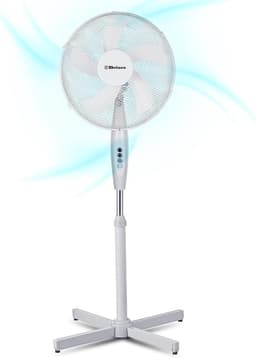
Most of the rattle people blame on a bearing is dust on the intake. Start with the casing closed. Use a soft brush on a vacuum, on low suction, along the vents and the foot. Work from the top of a floor tower downwards, so dust falls onto a pass you have not done yet. The Belaco has an open guard rather than a sealed column. Brush that guard, and do not push the nozzle through the wires onto the blades. A fan blows whatever is loose in the room, so dust the bedside table or the shelf the intake faces before you switch it back on. Where that fan should sit at night is on the quiet bedroom fan page. If the smell was only surface dust, and the tick has gone, stop. You do not need to open a casing the manual does not show you how to open. A rule of thumb from cleaning guides, not a British Standard, is every few weeks in heavy summer use, and again before storage. If the manual forbids compressed air, do not blast the vents. High speed will still be louder than the title decibel after a careful clean.
DREO DREO DR-HTF007 tower, white

Testsieger

DREO DREO DR-HTF007 tower, white
5.7/10about £79.99

Open a grille only if this model says you can

Open a cover only when that listing or its manual says the part comes off. In this set, three files say so in plain language. The white DREO DR-HTF007 describes a rear grille and an impeller you can remove. The SWEETFULL’s front cover comes off. The MBSM’s front grille is detachable. Those are three different machines. Do not copy a screw sequence from one DREO deep-clean page onto the Belaco, the Honeywell or the Levoit. If the maker does not show the clips, do not force them. The Belaco file gives a guard and no wash routine, so brush it and leave the motor alone. The Honeywell does not describe a strip-down. The removable-grille line is the white DR-HTF007’s bullet, so do not assume the black column uses the same clips until its own manual says so. If the part does come off, wash only that part. Lukewarm water and a drop of washing-up liquid are enough for a plastic grille or impeller. Do not run water into the column, the buttons or the motor. Dry every piece fully before it goes back. A damp impeller is how a musty smell replaces a dusty one. Refit the grille so it sits flush. A rattle after cleaning is often a loose guard, not a failed bearing. Do not oil a bearing because a video did. None of these listings asks you to.

Stop if it smells hot, sparks, or still grinds

Dust explains a tick and a warm, papery smell. It does not explain a burning smell, a spark, or a sharp grind that was not there before you opened the fan. Unplug it and leave it unplugged. A clean does not reset that stop. Do not test it in short bursts to see if the smell goes. A hot plug or a lead trapped under the base is a return, or an electrician if the socket itself is damaged. An electrician is for the socket or the circuit, not for a dusty grille on a normal plug-in fan. If you forced a casing and a clip is broken, the Consumer Rights Act 2015 is the route back to the seller, not tape. A fan that is simply loud on high may be working as specified. The Dr. Prepare’s table says 60 dB and the Belaco’s ceiling is 45 dB. Cleaning will not turn either figure into another brand’s 20 dB title. When the grille is dry and tight, plug it back in on the lowest speed. If the tick has gone, you are done. Plug checks are on the quiet fan buying guide.

Common questions

Do I unplug a USB fan too?
Yes. The SWEETFULL and the OCOOPA only run while the 5 V lead is powered. Pull it and wait until the impeller has stopped. There is no battery in those boxes. If it keeps spinning with the lead out, stop. A floor tower that has just been on high should be cool before you brush the vents. Do not start with a spray while any lead is still connected.
Which listings say a grille comes off?
The white DREO DR-HTF007 says the rear grille and the impeller come off. The SWEETFULL says the front cover comes off. The MBSM says the front grille is detachable. Do not treat those three lines as a licence to open the Levoit, the Dr. Prepare, the Honeywell or the Belaco. You can vacuum the outside of every fan the same way, with the casing closed. If your manual disagrees with a marketing bullet, follow the manual.
Can I wash a tower fan impeller?
Only if that model’s listing or manual says the impeller comes out, and only after it is off the motor. Wash the plastic part, not the column. Lukewarm water and a little washing-up liquid are enough. Do not immerse the motor, and do not refit the impeller while it is damp. A pictured deep clean on a maker’s own page is for the tower they show, not a sequence for the other eleven fans here. If the impeller does not come out, vacuum the outside and stop.
Why is it noisier after I put it back together?
A loose grille is the usual reason. The cover looks shut and still buzzes because one clip sits proud of the rim. Unplug again, press each clip home, and check the lead is not trapped under the base. If you cannot get the same flush fit, leave it unplugged. Do not oil the bearing to mask the rattle. High speed was never the title decibel, so a clean fan can still sound loud on the top step.
What if it smells of burning?
Unplug it at once and do not plug it back in to finish the clean. A burning smell, a spark or a sharp grind is outside dust on the impeller. If the socket is hot or marked, that is an electrician’s job. If the fan itself is at fault, use the seller’s return rather than a home repair. Do not leave it running overnight to burn off a smell.
How often should I clean it, and when do I return it?
Every few weeks in heavy use, and before storage, is a rule of thumb from cleaning articles, not a standard. Return the fan when it smells of burning, sparks, has a damaged lead, or will not run safely after you refit a grille the manual told you to remove. Also return it if a clip broke because the casing was not meant to open. A fan that is merely loud at the figure in its own table is a specification, not a failed clean.

Related pages

Sources

Public UK sources named below. amazon.co.uk prices, stars and review counts on these twelve listings were read on 19 October 2026. Page updated 20 October 2026.

  1. Electrical Equipment (Safety) Regulations 2016, regulation 35 (retrieved 19 October 2026)
  2. GOV.UK electrical equipment safety guidance (retrieved 19 October 2026)
  3. OPSS product safety report, T-SUN floor fan, 17 August 2026 (retrieved 19 October 2026)
  4. Household Appliances (Noise Emission) Regulations 1990 (retrieved 19 October 2026)
  5. Quiet Mark certification explainer (retrieved 19 October 2026)
  6. BS 8233 explained (retrieved 19 October 2026)
  7. GOV.UK energy-related products (retrieved 19 October 2026)
  8. Approved Document F (retrieved 19 October 2026)