Independent comparisons. We may earn from shop links. More info

How to connect an air hose

Updated: 21.10.2026

The new hose is on the bench, the compressor outlet is a different shape from the plug in your hand, and the obvious move is to force the coupler or to crack a joint that is still live. This is how to connect an air hose so the ends click, the thread you do assemble is the thread you actually have, and the first pressurisation is a controlled one. The [air hose comparison](/hub/compressors/air-hose) is where the eleven hoses and their fittings are listed. A qualifying purchase can earn us a commission at no extra cost to you. Those amazon.co.uk listings, fitting notes, and HSE guidance on flexible hoses were checked on 19 October 2026. Nothing here is a lab test of a coupling.

The new hose is on the bench, the compressor outlet is a different shape from the plug in your hand, and the obvious move is to force the coupler or to crack a joint that is still live.

Our top picks

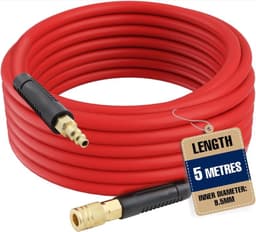
LIKEEM LIKEEM hybrid 5 m, 9.5 mm

Best overall

LIKEEM LIKEEM hybrid 5 m, 9.5 mm
7.3/10about £15.99
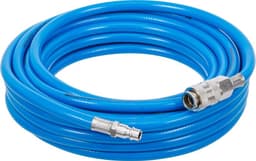
BGS BGS 3250 air hose 10 m

Alternative

BGS BGS 3250 air hose 10 m
5.0/10about £15.13
On this page

Click the nose before you worry about the thread

Look at the plug that already lives on your tools, because that profile decides whether the new hose clicks. A European nose and an older British PCL-pattern nose are both sold as quarter inch, and they do not interchange. Tanair's note on Euro fittings tells you to match the profile before you chase the thread, and not to assume Euro, PCL Standard, and QR100 are the same family. A Euro plug that will not seat in a British coupling is not a tight seal waiting for more force. Forcing it marks the nose and still leaks. LIKEEM and Bluespot state 1/4 inch BSP, which is the thread into a BSP port. YOTOO and TIANLIN state a European quick coupler, which is the nose. BGS prints 6.3 mm and reviews say those ends were Euro. If your compressor is British-pattern and the hose is Euro, you change the end or you change the hose. You do not file the nose until it almost clicks. The air hose buying guide is the longer version of that choice.

Ends you can unscrew, and ends you should leave

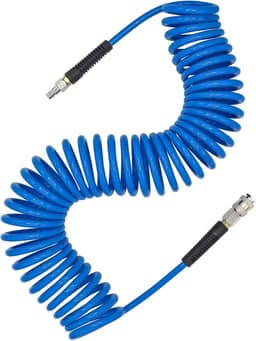
YOTOO's polyurethane coils say the 1/4 inch Euro coupler and plug can be removed with a spanner. That is the route when the supplied nose is the wrong profile and you already own a plug that matches the compressor. Reviews on the 15 m coil describe people doing exactly that swap. LIKEEM's red hybrid reviews say the brass connectors are fixed and that you should use a different connector on the tool rather than taking these ends off. The blue LIKEEM pages do not say either way, so do not assume they unscrew because the red ones are brass as well. BGS reviews describe owners cutting the fitted ends off and refitting their old ones. That is a repair, not a designed spanner joint, and it is the wrong first step if you have not depressurised the line. Darnassus names a 6 mm NPT industrial coupler and solid brass thread fittings in the same bullets. The Hosemaster's note on the two forms says a BSP fitting can take two or three turns into NPT and still leak, and that PTFE tape does not turn one thread into the other. If the ends are fixed and the nose is wrong, the hose is the wrong hose.
LIKEEM LIKEEM hybrid 5 m, 9.5 mm

Testsieger

LIKEEM LIKEEM hybrid 5 m, 9.5 mm
7.3/10about £15.99

First pressurisation

Switch the compressor off and let the tank down, or close the outlet valve and bleed the hose you are replacing, before you uncouple anything. Tanair's fitting guidance makes the same point: isolate and depressurise before a change. Seat the plug until it clicks, then tug it once by hand. A coupler that needs a hammer has not fitted. Open the outlet slowly and listen at the joint for a few seconds with the tool disconnected or with its trigger closed. A small weep at a threaded joint you have just made can be a loose spanner fit. A hiss that grows, a bulge, or a coupling that creeps off the hose is a stop, not a tighten-under-pressure job. HSE's HSG39 says that for hoses above 10 mm bore, longer than 10 m, or used over 7 bar, a self-venting connector that dumps the downstream pressure before the hose is released is the sort of fitting to select. That is guidance for choosing a connector. It is not a claim that any hose in this set includes one. Most of these bores are 6 mm, and the 9.5 mm LIKEEM line is the one that crosses the 10 mm discussion. Do not blow dust off your skin or your clothes with the new blow gun while you are testing the joint.

When to stop

Stop if the hose has already split, blistered, or whipped. A BGS review pattern of bursts around 6 to 7 bar, and a YOTOO hybrid review of a hose shearing at 140 PSI, are reasons to scrap that hose, not to tape it and carry on. Stop if you are about to re-end a hose that will be used at work. At work in Great Britain the hose is part of a pressure system once the air is above 0.5 bar, and PUWER requires work equipment to be maintained. A written scheme under PSSR 2000 depends on the vessel and on whether the use is work. A 50 litre receiver at 10 bar is 500 bar litres, which sits outside the small-vessel exception. Northern Ireland is outside that instrument. Domestic use that is not work is a different situation, and a split hose in your hand is still a reason to stop. A faulty receiver, a safety valve that will not lift, or a coupling you cannot identify is a job for a competent person, not for another turn of tape. The best air hose page is the buy-or-skip list if this hose was the wrong family.

Common questions

Which end goes on the compressor?
The plug goes into the coupler that is fixed on the compressor outlet, or the hose's female coupler receives the plug that is already on the outlet. Match the nose first. On a YOTOO coil the listing's Euro plug and coupler are a pair, and either can be the end you change with a spanner if your outlet is a different Euro-compatible fitting. A fixed LIKEEM end stays where it was crimped.
Why will the new hose not click on?
The usual reason in a UK garage is a Euro nose against an older British coupling, or the reverse. Both are sold as 1/4 inch. Forcing the plug does not create a seal. BGS reviews describe Euro ends that would not fit British fittings until the ends were replaced. Check the profile before you blame the compressor.
Can I put PTFE tape on an NPT plug in a BSP outlet?
No. The Hosemaster's comparison of the two threads says they are not interchangeable, and that tape will not seal a mismatch even if the fitting turns in a couple of times. Darnassus is the listing that names NPT and brass fittings together. Do not use that page as permission to adapt one into the other.
Which hoses in this set let me remove the fitted ends?
YOTOO's 10 m and 15 m coils say the Euro ends come off with a spanner. LIKEEM red-hybrid reviews say the brass ends are fixed. The blue LIKEEM listings do not say. BGS owners describe cutting ends off, which is not the same as a joint designed to unscrew. Darnassus does not say the ends are removable, and the thread name is unsettled.
Do I depressurise before I uncouple?
Yes. Switch off, close the outlet or bleed the tank, and let the hose you are removing go soft before you press the coupler. Opening a live coupling is how a hose whips. HSG39's self-venting advice is for larger, longer, or higher-pressure hoses, and it is about the connector you choose, not a feature listed on these ASINs.
When do I stop and get a competent person?
Stop for a hose that has split in the hand, a receiver or safety valve you do not trust, a workplace system that needs a written scheme, or before you re-end a hose that will be used at work. A domestic tyre inflator with a fitting that simply does not match is a buying problem, and the comparison is the place to change the hose.

Related pages

Sources

Public UK sources below. amazon.co.uk listings for these eleven hoses, shelf date 19 October 2026.

  1. HSE: introduction to pressure equipment (retrieved 19 October 2026)
  2. HSE: INDG261 (rev 2), written schemes of examination (retrieved 19 October 2026)
  3. HSE: HSG39, compressed air safety (retrieved 19 October 2026)
  4. legislation.gov.uk: Pressure Systems Safety Regulations 2000 (retrieved 19 October 2026)
  5. legislation.gov.uk: Pressure Equipment (Safety) Regulations 2016 (retrieved 19 October 2026)
  6. legislation.gov.uk: PUWER 1998 regulation 5 (retrieved 19 October 2026)
  7. legislation.gov.uk: Consumer Rights Act 2015 section 9 (retrieved 19 October 2026)
  8. BSI: BS EN ISO 2398:2016 rubber hoses for compressed air (retrieved 19 October 2026)
  9. BSI: BS EN ISO 5774:2001 plastics hoses for compressed air (retrieved 19 October 2026)