Independent comparisons. We may earn from shop links. More info

Bluetooth thermometer for a greenhouse

Updated: October 2026

A UK greenhouse can lose seedlings to a cold night or a shut vent on a bright afternoon. A Bluetooth thermometer can show the overnight low and the afternoon high from the house, once the phone still connects and the stated upper limit still makes sense in hot glass. It will not open a vent or ping you at work. The five sensors in the [Bluetooth thermometer comparison](/hub/climate-measuring/bluetooth-thermometer) are Bluetooth-only, from amazon.co.uk on 19 October 2026. None states an IP rating. A qualifying purchase can earn a commission at no extra cost to you.

A UK greenhouse can lose seedlings to a cold night or a shut vent on a bright afternoon.

Our top picks

Govee Govee H5075

Best overall

Govee Govee H5075
9.2/10about £9.98
TempPro TempPro TP357

Best value

TempPro TempPro TP357
8.8/10about £8.99
Brifit Brifit Bluetooth 5.0, 2-pack

Alternative

Brifit Brifit Bluetooth 5.0, 2-pack
8.8/10about £16.99
On this page

The temperatures that matter

The Royal Horticultural Society still points growers to a maximum-minimum thermometer, plus shade and ventilation. Prolonged heat above about 27°C can damage plants. Shade and ventilate so the house stays below about 25–27°C. Many seeds germinate around 18°C, and the packet overrides that average. Tender plants may need about 5°C. Many tropical plants want at least 12°C. Those are plant bands, not a lab promise for these sensors. The job is the highest and the lowest, not one glance at lunchtime. App history can stand in for a max-min thermometer when it stored the night. A high humidity reading is a reason to vent and to look at the leaves. It does not tell you the compost is dry.

Placement and the path to the house

Put the sensor at plant height, in shade. Sun on the casing reads the plastic rather than the air. On a still night the cold air pools low, near the glass or the door, so one sensor in the middle of the bench will miss that. The Brifit listing is a two-pack for two spots, if both stay in range of the same phone. Prove the radio where you keep your phone at night. If the live reading stalls, the overnight alert will stall too. Pairing is in how to use a Bluetooth thermometer. Test on the garden path, not only on the kitchen table. With bubble insulation, hang the sensor on the plant side of the plastic.
Govee Govee H5075

Testsieger

Govee Govee H5075
9.2/10about £9.98

What these five listings actually state

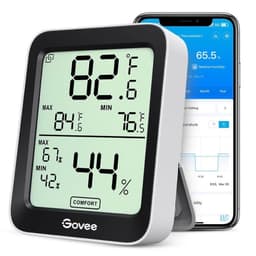
Read the upper field on the ASIN. Do not collapse different statements into one number. The TP357 states 60°C. The TP350 states 50°C. The Brifit pack states 65°C. Those ceilings sit above the RHS line of about 27°C. They are manufacturer attributes, not a test we ran, and they do not make the unit waterproof. The H5074 upper attribute is printed as 104°F. Leave it as a listing field. One review title says it is good in the cold and not for high temperatures, and the listing states that Wi-Fi is not supported. The H5075 upper attribute is printed as 86.54°F. A sibling Govee table states −20°C to 60°C for the H5075 family. Those two statements are not one range. Do not convert the Fahrenheit figure and treat the result as settled. On 19 October 2026 Govee’s shop listed the H5075 at £27.99, so confirm the ASIN. Price does not tell you which upper field survives a hot afternoon.

When Bluetooth is the wrong greenhouse tool

Bluetooth is the wrong tool when you are out all day and you need the warning then. These five do not include a gateway. An alert exists while your phone is in range. It does not follow you to work. That choice sits on the Bluetooth or Wi-Fi thermometer page. It is also the wrong tool when the house runs past the upper figure on the listing you bought. Shade and vent so the air stays under about 25–27°C. If it still overshoots, a non-radio max-min at the door is the honest fallback. Leave the sensor out of standing water. Set the high alarm so it speaks before a prolonged spell above about 27°C, not on every brief spike when you open the door. Then check, from the room where you charge your phone, that the reading still moves.

Common questions

Is a home humidity band the right target in a greenhouse?
No. East Herts suggests about 30–60% relative humidity for homes in cooler weather. That is not a greenhouse band. High humidity plus poor ventilation encourages grey mould, and very dry air encourages red spider mite. A high reading is a reason to vent and look at the leaves. It does not tell you the compost is dry.
Can one of these sensors run a heater or a vent?
None of these units is a mains controller. A heater, a propagator supply, or any other greenhouse electrics job belongs with a qualified electrician. The sensors are battery gadgets. They do not belong in pooling condensate. No listing here states an IP rating, so a greenhouse mention in the bullet points is not a seal against water.
Which upper temperature should I trust on the H5075?
The H5075 upper attribute is printed as 86.54°F, while a sibling Govee table states −20°C to 60°C for the family. Those are not one range. Do not convert the Fahrenheit attribute and treat the result as settled. Reviewers use it in a greenhouse. That use does not decide the ceiling. Check the live listing if the air can sit above 27°C for hours.
Why does the H5074 look unsure about heat?
The H5074 upper attribute is printed as 104°F. Leave that as a listing field rather than a Celsius range you calculate. One review title says the sensor is good in the cold and not for high temperatures. The listing also states that Wi-Fi is not supported, so a greenhouse mention is still a local Bluetooth check.
Where should spare cells stay?
Spare button cells, where a model uses them, stay off the potting bench and away from children. Fit fresh cells before you trust a week of lows. A repeated review theme on the TP350 is lost data when the cells run flat. A wet propagator lid is a splash risk, not a seal the listing states.

Related pages

Sources

Public UK sources used for this comparison. Listing prices, stars, and review counts are from amazon.co.uk on 19 October 2026.

  1. NHS — sudden infant death syndrome (retrieved 19 October 2026)
  2. The Lullaby Trust — room temperature (retrieved 19 October 2026)
  3. GOV.UK — damp and mould health risks (retrieved 19 October 2026)
  4. East Herts Council — damp and mould (retrieved 19 October 2026)
  5. RHS — greenhouse ventilation (retrieved 19 October 2026)
  6. GOV.UK — UKCA and CE by sector (retrieved 19 October 2026)
  7. Consumer Rights Act 2015, section 22 (retrieved 19 October 2026)
  8. amazon.co.uk listings B086YYL439, B093PT1NL1, B0CRY35J2R, B0C8N43JL6, B0D1G2LK9P (retrieved 19 October 2026)