How to set a barometer
You have hung a new aneroid in the hall, checked the forecast, and the needle sits nowhere near the Met Office figure for your town. The capsule left the factory set for another height and another afternoon, so the hand is not a reading you can trust yet. This page shows how to set a barometer to the latest sea-level pressure, which screw moves the working needle, and when a still hand is a fault. The dials in the [barometers comparison](/hub/climate-measuring/barometers) need that match before a trend means anything. The steps follow Met Office and Royal Meteorological Society guidance, not a laboratory test. A qualifying purchase can earn a commission at no extra cost to you.
You have hung a new aneroid in the hall, checked the forecast, and the needle sits nowhere near the Met Office figure for your town.
You have hung a new aneroid in the hall, checked the forecast, and the needle sits nowhere near the Met Office figure for your town. The capsule left the factory set for another height and another afternoon, so the hand is not a reading you can trust yet. This page shows how to set a barometer to the latest sea-level pressure, which screw moves the working needle, and when a still hand is a fault. The dials in the barometers comparison need that match before a trend means anything. The steps follow Met Office and Royal Meteorological Society guidance, not a laboratory test. A qualifying purchase can earn a commission at no extra cost to you.
Our top picks
| Badge | Product | Rear screw | Set pointer | What you match | Note | Price | Offer |
|---|---|---|---|---|---|---|---|
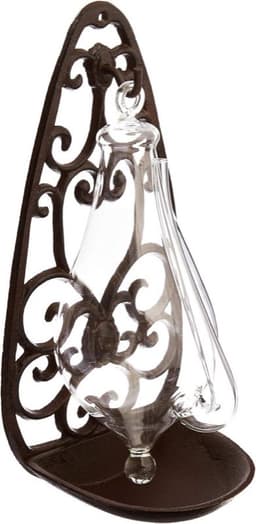
| Best overall |  Esschert Esschert Design crystal barometer with cast-iron stand, TH31 | None | No | Water level | 9.2 | about £28.14 | View offer |
 Youshiko Youshiko traditional barometer, mahogany wood surround | Tool in the box | Not stated | 960–1070 mb | 8.8 | about £49.99 | View offer | |
| Alternative |  Generic Classic analogue 3-in-1 barometer, thermometer and hygrometer, aged bronze | Not stated | Reference needle | Not stated | 7.8 | about £35.99 | View offer |


Alternative
Generic Classic analogue 3-in-1 barometer, thermometer and hygrometer, aged bronzeOn this page
The number you are aiming at
Set the screw, then the pointer
If the needle will not move
When it is a fault
Common questions
Where do you read the pressure for your town?
Why tap the barometer, and where?
How long before you decide the setting is wrong?
What if the screw does not move the needle?
Should you set a weather glass the same way?
Related pages
Sources
Public UK sources and the amazon.co.uk listings used for this comparison. Prices and review counts were taken on 19 October 2026.
- Royal Meteorological Society — Set your barometer (retrieved 19 October 2026)
- Met Office — How we measure atmospheric pressure (retrieved 19 October 2026)
- Met Office — High and low pressure (retrieved 19 October 2026)
- GOV.UK — Controls on mercury (retrieved 19 October 2026)
- Consumer Rights Act 2015, section 22 (retrieved 19 October 2026)
- WMO pressure chapter — exposure, not a retail accuracy claim (retrieved 19 October 2026)
- Physics Education — The weather glass (retrieved 19 October 2026)
- amazon.co.uk Best Sellers — Barometers (retrieved 19 October 2026)