Weather glass vs barometer
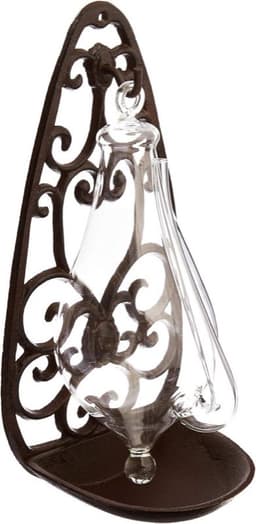
You have two amazon.co.uk listings open, both called barometers. One is a numbered dial. The other is a cast-iron frame with a glass spout of coloured water. A weather glass vs barometer choice is a choice between two instruments that shops file under the same word. On the [barometers comparison](/hub/climate-measuring/barometers) they sit in one set because buyers search for both, though they do not answer the same question. One gives a figure you can check against the Met Office. The other is a glass you keep filled and watch. Listings were checked on 19 October 2026. There is no laboratory test. A qualifying purchase can earn a commission at no extra cost to you.
You have two amazon.co.uk listings open, both called barometers. One is a numbered dial. The other is a cast-iron frame with a glass spout of coloured water.
You have two amazon.co.uk listings open, both called barometers. One is a numbered dial. The other is a cast-iron frame with a glass spout of coloured water. A weather glass vs barometer choice is a choice between two instruments that shops file under the same word. On the barometers comparison they sit in one set because buyers search for both, though they do not answer the same question. One gives a figure you can check against the Met Office. The other is a glass you keep filled and watch. Listings were checked on 19 October 2026. There is no laboratory test. A qualifying purchase can earn a commission at no extra cost to you.
Our top picks
| Badge | Product | What you read | How you set it | Room heat | Note | Price | Offer |
|---|---|---|---|---|---|---|---|
| Best overall |  Esschert Esschert Design crystal barometer with cast-iron stand, TH31 | Water line | Fill the glass | Trapped air expands | 9.2 | about £28.14 | View offer |
 Youshiko Youshiko traditional barometer, mahogany wood surround | 960–1070 mb | Rear tool in the box | Capsule, not a water line | 8.8 | about £49.99 | View offer | |
| Alternative |  Generic Classic analogue 3-in-1 barometer, thermometer and hygrometer, aged bronze | Pressure plus room dials | Reference needle stated | Side dials read the case | 7.8 | about £35.99 | View offer |


Alternative
Generic Classic analogue 3-in-1 barometer, thermometer and hygrometer, aged bronzeOn this page
Two different instruments
What you can read off each
The Esschert as sold
Which to buy
Common questions
Is the Esschert a barometer?
Is it a FitzRoy storm glass?
Why does the water move when the room warms up?
Can you set it to the Met Office number?
When is an aneroid the better buy?
Related pages
Sources
Public UK sources and the amazon.co.uk listings used for this comparison. Prices and review counts were taken on 19 October 2026.
- Royal Meteorological Society — Set your barometer (retrieved 19 October 2026)
- Met Office — How we measure atmospheric pressure (retrieved 19 October 2026)
- Met Office — High and low pressure (retrieved 19 October 2026)
- GOV.UK — Controls on mercury (retrieved 19 October 2026)
- Consumer Rights Act 2015, section 22 (retrieved 19 October 2026)
- WMO pressure chapter — exposure, not a retail accuracy claim (retrieved 19 October 2026)
- Physics Education — The weather glass (retrieved 19 October 2026)
- amazon.co.uk Best Sellers — Barometers (retrieved 19 October 2026)