Independent comparisons. We may earn from shop links. More info

Fridge thermometer dial

Updated: October 2026

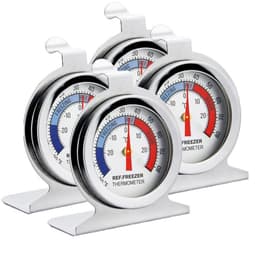
A fridge thermometer dial is a small analogue face you put in the cabinet so you can see the air temperature in degrees Celsius. The numbered control on the fridge itself is not that reading. GOV.UK household guidance asks you to keep the fridge at 0–5°C and the freezer at about −18°C, and to check with a fridge thermometer about once a week. The dials on the [analogue thermometer comparison](/hub/climate-measuring/analogue-thermometer) are air instruments. They do not measure the food, and they do not replace a probe if you hold food for other people. A purchase through those links can earn us a commission at no extra cost to you.

A fridge thermometer dial is a small analogue face you put in the cabinet so you can see the air temperature in degrees Celsius. The numbered control on the fridge itself is not that reading.

Our top picks

On this page

The number on the door is a setting

The wheel or the snowflake on a domestic fridge is a power setting. It does not print the temperature of the shelf. GOV.UK’s heatwave note makes the same point: the built-in gauge is not a Celsius reading, so you use a separate thermometer. Chilled food at home should live in air at 0–5°C. About −18°C is the freezer figure in the same chilling guidance. A dial whose scale cannot show both, clearly, cannot do both jobs. Check about once a week. If you are still choosing the face, the analogue thermometer buying guide keeps those criteria.

Where the dial sits, and how long you wait

Cold air pools. The back of a shelf often runs colder than the middle, and the door bins run warmer because they meet the kitchen each time the door opens. For a general check, hang or stand the dial in clear air on a middle shelf, not buried behind a carton and not pressed against the back wall. A Thermometer World catalogue page for a 65 mm fridge-freezer dial says to allow about two hours, and it states ±2°C at ambient for that model, on a scale of −30°C to 30°C. That is their description of their own item, not a laboratory result for the LinCoo or LIUQOBN dials. A needle you read thirty seconds after you unbox it is the kitchen, not the cabinet. How to cross-check 0°C in ice water sits on the how to use an analogue thermometer page.

Fridge dials in this comparison

Three listings in this set are sold as fridge dials. None publishes a calibration certificate, and none is a food probe. The INRIGOROUS 4-pack is about £9.99, rated 4.3 from 238 reviews: four stainless dials, a hook, and a retractable stand, with no power source listed. The attributes print 30°C as both the upper and the lower rating, while a live bullet also states −30°C to 30°C. “High accuracy” is listing language, not a stated tolerance. The LinCoo 2-pack is about £4.99, rated 3.8 from 10 reviews. The title describes two 50 mm dials with colour-coded zones. Colour zones without a Celsius key are a hint, not the 0–5°C band. The LIUQOBN 2-pack is about £5.29, rated 4.3 from 10 reviews: two plastic dials, a hook, and no battery. Blue, red, and green zones have no published degree marks. A green wedge is print, not the household target. The PaYuanRaoTi wall dials do not belong here. Reports describe readings around 20°C.

What a dial will not prove

A needle in the cabinet air is not the temperature of the food. Safer Food, Better Business asks you to check a cabinet display with a fridge thermometer or a probe, and to take the food temperature with a probe between packs or in the food. The Food Safety (Temperature Control) Regulations 1995 prohibit commercial chill holding above 8°C in England, Wales, and Northern Ireland. In Scotland that 8°C food limit is the recommended figure. GOV.UK tells businesses to set the equipment at 5°C or below so the food can stay at 8°C or below. 5°C is a setpoint for the kit. 8°C is the food limit for a business. A household fridge at 0–5°C is a third sentence. Do not fold them into one mark on a £5 dial.

Common questions

What temperature should a UK fridge be?
GOV.UK asks households to keep the fridge at 0–5°C and the freezer at about −18°C, and to check with a fridge thermometer about once a week. The number on the appliance door is the setting that gets you there, not the temperature itself. A room column with a top mark around 50°C cannot show that freezer floor.
Does the dial inside the fridge show degrees?
Only if it is a separate thermometer marked in Celsius. The built-in control is a power setting. Read the scale on the face you receive. If 0–5°C is a guess between tiny marks, it will not do the weekly check.
Are colour zones the law?
No. Blue, red, and green on the LIUQOBN dials, and the colour-coded zones on the LinCoo title, are printing. The household band is 0–5°C. The business food limit of 8°C, in England, Wales, and Northern Ireland, is a regulation about the food, not a wedge on the glass. In Scotland that 8°C figure is the recommended limit, not the same legal sentence.
Is a fridge dial enough for a café?
No. A dial shows cabinet air. A food business still probes the food, and it still has to meet the chill-holding rule that applies to it. A domestic weekly check is a different job. If you need the temperature inside the food, use a probe.
Why do two dials from one pack disagree?
Four dials that do not match are usually placement, a short wait, or a pack that already disagreed. Buyer reports on the INRIGOROUS listing include units from one pack differing by 2–3°C. Read them in the same spot after the door has been shut for hours. If they still differ by more than a couple of degrees, believe the spread, not the green paint.

Related pages

Sources

Public UK sources listed in the research digest. Listing prices, stars, and review counts are from amazon.co.uk on 19 October 2026.

  1. GOV.UK — controls on mercury (retrieved 19 October 2026)
  2. Food Safety (Temperature Control) Regulations 1995, regulation 4 (retrieved 19 October 2026)
  3. GOV.UK — chilling and freezing for food businesses (retrieved 19 October 2026)
  4. GOV.UK — how to chill, freeze and defrost food safely (retrieved 19 October 2026)
  5. Food Standards Agency — Safer Food, Better Business, chilled storage (retrieved 19 October 2026)
  6. The Lullaby Trust — room temperature (retrieved 19 October 2026)
  7. Centre for Sustainable Energy — temperature and humidity at home (retrieved 19 October 2026)
  8. Royal Meteorological Society — measuring temperature and humidity (retrieved 19 October 2026)