Independent comparisons. We may earn from shop links. More info

Pool alarm UK: what to check before you buy

Updated: 20.10.2026

You are choosing a first alarm for a garden pool, or for a pool you will use on holiday, and the amazon.co.uk sort is happy to rank a loud number above a plug you can actually use. A pool alarm UK listing is a warning device. It is not a fence and it is not someone watching the water. Work through the type, the indoor sound, wind and jets, power, and the size the seller prints, and leave price until those are settled. The shelf, with GBP prices from the 19 October 2026 scrape, is the [pool alarm comparison](/hub/burglar-protection/pool-alarm).

You are choosing a first alarm for a garden pool, or for a pool you will use on holiday, and the amazon.co.uk sort is happy to rank a loud number above a plug you can actually use.

Our top picks

On this page

Hear it where you sleep

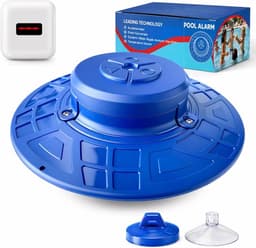
The figure on the box is a seller’s claim, not a test of your house. These listings print 85 dB, 90 dB, or 110 dB. ESHANG claims 110 dB, and its seven reviews praise the indoor receiver while calling the unit in the water soft. BCONE prints 90 dB with a home-unit siren. Stand in the bedroom with the door shut and have another adult trigger the alarm. You have heard it only if that sound would have woken you. The weight for that test is on the how to set up a pool alarm page.

Match the type to the risk

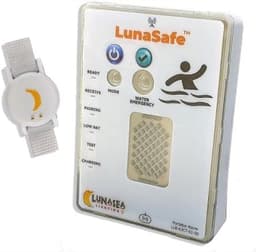
A floating sensor or a poolside sensor watches the water. A wristband watches one paired transmitter and ignores everyone else. Your own pool wants a sensor in that water, because a visitor’s child will not be wearing your band. One child moving between other pools wants a band that travels. LunaSafe’s one-transmitter kit is £188.53. The two-transmitter kit is £271.50 and has no review line. Both say the product is not a life-saving device. The only UK review, dated 17 December 2025, says a toddler fell in while the sensor was not synchronised. The failures of each type are on the floating pool alarm or wristband page.
Lifebuoy BCONE pool safety alarm

Testsieger

Lifebuoy BCONE pool safety alarm
8.1/10about £352.92

Power, the plug, and the size on the listing

UK mains are 230 V, and a socket takes a BS 1363 plug. A battery float keeps a mains lead off the wet deck. UK reviews of ZEPLIHS, blue at £99.56 and red at £99.85, say the unit arrived with a US two-pin plug. A Generalman review says the notice specifies 110 V and a US plug, while the table still says battery powered. Do not rewire the lead. Mystique Maison claims a pool up to about 20 by 40 feet. RoamRider prints both 16 by 32 square feet and a 16-foot maximum. ZEPLIHS prints 220 feet, 80 metres, or 262 feet depending on the line. Wind and jets you have not retested are on the pool alarm false alarms page.

What this set actually costs

These are shelf prices for these ASINs. Entry floats are £73.31 for the ESHANG, £75.62 for the Mystique Maison, and £86.46 for the Generalman. Then £99.56 and £99.85 for the two ZEPLIHS colours, and £110.82 for the RoamRider. Wristbands are £188.53 and £271.50. The BCONE was £352.92 in the scrape and £368.56 on the 19 October 2026 check. Past £350 you are buying the phone alert, and a UK review still reports water inside the pool unit.

What an alarm does not replace

Nothing checked here requires an alarm on a private family pool. HSG179 excludes family-only domestic use and describes a motion sensor as not a life-saving device. RoSPA still wants an adult present and a barrier with a self-locking gate. EuroSafe says a prevention effect from pool alarms has not been shown. Buy the unit you can hear from the room you sleep in, then test it with a weight.

Common questions

What should I check before I buy a pool alarm in the UK?
Start with the type, then the indoor receiver, then wind and the filter jets, then the plug and the batteries, then the printed pool size, and only then the price. A pool alarm UK page can lead with 110 dB and still ship with a US two-pin plug, which is what reviews say about ZEPLIHS.
Do I need an indoor receiver?
You need one if you will not be standing beside the pool. A siren on the water is easy to miss from a brick kitchen or a shut bedroom. The floats in this set claim a receiver or a home unit. Hear that indoor unit on a test before you call the listing finished.
Will a US plug be a problem on a UK socket?
Yes, when the part you must plug in uses a two-pin US plug, especially if the notice says 110 V. UK sockets are BS 1363 at 230 V. ZEPLIHS reviews report a US plug, and one Generalman review reports 110 V and a US transformer. Do not rewire the lead, and do not leave an adaptor on the wet deck.
Does a pool alarm replace a fence?
No. RoSPA still wants supervision and a barrier with a self-locking gate. HSE does not require an alarm on a domestic family pool, and HSG179 calls a motion sensor not a life-saving device. LunaSafe prints that limit on the listing. Fit the barrier, and treat the alarm as a backup you have tested.
When is a wristband the wrong buy?
It is the wrong buy when the pool itself needs watching, including any child who is not wearing a paired band. LunaSafe covers the wearer. Its only UK review describes a fall with no alarm because the base was not synchronised after it was switched on. Take a band when the child is the thing that moves.

Related pages

Sources

Sources taken from the research digest. Listings were checked on 19.10.2026.

  1. RoSPA — Drowning prevention (retrieved 19.10.2026)
  2. HSE — Swimming pools (retrieved 19.10.2026)
  3. HSE — HSG179 Managing health and safety in swimming pools (retrieved 19.10.2026)
  4. ASTM — F2208 pool alarms (retrieved 19.10.2026)
  5. BSI — BS EN 16582-1 domestic swimming pools (retrieved 19.10.2026)
  6. NCMD — Child drowning deaths in England, 2019–2025 (retrieved 19.10.2026)
  7. CPSC — Pool alarm study (retrieved 19.10.2026)
  8. EuroSafe — Pool alarms and drowning prevention (retrieved 19.10.2026)