Part P video doorbell: when to call an electrician

A Part P video doorbell on a 13 A plug is not a new circuit in England. Stop for new 230 V work, a doubtful transformer, or a fire-door electric strike.
On this page
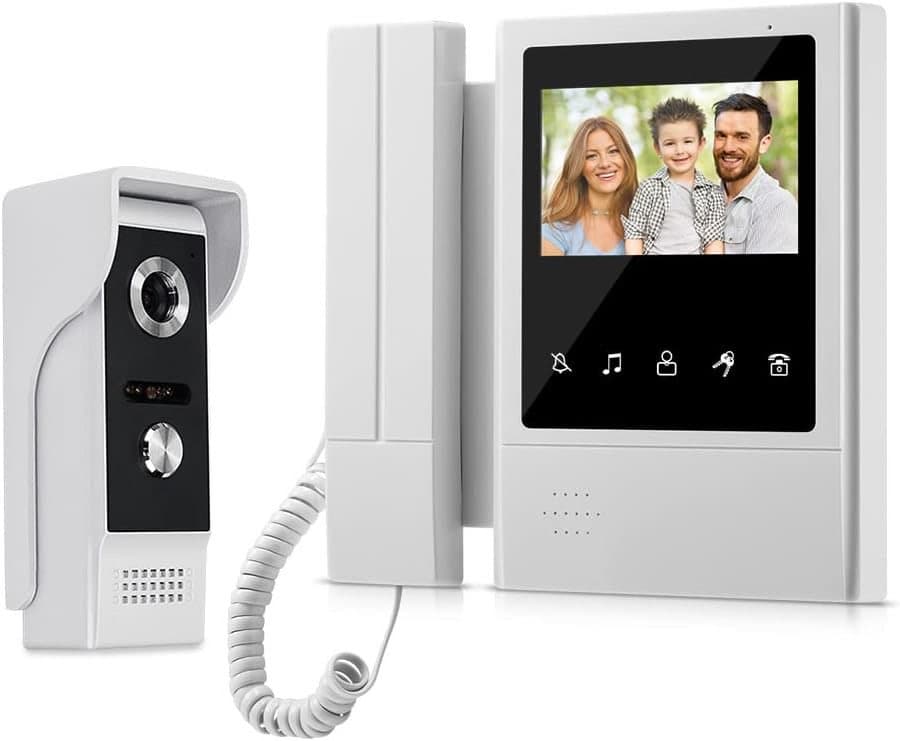
The spare socket is on the hall wall, the monitor still has its film on, and the listing has nudged you toward the consumer unit because it mentioned a transformer. A Part P video doorbell is not one job. Plugging a screen into a sound BS 1363 socket, or reusing a low-voltage pair the kit is built for, is a different piece of work from a new 230 V circuit in a dwelling in England. The Products Compared editorial team set amazon.co.uk listings beside that question on 15 October 2026, including the QingTianTongYun V168M4, using Approved Document P and the IET Part P FAQ. We ran no lab test. A qualifying amazon.co.uk purchase can earn a commission at no extra cost to you.
You stop for a new circuit, a transformer you cannot identify, or a fire-door strike. Fitting steps, once the cable matches the kit, are on the how to install a video door intercom page, and the sets are on the video door intercom comparison.
In short
A monitor on an existing 13 A socket is not a new circuit. In England, Approved Document P treats a new circuit in a dwelling as notifiable, and the IET Part P FAQ points at BS 7671 for that work. A 12–24 V feed is still a stop if the transformer is scorched or missing, a fire-door strike belongs with an electrician, and Scotland, Wales and Northern Ireland are not decided by the English document.
The job you can finish on a plug
Look at the socket before the consumer unit. A 13 A outlet already where the monitor will sit, with an intact cool faceplate, can feed the screen. BS 1363 is the British three-pin plug. Two minutes with the carton tells you whether that plug is in your hand and reaches without a coiled reel. Adding a socket, a fused spur, or a breaker is another job, so put the consumer unit cover back if it is already off.
The QingTianTongYun V168M4 shows why the carton matters. On 15 October 2026 it was £79.99, rated 4.0 from 34 reviews. The parts list names a UK 3-pin adapter. Bullet 5 says the power supply is not included, and no voltage figure is printed. If the adapter is in the box you have a plug-in monitor, and if it is absent do not take a feed from a lighting rose.
The TMEZON at the same £79.99, with 4.2 from 416 reviews, is 12 V corded and wants one socket. The EZVIZ CP5 at £161.49 takes power through the door cable, and a parts field that reads 36 EU is not a UK plug chart. Prove the picture before you drill.
A 12V door phone transformer is a stop when you doubt it
On the ACEBELL and the XPJ, 12–24 V is an optional feed for the outdoor unit, beside the battery. It powers that unit. It does not carry a four-wire bus, and it is not a new circuit while the transformer is one the kit is built for and you can identify. The indoor screen stays on its own plug. A line that says it is only 12 volts skips the primary side, which is mains.
The ACEBELL was £189.99 on 15 October 2026, rated 4.4 from 74 reviews, with a 7,000 mAh cell claimed at about 45 to 60 days. An owner review describes about two days and a missing hard-wire connector, so do not start the feed until that connector is in the carton. The XPJ TL-WF701 at £207.99, rated 4.4 from 31 reviews, follows the same pattern. No connector means the battery, not a lead taken from a lighting circuit.
Give the label a minute. Scorch marks, a crack, a burnt smell, or no printed secondary voltage end the job for you, because the primary is 230 V. Which? separates a battery doorbell from an 8–24 V wired install on another shelf, and that line is not this option. A new breaker to create 12 V is electrician work. Cable versus battery is on the wired and wireless comparison.
New mains work and a fire door electric strike
New 230 V work is the job for an electrician for a video intercom. In England, Approved Document P is the guidance on electrical safety in dwellings, and a new circuit is notifiable. The IET Part P FAQ discusses BS 7671, the UK wiring standard, alongside new circuits. If the consumer unit cover is off, put it back.
These cartons do not contain a gate strike or a fire door electric strike. On the V168M4, bullet 5 says the electric lock and the exit button are not included. The TMEZON unlocks from the monitor, and the CP5 also unlocks from the app or two RFID tags. On your own front door, match a lock you already own only with both diagrams. A colour chart from another brand leaves the release latched open, so if the diagrams are missing, the unlock waits.
A fire door has a closer so the leaf shuts. Do not cut that leaf or fit a strike that holds it open. A communal entrance belongs to the managing agent's installer, because the cable may serve other flats. A shop door is a different duty. The mistake is to call the job 12 volts while the transformer primary is 230 V and the leaf is a fire door.
Part P in England does not cover every UK home
Approved Document P, on GOV.UK, is the England document. The notifiable example these sources give you is a new circuit in a dwelling. A flat in Scotland and a house in Northern Ireland sit under those nations' own building rules. Wales is not a photocopy of the English PDF, and the IET Part P FAQ discusses England and Wales together, beside BS 7671. Use that page as a pointer, not as the rule for every delivery address.
Tell the electrician the nation, the door, and whether you need a new circuit, a transformer you cannot identify, or a fire-door strike. Do not ask anyone to sign off a circuit you have already added. If you rent, a consumer unit in a landlord's cupboard, or a cable that leaves your flat for a shared riser, is not yours to extend. The same stop applies when you cannot say which nation's rules cover the door.
Weather text does not move the boundary. IP65 means dust-tight and resistant to low-pressure jets. It is not a vandal-proof rating and not an electrical approval. In this set the TMEZON outdoor unit is listed as IP65. The V168M4 has a rainproof cover and no IP code, so do not copy the TMEZON figure onto it.
Ofcom covers radio, so a 2.4 GHz link is not paperwork under Approved Document P. This article is not a building notice, and it prints no core colours. A faulty-bell complaint is a rights question, not this wiring page.
What a BS 1363 adapter in the box actually tells you
Expect a BS 1363 three-pin plug when a UK listing claims a UK supply. A Schuko-only lead is a UK buying problem. Do not pare the pins, and do not leave a travel adapter feeding a monitor all day. If that is the only mains lead, the kit goes back.
The V168M4 is the worked example: the parts list includes a UK 3-pin adapter, and bullet 5 says the power supply is not included. The carton wins on the day. Thirty-four reviews is a short sample beside the TMEZON's 416 at the same £79.99. The stated 100 metres is a listing limit, not permission to pull cable through a fire compartment. A CP5 parts field that reads 36 EU is not a BS 1363 plug either.
Match the cable after that check. Four intact cores and a plug-in monitor point at the TMEZON or the V168M4, both £79.99 here. Two intact cores point at the CP5 at £161.49, with power through that cable. No usable cable points at a wireless kit, and the ACEBELL and the XPJ still need the indoor screen on a socket.
Those models run from £79.99 to £207.99 on the 15 October 2026 listings, set out on the video door intercom comparison. New 230 V work, a transformer you do not trust, a fire-door strike, a communal entrance, or a shop door is where you book someone else.
Common questions
Is a monitor on a 13 A plug notifiable in England?
What about the outdoor 12–24 V feed?
The transformer looks scorched. Do I reuse it?
Can I add a circuit for a gate strike myself?
Does Part P in England cover my flat in Scotland?
The kit says vandal-proof and IP65. Is that an electrical approval?
Who fits a communal entrance?
What plug should I expect in the box?

Products Compared publishes British-English buying guides based on amazon.co.uk listings and public UK sources. We do not run a lab and we do not invent test scores.
Related articles
Replace old video door phone: count the cores first
Count intact cores before you order. Two wires suit a 2-wire kit. Four suit a bus. A fire-door strike stays with an installer.

CCTV for a small shop UK: the householder guide stops
A domestic door station on a shop entrance is organisational CCTV, not the householder fitting described here.

Video doorbell for elderly no app: use the room screen
The useful product is the screen in the room, not a phone someone in the house will not open.