Independent comparisons. We may earn from shop links. More info

230 V or 110 V work light: which socket you have

Updated: October 2026

You are standing in front of a yellow outlet on a site, with a domestic tripod flood in the van and a 13 A plug in your hand. A 230 V or 110 V work light decision is a veto before it is a shop. If that outlet is 110 V, none of the corded lights in the [work light with tripod comparison](/hub/workshop/work-light-with-tripod) is the light, and an adapter is not the fix. The Products Compared editorial team checked the eleven amazon.co.uk listings dated 16 October 2026 against HSE’s construction guidance. We did not test a transformer. A qualifying purchase can earn us a commission at no extra cost to you.

You are standing in front of a yellow outlet on a site, with a domestic tripod flood in the van and a 13 A plug in your hand. A 230 V or 110 V work light decision is a veto before it is a shop.

Our top picks

AUTOUTLET AUTOUTLET EFU215

Best overall

AUTOUTLET AUTOUTLET EFU215
8.1/10about £60.99
Saker Saker LD10

Alternative

Saker Saker LD10
7.7/10about £54.98
T-SUN T-SUN twin 11000

Best value

T-SUN T-SUN twin 11000
6.9/10about £47.49
On this page

Two sockets, two purchases

A house garage uses a 13 A socket on UK mains, nominally 230 V, with a BS 1363 plug. A construction site that has reduced the voltage uses a yellow socket, typically to BS EN 60309, fed from 110 V centre-tapped-to-earth so that the voltage from either line to earth is about 55 V. The plugs do not fit each other. That is the point of the yellow outlet. If you are still choosing a lead or a battery for a house with no socket, that is the mains or rechargeable page, not this one.

What HSE expects on a site

HSE’s construction guidance says DIY plugs and cables are not the site tool. Use cordless equipment, or 110 V centre-tapped-to-earth, so the voltage to earth does not exceed 55 V. The IET describes 110 V centre-tapped-to-earth as long-standing good practice, not as a rule this page can call compulsory in every workplace. On a site with yellow outlets, do not arrive with a domestic 230 V flood. How to lock the stand at home is on the how to set up page.
AUTOUTLET AUTOUTLET EFU215

Testsieger

AUTOUTLET AUTOUTLET EFU215
8.1/10about £60.99

Every corded light here is the house-socket kind

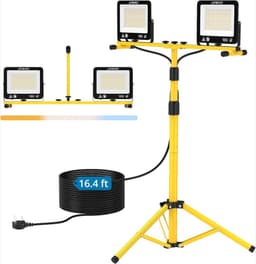
None of the eleven listings is sold as 110 V centre-tapped-to-earth. AUTOUTLET states 230 V. EOTO’s specification says 230 V and a bullet says 100–240 V, which is a wide mains range, not a site voltage. CORESLUX and Al waha print 220 V. BDDFOTO prints 230 V. NATPOW and T-SUN are sold as mains and do not print a voltage, which is a gap, not a 110 V claim. No yellow 110 V plug is described on any of them. A house garage on a 13 A socket is a different job, covered on the buying guide.

Battery is the cordless path, not a converted flood

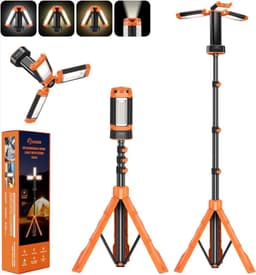
If you do not want a 230 V lead across the site, the cordless path in this set is a battery stand, not a converted flood. Saker LD10-UK states 3,200 lumens and charges by USB-C. SYLSTAR GZ035-OG states 3,000 lumens on a telescopic pole. Both avoid the 13 A plug while they are running. They do not carry a 110 V site certificate, and the charger still needs a supply afterwards. Do not fit an adapter and call a 230 V flood a 110 V light. A single tripod flood is task light. It is not the site’s emergency lighting, at either voltage.

Common questions

Will a travel adapter or a transformer make a 230 V flood into a 110 V light?
A transformer is a separate piece of site kit: 230 V in, 110 V out, to yellow sockets. It does not change the flood you already bought into a 110 V product. A travel adapter is not a fix this page will describe. The two purchases stay separate. A UK plug on BDDFOTO is still a domestic plug.
Is 110 V the law?
HSE expects cordless tools or 110 V centre-tapped-to-earth on construction sites, so the voltage to earth stays about 55 V. The IET describes that as long-standing good practice, not as a rule this page can call a criminal offence in every workplace. On a site that already has yellow outlets, follow that system. Do not arrive with a 230 V domestic flood.
Can I plug one of these into a yellow site socket?
No. A 13 A plug does not belong in a yellow 110 V outlet, and none of the corded listings here is sold as 110 V centre-tapped-to-earth. Hire or buy a 110 V stand, or use cordless equipment specified for that job. Do not force the plug. A transformer does not relabel the flood you already own.
Is a house garage a construction site?
A domestic garage on a 13 A socket is the job these corded floods are sold for. That is 230 V and a BS 1363 plug. It becomes the site case when the outlet is the yellow 110 V socket, or when the work is construction and HSE’s reduced-voltage line applies.
What checks apply if someone does use 230 V on a site?
HSE’s schedule is stricter than for 110 V: a user check every shift, a formal visual check every week, and a combined inspection and test before first use and then monthly. That schedule is not permission. It is what HSE sets out where 230 V equipment is used on a site anyway. A buzzing plug still means unplug and stop, whatever the voltage.
Do the battery lights avoid this problem?
They avoid a trailing 230 V lead while they are running. Saker is USB-C and states 3,200 lumens. SYLSTAR states 3,000 lumens. Neither is described as 110 V centre-tapped-to-earth, and the charger still needs a supply. They are the cordless path in this set, not a converted domestic flood, and not a substitute for site emergency lighting.

Related pages

Sources

Public UK sources used for this comparison. Listing prices, stars, and review counts are the amazon.co.uk lines from 16 October 2026.

  1. HSE, Site lighting (retrieved 16 October 2026)
  2. CDM 2015, regulation 35 (retrieved 16 October 2026)
  3. Workplace (Health, Safety and Welfare) Regulations 1992, regulation 8 (retrieved 16 October 2026)
  4. HSE HSG38, Lighting at work (retrieved 16 October 2026)
  5. HSE, portable equipment on construction sites (retrieved 16 October 2026)
  6. Electrical Equipment (Safety) Regulations 2016, regulation 35 (retrieved 16 October 2026)
  7. HSE, electrically powered equipment (retrieved 16 October 2026)
  8. IP code overview (BS EN 60529) (retrieved 16 October 2026)