Independent comparisons. We may earn from shop links. More info

How to fit a bench vice with a swivel base

Updated: October 2026

You would like the vice fixed before the holes go in the wrong place. How to fit a bench vice in this set is two jobs: a table screw, or a base with lugs you bolt through. Offer the vice up before you drill, put a bolt in every hole, and tighten the swivel lock by hand. Do not weld the base or slip a pipe over the handle. Choose the model on the [Swivel vice](/hub/workshop/swivel-vice) comparison. This page assumes you already have one. The steps follow UK maker sheets and amazon.co.uk reviews as of 16 October 2026. A purchase through our links may earn a commission at no extra cost to you.

You would like the vice fixed before the holes go in the wrong place. How to fit a bench vice in this set is two jobs: a table screw, or a base with lugs you bolt through.

Our top picks

On this page

If it clamps, skip the drill

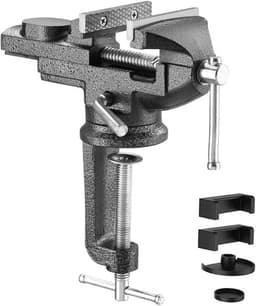
A clamp-on needs a solid edge, a pad that fits, and a screw you recheck after the first cut. The LDHHYH bullets claim a table up to 62 mm. The VonLux card says the clamp takes 70 mm. Measure the edge. If the top is thicker than the screw can close, do not pack it with scraps. Tighten, then try to twist the body by hand. VonLux and TEENO reviews both describe slip when the screw is slack. When the vice must stay for filing every weekend, use a bolt-down on a top you may drill. Which you should have bought is on the clamp on vice vs bench vice page.

Mark the holes with the vice, not with a guess

Put a bolt-down vice where long work can hang, then mark through the holes in the casting. C2 Safety's vice sheet says the stationary jaw should sit slightly past the bench edge, and that every hole gets a bolt. That overhang lets a hacksaw pass the front. If the jaw is flush, or behind the edge, you saw the bench or you hold the metal too high. Use the holes you have. Do not drill an extra hole through a lug.

Bolts, washers, and what is under the top

Bolt length is the vice base, plus the top, plus a washer and a nut. A DIYnot thread suggests taking the vice to the shop, and Nyloc nuts because vibration loosens plain nuts. That is forum practice, not a British Standard. Buy bolts that fill your holes. The Pony Jorgensen sheet's M8 size is one maker's manual. Copy the rule to bolt every hole, not the diameter, unless your base matches it. Look under the top before you drill, for cables, pipework, and a drawer. Through-bolts are the safer default, because a coach screw in chipboard pulls out when the work twists. Do not weld the base. C2 Safety and Wonkee Donkee both reject weld repair.

Lock the swivel by hand and try to twist it

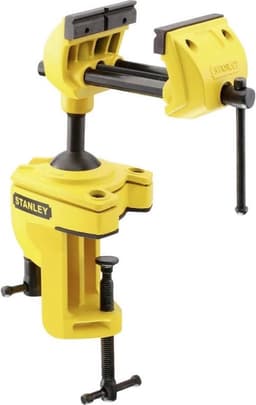
If the base and the body arrived apart, take the lock nuts off, sit the vice on the base, and put the nuts back, which is Wonkee Donkee's order. Snug the swivel locks by hand. The Pony sheet says the same. Turn the vice through the positions you will use, lock again, and try to rotate the body. UK reviews on the Stanley 4 inch, the HYCHIKA 5 inch, and DAYUAN say a light lock lets the body move. Once it holds, you can saw, which is the vice for light metalwork page. Wear safety spectacles. HSE lists projectiles as an eye hazard.

Stop if the top is thin and the job will shock it

Chipboard under about 18 mm, a hollow door on trestles, and a thin veneered skin will not hold a bolt-down vice you then saw against. A longer pipe on the handle does not fix a weak top. Fit a proper top before you drill. Get help when employees will use an unstable bench, or when the work is structural. Paying repair work is outside the domestic exception in HSE's PUWER guidance. Do not weld a cracked body. If it arrives broken, use the returns route. This is not legal advice. The bench vice buying guide is the check on jaw and weight before you drill.

Common questions

Where on the bench does it go?
Set the stationary jaw slightly past the front edge, which is the C2 Safety layout, so a saw can pass and long work can hang. A corner helps when stock must hang either way. Clamp-on vices sit on the edge by design. Offer the vice up with a real offcut before you mark anything.
What bolts do I buy if none are in the box?
Buy bolts that fill the holes in your base. Length is base plus top plus washer and nut. Stanley 4 inch reviews say bolts are not included, and one person used M5 in that vice only. Do not assume M5 or M8 for every model. A DIYnot discussion suggests Nyloc nuts because vibration loosens plain nuts. That is forum advice. Take the vice to the shop if you can.
Do I weld the base to a steel bench?
No. C2 Safety says not to weld-repair a vice, and the same objection applies to welding the base down. Bolt every hole, with washers, and use a lock nut if the bench vibrates. If the steel top is too thin to bolt through, it is the wrong top.
How tight should the swivel locks be?
Hand-tight, then prove it. The Pony Jorgensen sheet warns against overtightening swivel locks. After you lock, try to twist the body. UK reviews say a casual nip lets the base creep. A pipe on the lock, or on the main handle, overloads these castings.
What if the top is thin chipboard?
Do not bolt a vice to it and then saw steel. Through-bolts may hold a static clamp for light work, and they still pull through when the job shocks the top. Faithfull's woodworking note treats tops under about 50 mm as a through-bolt case, not as coach screws. A thin flap is a reason to clamp small jobs or to fit a solid top first.

Related pages

Sources

Public UK sources used for this comparison. Listing prices, stars, and review counts are the amazon.co.uk lines from 16 October 2026.

  1. HSE — PUWER overview (retrieved 16 October 2026)
  2. The Provision and Use of Work Equipment Regulations 1998 (retrieved 16 October 2026)
  3. HSE — Safe use of work equipment (L22) (retrieved 16 October 2026)
  4. Consumer Rights Act 2015, section 9 (retrieved 16 October 2026)
  5. HSE — using the right type of PPE (retrieved 16 October 2026)
  6. Stanley UK — MaxSteel multi-angle vice 1-83-069 (retrieved 16 October 2026)
  7. Stanley UK — MaxSteel 115 mm light-duty bench vice 1-83-065 (retrieved 16 October 2026)
  8. Excel Machine Tools — all-steel bench vice weights (retrieved 16 October 2026)