Bench vice buying guide: what to check before the stars
You have a small shed bench, or a kitchen table you must not drill, and the listings all say swivel or heavy duty. A bench vice buying guide for this set starts with the mount and the listed kilograms, because a high star line can belong to a 1.5 kg hobby clamp. You need a table screw, a bolt-down base, or a ball joint, and the jaw rather than the opening. The [Swivel vice](/hub/workshop/swivel-vice) comparison holds the twelve amazon.co.uk listings. This checklist does not name a top pick. Figures are the UK cards from 16 October 2026. A purchase through our links may earn a commission at no extra cost to you.
You have a small shed bench, or a kitchen table you must not drill, and the listings all say swivel or heavy duty.
You have a small shed bench, or a kitchen table you must not drill, and the listings all say swivel or heavy duty. A bench vice buying guide for this set starts with the mount and the listed kilograms, because a high star line can belong to a 1.5 kg hobby clamp. You need a table screw, a bolt-down base, or a ball joint, and the jaw rather than the opening. The Swivel vice comparison holds the twelve amazon.co.uk listings. This checklist does not name a top pick. Figures are the UK cards from 16 October 2026. A purchase through our links may earn a commission at no extra cost to you.
Our top picks
| Badge | Product | Mount | Jaw | Listed weight | Note | Price | Offer |
|---|---|---|---|---|---|---|---|
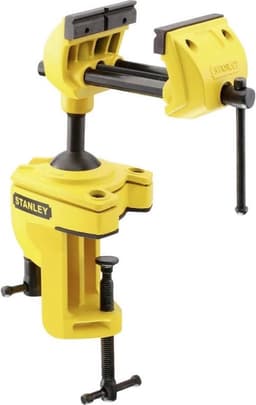
| Best overall |  Stanley Stanley MaxSteel multi-angle vice | Screw clamp | 75 mm (3 in) on the included line | 1.5 kg | 8.6 | about £22.31 | View offer |
| Best value |  Stanley Stanley MaxSteel 4 inch light-duty vice | Bolt-down | 100 mm (4 in) | 5.04 kg | 8.0 | about £29.95 | View offer |
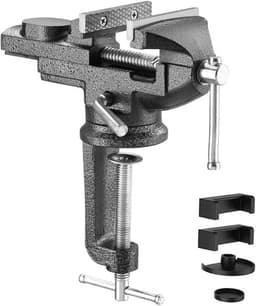
| Alternative |  TEENO TEENO 70 mm table vice | Clamp-on | 70 mm, opening to 77.5 mm | 1.86 kg | 6.8 | about £18.99 | View offer |

On this page
Start with the job, not the star rating
Jaw width is not the opening
Weigh the listing against a workshop vice
Lock, pads, and anvil
A thin review count is not a test
Common questions
Does a swivel base make the vice weaker?
What jaw width do I need?
Is jaw width the same as opening?
Why does listed weight matter if the title says heavy duty?
What if it snaps on the first weekend?
Related pages
Sources
Public UK sources used for this comparison. Listing prices, stars, and review counts are the amazon.co.uk lines from 16 October 2026.
- HSE — PUWER overview (retrieved 16 October 2026)
- The Provision and Use of Work Equipment Regulations 1998 (retrieved 16 October 2026)
- HSE — Safe use of work equipment (L22) (retrieved 16 October 2026)
- Consumer Rights Act 2015, section 9 (retrieved 16 October 2026)
- HSE — using the right type of PPE (retrieved 16 October 2026)
- Stanley UK — MaxSteel multi-angle vice 1-83-069 (retrieved 16 October 2026)
- Stanley UK — MaxSteel 115 mm light-duty bench vice 1-83-065 (retrieved 16 October 2026)
- Excel Machine Tools — all-steel bench vice weights (retrieved 16 October 2026)