Stair climbing trolley buying guide
You are comparing a stair climbing trolley because one kilogram on the page is often the flat figure, not the stair figure. This stair climbing trolley buying guide sets the order: the job, the stair figure, the empty truck, then the stairs themselves. The twelve GBP rows are on the [stair cart comparison](/hub/workshop/stair-cart). The bag-or-plate choice is the [shopping trolley or sack truck](/hub/workshop/stair-cart/sub/stair-cart-shopping-or-sack-truck) page, and the pull is [how to use a stair climbing trolley](/hub/workshop/stair-cart/sub/stair-cart-how-to-use). Products Compared read the amazon.co.uk files on 16 October 2026, with no lab test. A qualifying purchase can earn a commission at no extra cost to you.
You are comparing a stair climbing trolley because one kilogram on the page is often the flat figure, not the stair figure.
You are comparing a stair climbing trolley because one kilogram on the page is often the flat figure, not the stair figure. This stair climbing trolley buying guide sets the order: the job, the stair figure, the empty truck, then the stairs themselves. The twelve GBP rows are on the stair cart comparison. The bag-or-plate choice is the shopping trolley or sack truck page, and the pull is how to use a stair climbing trolley. Products Compared read the amazon.co.uk files on 16 October 2026, with no lab test. A qualifying purchase can earn a commission at no extra cost to you.
Our top picks
| Badge | Product | Type | Stair load | Empty weight | Note | Price | Offer |
|---|---|---|---|---|---|---|---|
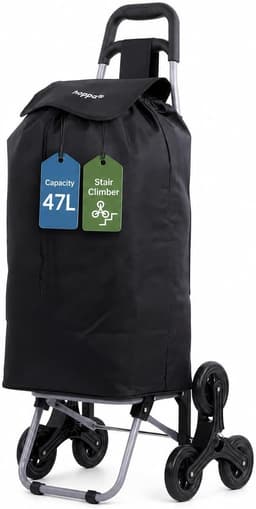
| Best overall |  Hoppa Hoppa 47 L stair-climbing shopper | Shopping trolley | n/a | 2 kg | 8.2 | about £24.99 | View offer |
| Best value |  VOUNOT VOUNOT 6-wheel shopping trolley | Shopping trolley | n/a | 2 kg | 8.0 | about £18.99 | View offer |
| Alternative |  YEAUPE PRO YEAUPE PRO folding stair sack truck | Sack truck | 50 kg | 5 kg | 7.0 | about £48.03 | View offer |


On this page
Two products share the search
Stair kilograms are often lower
The truck is part of the load
Wheels only match some stairs
Then look at fold and price
Common questions
Is the biggest kilogram the right truck?
Why do some listings print two weights?
Should I buy a shopping trolley or a sack truck?
How heavy is the empty truck?
Will six wheels climb a winder?
Related pages
Sources
Public UK sources first, then the stored amazon.co.uk listings for these twelve ASINs, checked on 16 October 2026. Shelf prices and star lines are the UK figures in the display file.
- HSE INDG143: Manual handling at work (retrieved 16 October 2026)
- HSE L23: Manual handling (retrieved 16 October 2026)
- HSE INDG478: Risk assessment of pushing and pulling (RAPP) (retrieved 16 October 2026)
- Approved Document K (PDF) (retrieved 16 October 2026)
- GOV.UK: Approved Document K (retrieved 16 October 2026)
- Manutan UK: stair-climbing sack truck (retrieved 16 October 2026)
- Compel Group: stair-climbing trolley (retrieved 16 October 2026)
- Workplace Stuff: aluminium 3-wheel stair climber (retrieved 16 October 2026)