Independent comparisons. We may earn from shop links. More info

Hop up or stepladder

Updated: October 2026

You are choosing a hop up or stepladder for the same ceiling, and both adverts sound like the safe one. A hop-up is the better of these two only when you need both feet on a deck for a short, low job on a level floor. It is not the legal next step after 30 minutes on a ladder. This page is that comparison, and it is allowed to say neither. The seven amazon.co.uk listings are on the [small scaffold comparison](/hub/workshop/small-scaffold). Products Compared used HSE’s ladder pages and those listings, not a lab. A qualifying purchase can earn a commission at no extra cost to you.

You are choosing a hop up or stepladder for the same ceiling, and both adverts sound like the safe one. A hop-up is the better of these two only when you need both feet on a deck for a short, low job on a level floor.

Our top picks

ORIENTOOLS ORIENTOOLS XCT-001-SID

Best overall

ORIENTOOLS ORIENTOOLS XCT-001-SID
7.3/10about £119.99
CattleBi CattleBi 100 cm hop-up

Best value

CattleBi CattleBi 100 cm hop-up
6.7/10about £56.99
GMGSPT GMGSPT 1,000 × 300 mm

Alternative

GMGSPT GMGSPT 1,000 × 300 mm
6.5/10about £59.11
On this page

What the 30-minute line does and does not say

HSE does not ban ladders. The overview says ladders and stepladders can be used when a risk assessment shows that more protective equipment is not justified. More than about 30 minutes on a leaning ladder or a stepladder is a prompt to look at other equipment. A brief job in a dangerous place is still the wrong place for a ladder. The HSE page does not mention hop-ups. Retailers fill that hole by treating the hop-up as the thing you switch to when the half hour is up. Other equipment in that sentence is not automatically the folding platform in this set. A hop-up with no guard rail is not collective protection just because it is not a ladder. Read the 30 minutes as a reason to look again, not as a timer that makes a 300 mm deck legal.

Choose the hop-up when both feet and a free hand matter

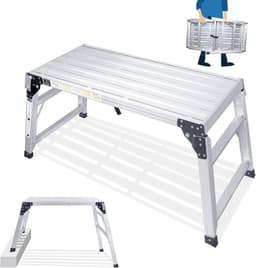
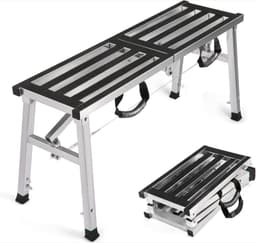
Choose the hop-up when the task needs both hands for a short spell and both feet can stay on a deck. Painting a ceiling patch and fitting a short run of coving are the usual cases, if the floor is level and you will move the platform rather than lean. Ladders UK Direct and Ladders4Sale, which are retail advice rather than HSE, put the hop-up on that both-hands job. They do not score these seven listings. In this set the honest hop-ups for that job are the low ones. The CattleBi at £56.99 is 100 by 30 cm, with pins at 50, 60 and 70 cm. The shorter GMGSPT stops at 68 cm, but its written reviews are copied from the longer GMGSPT. The ORIENTOOLS at £119.99 is the wider low deck, 39.4 by 18.5 inches, with one review. None of them states a guard rail. A deck you cannot turn around on is not a safer ladder. Paint and kettle space stay on hop up for painting ceilings. Here the test is simpler: both feet, short, level, and a deck you can actually stand on.
ORIENTOOLS ORIENTOOLS XCT-001-SID

Testsieger

ORIENTOOLS ORIENTOOLS XCT-001-SID
7.3/10about £119.99

Choose the stepladder when the job is one spot and brief

Choose the stepladder when the work is one spot, you can keep three points of contact, and you will not park tools on a tread. HSE allows that pattern where the assessment supports it. Do not keep a paint kettle on a stepladder tread. The tread is a step, not a shelf. If the job needs the kettle within reach for more than a reload or two, you have drifted into hop-up territory.

When you need a rail instead of either

Neither tool is enough when the job needs a guard rail, when you are beside a stair void, when someone suggests stacking, or when the only reach is a pin past about 1 m with no rail stated. The longer GMGSPT tops out at 109 cm. The WUDLEP details height is 156 cm. Using those top holes is not a win over a stepladder. Employment does not make the hop-up the default. A principal contractor using the Home Builders Federation note, or a Morgan Sindall rule that refuses 300 mm decks, will not accept these strips in place of a 600 mm hop-up or a podium. Your own hallway is not that site. A customer’s stairwell, if you are being paid, might be.

Common questions

Is a hop-up safer than a stepladder?
Only for a short, low job where both feet stay on a deck and you need a free hand. It is not safer because it is sold as a scaffold, and it is not collective protection if the listing states no guard rail. A stepladder can be the better tool for one brief spot if you keep three points of contact. HSE allows ladders where the assessment supports them. It does not rank these amazon.co.uk hop-ups.
Does the 30-minute rule mean I must switch to a hop-up?
No. HSE uses about 30 minutes on a ladder or stepladder as a prompt to consider other equipment. The hop-ups in this set are not named on that page. A 300 mm deck with no rail is not the automatic replacement. Look at the risk first, then the duration, then whether a guarded platform is the thing the job actually needs.
When is a stepladder the better tool?
When the task is a single high spot, it will be brief, and you will keep three points of contact without standing a kettle on a tread. A bulb or a detector fits. A ceiling you keep reloading a roller for does not. If you would lean a metre to the side rather than move the ladder, the ladder has stopped being the right choice.
What if the hop-up is only 300 mm wide?
Then it beats a stepladder only if both feet fit along the length and you do not need to turn. The CattleBi and the shorter GMGSPT are that width. A deck you cannot turn on is not a safer ladder. The ORIENTOOLS deck, stated at 18.5 inches, is the wider low option in this set, with the limit that it has one review.
What should I use if both feel wrong?
Use a railed podium or a tower, or change the method so you are not up there. That is the case for a stair void, a long session, stacking, or a 109 cm or 156 cm pin with no guard rail in the listing. Do not solve it by buying the £393.99 generic frame, which does not state a deck size or a standard.

Related pages

Sources

Public UK sources and the amazon.co.uk listings compared on this page. Updated October 2026.

  1. Work at Height Regulations 2005 (retrieved October 2026)
  2. Work at Height Regulations 2005, Schedule 2 (retrieved October 2026)
  3. HSE: Work at height FAQs (retrieved October 2026)
  4. HSE: When and how to use ladders safely (retrieved October 2026)
  5. PASMA: Product standards (retrieved October 2026)
  6. PASMA: Towers and low-level access (retrieved October 2026)
  7. BSI: BS 8620:2016 (retrieved October 2026)
  8. Home Builders Federation: Trestles and hop-ups (retrieved October 2026)