Independent comparisons. We may earn from shop links. More info

Hop up for painting ceilings

Updated: October 2026

You are painting a ceiling, or the top of a wall, and the stepladder means a climb down every time the roller, the kettle, or your feet need to move. A hop up for painting ceilings earns its place when both feet stay on the deck and the kettle is not balanced on the edge. This page stays on that job. The rows and the prices, read on 19 October 2026, are on the [small scaffold comparison](/hub/workshop/small-scaffold). Products Compared used those amazon.co.uk files, decorator-platform notes, and HSE’s ladder guidance, not a lab. A qualifying purchase can earn a commission at no extra cost to you.

You are painting a ceiling, or the top of a wall, and the stepladder means a climb down every time the roller, the kettle, or your feet need to move.

Our top picks

ORIENTOOLS ORIENTOOLS XCT-001-SID

Best overall

ORIENTOOLS ORIENTOOLS XCT-001-SID
7.3/10about £119.99
CattleBi CattleBi 100 cm hop-up

Best value

CattleBi CattleBi 100 cm hop-up
6.7/10about £56.99
GMGSPT GMGSPT 1,400 × 380 mm

Alternative

GMGSPT GMGSPT 1,400 × 380 mm
5.2/10about £80.00
On this page

Why a deck beats a stepladder for a ceiling patch

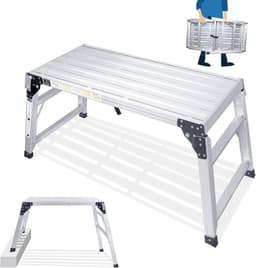
A stepladder puts you on a tread, with a free hand only if you give up a point of contact. A ceiling patch wants the roller in one hand and the other hand free to steady you, and it wants the kettle where you can reload without climbing down. That is the rhythm a low deck is sold for. Auxil and a THSP employer note tells you to keep both feet on the deck and to move the unit rather than stretch. The patch has to be low enough that a platform topping out around 50 to 70 cm actually meets it. This page will not invent a typical UK ceiling height. If your head still cannot reach with both feet flat, the hop-up has not solved the ladder. The ORIENTOOLS top is 35 inches, about 0.89 m. The CattleBi stops at 70 cm. The shorter GMGSPT stops at 68 cm. HSE’s guide treats more than about 30 minutes on a stepladder as a prompt to look at other equipment. That sentence is not permission to spend the afternoon on a 300 mm unguarded deck.

Width, length, and the listings that match a paint job

The kettle is the test of width. The CattleBi deck is 100 by 30 cm. The shorter GMGSPT is 1,000 by 300 mm. Both feet fit if you face along the length. A roller tray beside your toes does not. One CattleBi review used the platform for decorating. Do not treat the deck as non-slip when it is wet. Wipe paint off the standing area before you step back up. The shorter GMGSPT’s review text is a copy of the 1,400 by 380 mm file. The ORIENTOOLS deck, stated at 39.4 by 18.5 inches, is the one in this set with room for both feet and a small kettle. The limit is one amazon.co.uk review. It is not a 600 mm square. Selco’s ProDec, outside this set, is the light aluminium stand decorators often mean. Length is how you step along a wall without climbing down every metre. The longer GMGSPT is 1,400 by 380 mm. The WUDLEP is 180 by 40 cm. A longer deck lets you step. It does not let you lean past the end. The useful part is the length at a low pin. The WUDLEP details weight is 15 kg, so moving it is a carry you do from the floor.
ORIENTOOLS ORIENTOOLS XCT-001-SID

Testsieger

ORIENTOOLS ORIENTOOLS XCT-001-SID
7.3/10about £119.99

How long, and how high

The high pins are the wrong decorating height in this set. The longer GMGSPT lists a top of 109 cm. The WUDLEP details height is 156 cm. No guard rail is stated on either. A ceiling you can only reach from those tops has outgrown these listings. Use a lower pin for the bottom of a wall, or change the access.

When painting needs a different platform

Stairs are the clear stop. A stair ceiling opens a void beside you, and none of these listings states a guard rail. A hop-up set on a landing, with one side over the drop, is not the hallway patch this page started with. Hire a podium or a tower that is built for that void, or change the method so you are not standing over it.

Common questions

Can I paint a ceiling from one of these?
You can paint a low patch if both feet stay on the deck and you move the platform instead of stretching. The CattleBi and the shorter GMGSPT top out at 70 cm and 68 cm. The ORIENTOOLS tops out at 35 inches. This page does not state a standard UK ceiling height. If you still cannot reach with flat feet, the listing is too low, and standing on the frame is not the fix.
Where does the paint kettle go on a 300 mm deck?
Not beside your feet. A 100 by 30 cm CattleBi deck, or the 1,000 by 300 mm GMGSPT, has room for both feet along the length and little room for a tray. Set the kettle on the floor at the end, or use a deck as wide as the ORIENTOOLS 18.5 inch figure, and climb down to reload. A kettle on the edge of a 300 mm strip is how the platform gets painted and your footing goes.
Which kept listing lets me step along a wall?
The longer GMGSPT at 1,400 by 380 mm, and the WUDLEP at 180 by 40 cm, give you length to step. Use a low pin. Do not use 109 cm or the WUDLEP’s 156 cm details height as the decorating position, because neither file states a guard rail. Length lets you step. It does not let you lean past the end.
Is the wheeled one better for a whole ceiling?
It is better only for moving between patches, and only if you get off, roll, and lock the castors again. One review plastered a ceiling from it. The boards are 26.5 cm wide, the heights are not numbered, and other reviews report bent tubes and missing bolts. A whole ceiling still wants a wider, railed platform if you will be up there all afternoon.
When do I hire a podium or a tower instead?
Hire when you need a rail, a deck around 600 mm rather than 300 mm, a stair void, or a pin height these files only offer without a guard rail. Also hire, or buy outside this set, if you are on a managed site that refuses narrow hop-ups. The Selco-style 500 mm aluminium stand is the decorating shape those jobs usually mean, and it is not one of these seven.

Related pages

Sources

Public UK sources and the amazon.co.uk listings compared on this page. Updated October 2026.

  1. Work at Height Regulations 2005 (retrieved October 2026)
  2. Work at Height Regulations 2005, Schedule 2 (retrieved October 2026)
  3. HSE: Work at height FAQs (retrieved October 2026)
  4. HSE: When and how to use ladders safely (retrieved October 2026)
  5. PASMA: Product standards (retrieved October 2026)
  6. PASMA: Towers and low-level access (retrieved October 2026)
  7. BSI: BS 8620:2016 (retrieved October 2026)
  8. Home Builders Federation: Trestles and hop-ups (retrieved October 2026)