Independent comparisons. We may earn from shop links. More info

How to use a hop up platform

Updated: October 2026

The platform is already in the room, the ceiling is the job, and the bullet said no installation. That sentence is how pins, feet, and castor locks get checked after the first step up. This is how to use a hop up platform once you have chosen one: look, lock, stand, get off before you move it, then fold it before the levers stick. It assumes the unit is already yours. The seven rows are on the [small scaffold comparison](/hub/workshop/small-scaffold). Products Compared used HSE notes and the amazon.co.uk review lines, not a lab. A qualifying purchase can earn a commission at no extra cost to you.

The platform is already in the room, the ceiling is the job, and the bullet said no installation. That sentence is how pins, feet, and castor locks get checked after the first step up.

Our top picks

ORIENTOOLS ORIENTOOLS XCT-001-SID

Best overall

ORIENTOOLS ORIENTOOLS XCT-001-SID
7.3/10about £119.99
CattleBi CattleBi 100 cm hop-up

Best value

CattleBi CattleBi 100 cm hop-up
6.7/10about £56.99
GMGSPT GMGSPT wheeled platform

Alternative

GMGSPT GMGSPT wheeled platform
5.2/10about £139.00
On this page

Open it and look

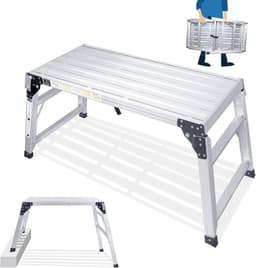
None of the kept raw files includes a full manual. Open it on the floor you will actually use. Look at the feet before you look at the deck. The CattleBi bullets claim a hard pair and a soft pair. Fit the pair that matches the room, and do not mix them. The ORIENTOOLS bullets name rubber pads. If a pad is missing, or a foot rocks, that corner is not ready. Look at the metal. GMGSPT bullets tell you to wear gloves because of weld marks. CattleBi reviews mention sharp edges. A flake of paint or a protruding wire is a reason to stop. The wheeled GMGSPT reviews include bent corner tubes on arrival. A tube that is already bent is not straightened by standing on the boards.

Locks before weight

Seat every lock, then stand. On the steel hop-ups the height is a pin through a leg. The CattleBi offers 50, 60 and 70 cm. The shorter GMGSPT offers 48, 58 and 68 cm. The longer GMGSPT offers 68, 78, 88, 99 and 109 cm. The WUDLEP bullet runs from 35.8 to 61.4 inches. The ORIENTOOLS uses seven steps from 24 to 35 inches, and its one review describes a sprung pin in each leg. Each pin has to be through, not resting on the lip. Wheels are a brake, not a convenience you leave free. The wheeled GMGSPT has four 10 cm dual-locking castors. Lock both the roll and the swivel, on every castor, and then try to push the frame with it empty. If it creeps, it is not locked. If you are employed, the Home Builders Federation paper asks for an inspection after assembly. Home use does not need that form. It still stops for a missing pin or a bent tube.
ORIENTOOLS ORIENTOOLS XCT-001-SID

Testsieger

ORIENTOOLS ORIENTOOLS XCT-001-SID
7.3/10about £119.99

Move it empty

You cannot roll a hop-up with someone on the deck. Release the locks only when the boards are empty. Push from the floor, on a surface that will not throw a castor into a gap. A rug edge, a cable, and a door threshold are enough to tip a narrow board. The two boards are 126 by 26.5 cm. That is not a wide enough deck to ride while someone else steers. Do not pack blocks under a short foot. The Sealey pattern forbids it on that EN 131 platform, and these listings give you pins for a reason. If the pin range is too low for the ceiling, this platform is the wrong tool.

Fold it before you are stuck upstairs

Fold it while you are still in the room. Clear the deck. Release the locks in the order the frame allows, from the floor, with both feet off the platform. If a clip will not move, do not jump on the deck to jar it. Reviews of the longer GMGSPT describe a fold that would not close and a leg screw that stuck. If it sticks, look for the pin that is still through a hole. Work one leg at a time. The WUDLEP folded size is not stated. Strap it so it cannot spring open in a car boot.

Common questions

What do I check before I stand on it?
Check the feet are the right pair and all four touch the floor, the deck and the tubes you will grip are free of sharp weld marks, and every pin or clip is through, not resting on the edge of the hole. On a wheeled frame, lock every castor and try to push the empty platform. HSE’s ladder check is the same idea: feet and locks before use, and again if the unit has moved onto a different floor.
What if a pin is missing?
Do not stand on it, and do not replace the pin with a nail or a spare bolt. A WUDLEP review reports pins that were missing and had to be bought separately. Until the correct pins are in every leg you intend to use, the platform is incomplete. That applies at home. Employment adds a recorded inspection, which the HBF paper asks for weekly on site hop-ups.
Should I fit hard feet or soft feet?
Use the pair that matches the floor. The CattleBi bullets claim a hard pair and a soft pair. Hard feet are for a surface you must not mark. Soft feet are for a surface where the frame might slide. Do not mix them, or the deck sits out of level. If a pad is torn or a foot rocks, stop. The HBF note treats damaged rubber pads as a reason not to use the hop-up.
Do I need a written inspection at home?
A simple pre-use look is not normally written down. HSE says records are not usually required for that basic ladder check. If the hop-up is work equipment, the duty is stricter, and the HBF paper asks for a weekly record on site. Home use still stops for missing pins, bent tubes, and locks that will not seat. The form is optional. The look is not.
When do I stop and get another kind of access?
Stop when a pin is missing, a tube arrived bent, a lock will not close, or the only useful height is a pin past about 1 m with no guard rail stated. Stop when the job is a stair void, a long session, or paid work under a rule that wants about 600 mm of deck. Those jobs need a podium or a tower, not a harder push on this frame.

Related pages

Sources

Public UK sources and the amazon.co.uk listings compared on this page. Updated October 2026.

  1. Work at Height Regulations 2005 (retrieved October 2026)
  2. Work at Height Regulations 2005, Schedule 2 (retrieved October 2026)
  3. HSE: Work at height FAQs (retrieved October 2026)
  4. HSE: When and how to use ladders safely (retrieved October 2026)
  5. PASMA: Product standards (retrieved October 2026)
  6. PASMA: Towers and low-level access (retrieved October 2026)
  7. BSI: BS 8620:2016 (retrieved October 2026)
  8. Home Builders Federation: Trestles and hop-ups (retrieved October 2026)