Independent comparisons. We may earn from shop links. More info

How to use a roller stand

Updated: October 2026

How to use a roller stand comes down to three checks before the motor starts: the roller sits at the bed or a fraction under it, every foot touches the floor, and the kilogram figure matches the height you locked. The stand supports the timber. It is not a step, and one stand is one end of the work. Which listing to buy is on the [roller trestle comparison](/hub/workshop/roller-trestle). Height and load come first on the [roller stand buying guide](/hub/workshop/roller-trestle/sub/roller-trestle-buying-guide). Products Compared used HSE woodworking sheets and the amazon.co.uk pages, read on 19 October 2026. This is not a lab test. A qualifying purchase can earn a commission at no extra cost to you.

How to use a roller stand comes down to three checks before the motor starts: the roller sits at the bed or a fraction under it, every foot touches the floor, and the kilogram figure matches the height you locked.

Our top picks

Draper Draper 70273

Best overall

Draper Draper 70273
7.2/10about £26.96
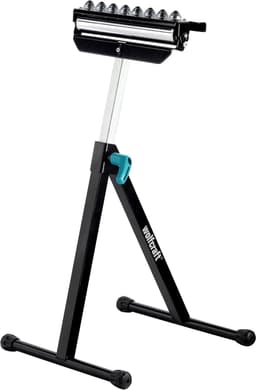
Wolfcraft wolfcraft 6102300

Rank 2

Wolfcraft wolfcraft 6102300
7.7/10about £64.95
On this page

Put the roller at the bed, not above it

A roller set above the machine bed becomes a ramp. The board climbs it, the near end lifts, and the timber can rise into the blade instead of sliding past. Set the roller level with the bed or slightly below it. HSE does not publish a millimetre offset. One US blog uses about 1/16 inch below the table. That is a workshop habit, not a UK legal limit, so do not treat 1.6 mm as something WIS16 requires. Check with a short offcut and the saw switched off. If the board seesaws or the roller is proud of the table, drop the column and lock it again. If the roller is clearly low, raise it until the timber runs without climbing. One trestle still cannot cover both ends.

One stand is one end

HSE sheet WIS16 asks for support at infeed and outfeed when large work goes through a circular saw bench. One roller trestle is one of those ends. The other is a second stand, an extension, or a person at the outfeed. Where that person works there, WIS16 looks for at least 1,200 mm from the saw spindle to the rear edge, and they stay there. Reaching toward the blade is the move the sheet is written to stop. On a mitre saw, WIS36 asks for support either side of the saw unit. That layout is on the roller stand for a mitre saw page. Park the stand so close that the board pivots as the cut starts, or so far that it sags onto the roller. Slide a scrap, then move the feet.
Draper Draper 70273

Testsieger

Draper Draper 70273
7.2/10about £26.96

All feet down, then the lock

A height that looks right on a crooked stand is still a ramp. Wolfcraft 6102300 reviews include feet that do not all touch the floor. Performance Tool W54010 reviews include a base that rocks, a missing rubber foot, and a stripped height handle. Those are themes, not a failure rate. Press each corner before the first cut. Then try the lock with a downwards push on the roller, saw still off. A clamp knob that spins without tightening, which wolfcraft reviewers also report, means the column can creep once the timber arrives. Draper’s page for the 70273 prints 60 kg at 670 mm and 30 kg at 1,060 mm. The amazon.co.uk bullet states 60 kg only. Use the figure for the height you have actually locked.

The point where you stop

Stop when the roller will not stay level with the bed, when a foot will not sit down, or when the load at that height is below the workpiece. At work, the Provision and Use of Work Equipment Regulations 1998 require equipment to be used as the manufacturer allows, including that load. A householder is not the employer those regulations are written for. The load line still describes what the stand was sold to carry. Stop, too, if the plan was to stand on the trestle. The Work at Height Regulations 2005 include a trestle as a working platform when it is a place of work or access. A roller stand sold to support timber is the wrong object for that. If the timber must stay still rather than roll, use a sawhorse, which is the split on roller stand vs sawhorse.

Common questions

How far from the saw should the stand sit?
Far enough that the board reaches the roller without sagging into a bump, and near enough that it does not lever up as the cut begins. Slide a scrap with the power off and move the feet until the timber runs on. Where a second person takes the outfeed, WIS16 looks for at least 1,200 mm from the spindle to the rear edge, and that person stays clear of the blade.
What do I do if it rocks?
Press each foot before you trust the height mark. Wolfcraft reviews describe feet that leave the stand crooked, and Performance Tool reviews describe a base that rocks. Packing one corner hides the lean for one cut and moves it for the next. If a foot or a lock will not sit, that stand stays out of the cut.
Does one stand cover infeed and outfeed?
It covers the end you place it at. WIS16 asks for support at both ends of large work on a circular saw bench. The second end is another stand, an extension, or a person positioned at the outfeed who does not reach in. On a mitre saw, WIS36 asks for support either side of the saw unit, which one floor stand cannot do alone.
What is the load once I have extended it?
Read the figure for the height you locked. On the Draper 70273 the maker prints 60 kg at 670 mm and 30 kg at 1,060 mm, while the amazon.co.uk bullet states 60 kg only. Wolfcraft states 50 kg without a second number. The Performance Tool title states 60 kg. A stable stand at full stretch can still be over the number that applies up there.
When should a second person leave the offcut alone?
When helping means reaching toward the saw. WIS16 places a second person at an outfeed at least 1,200 mm from the spindle to the rear edge, and they stay there. Catching a falling end by stepping in is the hazard the support was meant to remove. If the stand cannot hold that end at bed height, stop the cut and add support.

Related pages

Sources

Public UK sources and the amazon.co.uk listings compared on this page. Prices and stars were read on 19 October 2026.

  1. HSE WIS16: Circular saw benches (retrieved 19 October 2026)
  2. HSE WIS36: Safe use of manually operated cross-cut saws (retrieved 19 October 2026)
  3. PUWER 1998, regulation 4 (retrieved 19 October 2026)
  4. Work at Height Regulations 2005 (retrieved 19 October 2026)
  5. Consumer Rights Act 2015, section 9 (retrieved 19 October 2026)
  6. Draper 70273 roller stand (retrieved 19 October 2026)
  7. wolfcraft 6102300 multifunction support stand (retrieved 19 October 2026)
  8. Screwfix roller stands (retrieved 19 October 2026)