Independent comparisons. We may earn from shop links. More info

How to use a patio weeder

Updated: October 2026

The pole is already in the shed, and the first pass still misses the joint or leaves you kneeling with the head in your hand. How to use a patio weeder, standing up, is mostly the angle and the spoil. You fit the head that matches the crack, you pull toward yourself along the joint, and you bag what comes out. This is not a ranking of the sets in the [long handled crack weeder comparison](/hub/weed-control/long-handled-crack-weeder). Products Compared did not film a technique test. The method below follows the Royal Horticultural Society, with the pole notes taken from UK reviews of these sets, as checked on 19 October 2026.

The pole is already in the shed, and the first pass still misses the joint or leaves you kneeling with the head in your hand. How to use a patio weeder, standing up, is mostly the angle and the spoil.

Our top picks

On this page

Set the head before you extend the pole

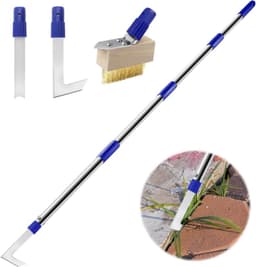
Fit the head while the pole is still short. On a multi-head set that means the brush or the scraper, not both at once, and not whichever piece was left on from last autumn. The Royal Horticultural Society uses a block-paving knife along the crack, and an angled wire brush for moss, seedlings and debris. If the green in front of you is a tuft in a concrete joint, start with the scraper or the knife. If it is a film of moss across the joint mouth, start with the brush. A thick L-scraper that will not enter the gap is the wrong first choice. Reviews of the cheaper sets say the brush is the piece that actually fits, and the scraper is the piece that skates. UK reviews of the Anwor WRTAH01 say you need an Allen key, and that the swap is a faff even when the listing calls it quick. The other Anwor set uses a bolt. One review says that bolt is hard with arthritis. If the joint unscrews while you work, as some ADLUH reviews describe, stop and retighten it. A loose blade is not a sharper blade. Only then add sections. One Anwor review said the long handle gave the wrong angle, and they used the head in the hand. Do not lean your weight on a pole that reviews already call thin. The GREELIX notes are the warning: light pressure, or the section bends.

The stroke

Pull the blade toward you along the joint. Do not stab downwards and hope the root pops. The RHS describes running a block-paving knife along the crack and hooking roots out. A 2006 paving-joint patent describes a pull toward the user, with the blade near vertical and the handle about 35–55 degrees above the horizontal. Use that as a picture of the angle, not as a test of any ASIN in this set. You should be able to see the metal in the crack. If you cannot, the pole is too long or the head is too thick. Work one joint at a time, a short reach you can watch, then step. A brush stroke is a scrub along the same line, not a sideways sweep across the slab. Sideways is how wire marks a soft stone. Keep the bristles in the joint mouth. Snapping is normal on dandelion, dock and cinquefoil in a narrow joint. The RHS says you repeat the topping when the root will not come out. One Saturday does not finish those plants.

What you do with the weeds

Bag the waste. Seed heads, runners and taproots do not belong in a home compost heap. The RHS is plain about that. A dandelion clock knocked onto the lawn is a new row, not a tidy finish. Shake the brush into the bag, not into the next joint. Knock the scraper on the rim of the bucket. If the pile is wet soil and sand from a block drive, that sand was part of the joint. Replacing it is a different job, and it is not optional if the blocks were only held by kiln-dried sand.

When to stop

Stop when slabs or blocks move under the tool. A rocking paver is no longer a weeding problem. That is the point to call a landscaper. Stop, too, before you reach for a professional weedkiller. Amateur products are the ones a gardener may use, and only as the label says. A crack weeder does not authorise a spray. Glyphosate’s approval in Great Britain has been extended to 15 December 2026 while renewal is assessed. That date is not a ban, and it is not permission to use a professional pack or to ignore the label. A flame weeder is a different tool, and it is the one to leave in the shed in dry weather. Royal Berkshire Fire and Rescue Service reported garden fires from weed burners in 2025 and asked people to prefer manual methods or labelled chemicals. If the standing stroke still misses after you have shortened the pole and swapped to the brush, the head is the wrong shape for that joint.

Common questions

Do I push or pull?
Pull the blade toward you along the joint, with the metal where you can see it. Pushing tends to ride the head up out of a narrow crack and onto the slab edge. A brush is a short scrub in that same direction, not a push across the face of the stone. If the head will not stay in, shorten the pole or change the head before you add force.
How steep should the handle be?
Steep enough that the blade is nearly vertical in the crack, and low enough that you are not stabbing. A design description used for this sort of tool puts the handle about 35–55 degrees above the horizontal. That is a guide to the picture, not a measured result for these Amazon sets. If you cannot see the head, the angle is wrong for you, even if the pole is a stated 150 cm.
Which head do I fit first?
The knife or scraper for a rooted weed in a joint it can enter. The wire brush for moss, seedlings and grit on hard concrete. Fit it before you add the upper sections, and keep the Allen key or the bolt tool with you. If the scraper will not drop into the gap, do not file the slabs to suit it. Use the brush, or a slimmer knife.
What if the crack is too narrow for the scraper?
Leave the scraper in the box for the wider gaps and use the brush, or use a slim paving knife if you have one. UK reviews of the ADLUH and GREELIX sets already describe this split. Forcing a thick blade widens the joint, chips the edge, and on a screw-together set can loosen the head. A brush will not pull a deep root. You top the regrowth later.
Where do the weeds go?
Into a bag, then into the council’s garden-waste collection or another route that is not your home compost. Seed, runners and taproots survive a heap and come back. Do not shake the brush out over the lawn or into the next dry joint. Soil you have scraped from block paving may be the jointing sand. That belongs back in the joint on a dry day, not in the border.
How often do I repeat the cut on dandelions?
When new leaves show, often within a few weeks in the growing season, and again until the plant weakens. The RHS treats dandelion, dock and cinquefoil in narrow joints as a repeat topping, because the root often will not come out in one pass. A single heavy session does not change that. It only empties the joint you then have to refill if it was sand.

Related pages

Sources

Public UK sources and the amazon.co.uk listings compared on this page. Updated October 2026.

  1. RHS: Weeds on hard surfaces (retrieved October 2026)
  2. HSE: Garden pesticides (retrieved October 2026)
  3. HSE: Glyphosate renewal (retrieved October 2026)
  4. HSE: Glyphosate approval extension to 15 December 2026 (retrieved October 2026)
  5. Pavingexpert: Pointing (retrieved October 2026)
  6. Universal Paving: How to clean Indian sandstone (retrieved October 2026)
  7. Burgon & Ball: Long handled block paving knife (retrieved October 2026)
  8. Royal Berkshire Fire and Rescue Service: Weed burners (retrieved October 2026)