Independent comparisons. We may earn from shop links. More info

Weeds in block paving

Updated: October 2026

The joints on the drive are green again, and last spring’s scrape did not stop it. Weeds in block paving live in the sand and silt between the blocks, not in a secret layer under them. You clear the plant, you let the face dry, and you brush kiln-dried jointing sand back. Leave the joint empty and the next seed has a better bed than the one you just cleaned. The four listings are in the [long handled crack weeder comparison](/hub/weed-control/long-handled-crack-weeder). Products Compared did not resurface a drive. The sequence below is the paving guidance those sources publish, checked for this page on 19 October 2026.

The joints on the drive are green again, and last spring’s scrape did not stop it. Weeds in block paving live in the sand and silt between the blocks, not in a secret layer under them.

Our top picks

On this page

Where the weed is living

A concrete block drive is a set of blocks with sand in the joints. The sand locks the blocks. It is also a thin line of soil once silt, leaves and seed collect there. Gardenscape’s account of failed jointing sand puts the germination in that silt, in the joint, not underneath the block. You are not digging a lawn weed out of the sub-base. You are emptying a 2–5 mm slot that is often no wider than a match. If your blocks are already jointed with a resin or polymeric compound that is still sound, do not rout it out to chase a seedling. Scraping them is damage. If the compound has crumbled and the blocks have started to move, you are past a weeder.

A spray does not fill the joint

A spray on the leaves does not fill that slot. Even a legal amateur weedkiller, used as the label says, leaves the silt. Glyphosate’s approval in Great Britain has been extended to 15 December 2026 while renewal is assessed. That is not a ban, and it is not an invitation to dose a drive. The open joint is the other half, which is why a scrape with nothing put back is how the green returns in May.

Clear the joint without emptying the drive

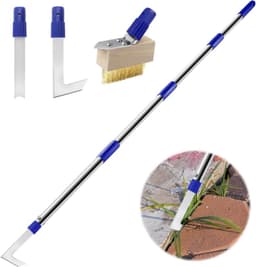
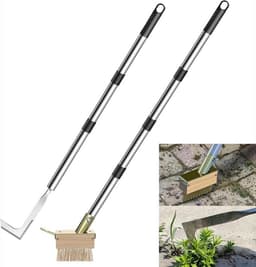
Use the head that fits. On the ADLUH and GREELIX sets, UK reviews say the brush enters block-paving gaps and the scraper is for wider gaps. A thick blade that will not go in will still knock sand out of the mouth of the joint if you lean on it. Take the weed and the loose silt. Leave the sand that is still locking the blocks lower down, as far as the head will allow. Bag the waste. Seed and taproots do not go on a home compost heap. A pressure washer is the step that undoes a drive if you treat the joints as grout to be blasted clean. Thomas Armstrong’s guidance says a hard wash removes the jointing sand. If you must wash the face, keep the lance moving and avoid drilling the nozzle into the joint. You will still lose sand. Do not add building sand, sharp sand from a leftover bag, or a mortar mix because it looks like the right colour. Pavingexpert and the installers quoted by Homebuilding are clear that unbound block paving takes kiln-dried jointing sand, with no cement. Building sand holds moisture, stains, and does not flow into a narrow joint.

Brush kiln-dried sand back

Wait until the blocks are dry. Pour small heaps of kiln-dried sand and brush on the diagonal, about 45 degrees to the joints, so the bristles push sand in rather than along one line and off the edge. Tobermore’s homeowner guidance asks for that dry surface, a soft brush, and a dust mask. Work the sand until the joints look full at the surface. Sweep the spare off. Thomas Armstrong says the joints need topping over the following 4–6 weeks as the sand settles and traffic works it down. A second bag on week three is normal. Stop and get a landscaper if blocks rock when you brush, if whole areas have sunk, or if you can see the bedding moving. More sand will not lock a drive that has lost its base. Once the sand is back, the next weed has a harder time in a full joint than in the empty slot you left last year.

Common questions

Do weeds grow up from under the blocks?
They grow in the silt in the joint. The sand between concrete blocks is the seedbed once it is dirty, which is why a leaf treatment with nothing brushed back does not hold. You are not required to lift the drive to reach a root under the sub-base. If a block rocks, the movement is a laying fault, and that is when a landscaper should look before you keep scraping.
Which sand goes back in?
Kiln-dried jointing sand, on a dry day, brushed in at about 45 degrees. That is the unbound-joint material Pavingexpert describes. It has no cement. Polymeric or resin compound is a separate system, and only if you are prepared to clear the old joint properly and follow that bag’s curing rules. A sound polymeric joint should be left alone.
Can I use building sand?
No. Building sand is the wrong product for these joints. It stays damp, it can stain the blocks, and it does not flow into a narrow gap the way kiln-dried sand does. Leftover sharp sand from a mixer has the same problem. The bag you want is sold as kiln-dried jointing sand for block paving, not as a general building sand.
Should I pressure-wash first?
Only if you accept that a hard jet empties the joint and that you will re-sand afterwards. Thomas Armstrong warns that pressure washing removes the sand that locks the blocks. Keep the lance off a concentrated blast down the joint. If the face is only lightly soiled, a stiff brush and the weeder move less sand than a washer does. Dry the drive before any new sand goes in.
How soon do joints need topping up?
Over the next 4–6 weeks, in Thomas Armstrong’s care notes, as traffic settles the sand. Check the bays you use most, including where the car turns. A joint that looks full on day one can sit low a month later. A light top-up is cheaper than a second wash. Publishers do not agree on how many square metres one 25 kg bag covers, so judge it on your own blocks.
What if the joint is already polymeric?
Leave it if the compound is still continuous and the blocks are tight. A scraper that cuts that joint out gives you a repair, not a weeded drive. If the polymeric sand has crumbled, weeds will sit in the crumbs, and a new polymeric joint only works once the failed material is cleared. That clearance is a bigger job than a Saturday scrape. Read the new bag before you start, including the weather window.

Related pages

Sources

Public UK sources and the amazon.co.uk listings compared on this page. Updated October 2026.

  1. RHS: Weeds on hard surfaces (retrieved October 2026)
  2. HSE: Garden pesticides (retrieved October 2026)
  3. HSE: Glyphosate renewal (retrieved October 2026)
  4. HSE: Glyphosate approval extension to 15 December 2026 (retrieved October 2026)
  5. Pavingexpert: Pointing (retrieved October 2026)
  6. Universal Paving: How to clean Indian sandstone (retrieved October 2026)
  7. Burgon & Ball: Long handled block paving knife (retrieved October 2026)
  8. Royal Berkshire Fire and Rescue Service: Weed burners (retrieved October 2026)