Independent comparisons. We may earn from shop links. More info

Patio weeder blade or brush

Updated: October 2026

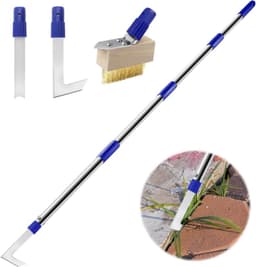
The box holds a scraper and a wire brush, and the listing talks as if they clean the same crack. A patio weeder blade or brush is a choice you make for one joint and one stone, not a pair you must use together. The blade cuts inside a gap it can enter. The brush scrubs moss and seedlings on hard concrete. Neither is the first tool on Indian sandstone. The four sets are in the [long handled crack weeder comparison](/hub/weed-control/long-handled-crack-weeder). Products Compared did not run a wear test on these heads. The split below is the RHS method plus the review pattern on the amazon.co.uk listings, checked on 19 October 2026.

The box holds a scraper and a wire brush, and the listing talks as if they clean the same crack. A patio weeder blade or brush is a choice you make for one joint and one stone, not a pair you must use together.

Our top picks

On this page

What each head can reach

A concrete block joint is often about 2–5 mm. A slim knife or a fine hook can pass into a slot in that narrow range and sever the stem. A thick L-shaped scraper often stops on the edges of the blocks. You feel a tap, and the weed is still there. A rotary brush disc of about 8–15 mm only works across the mouth of the joint. It does not become a knife because the motor is quick. The brush on these standing sets is a V of wire, brass on the Anwor heads and copper-plated on the GREELIX heads. The bristle tips can reach into a slot that the scraper plate cannot. They scrub moss, seedlings and grit. They do not clamp a taproot and lift it. The Royal Horticultural Society is explicit: a weeding knife for cracks, an angled wire brush for moss, seedlings and debris. Dandelion, dock and cinquefoil in a tight joint are a repeat cut, because the root often stays.

Concrete blocks and hard paving

On concrete blocks and other hard paving, a brass or copper-plated brush matches the job the listings claim: block paving, patios, drives and paths. The wire is harder than the moss and, used along the joint, it is a fair tool. Keep it off a decorative edge you care about. A scraper on the same concrete is for a gap wide enough to take the blade, including the wider cracks where sand has gone, and for moss mats the U-shaped head is described as shifting. It is a poor tool for a 3 mm joint, which is why the reviews split the way they do.

Indian sandstone and resin joints

Indian sandstone is the stop. Universal Paving says to use nylon or polypropylene, not wire, because wire scratches the face and can leave fragments that rust. Brass wire and copper-plated wire are still wire. None of the four sets in this comparison includes a nylon head, so a sandstone patio is a reason to leave the V-brush in the box until you have tried a nylon brush on a corner that is out of sight. A resin or polymeric joint is a third surface. The blade is not a weeder there. It is a chisel. If the joint is sound, do not rout the compound out. If both materials are on the same house, the drive can take the wire brush along the joint. The sandstone cannot borrow that head.

What to fit on a multi-head set

Read the reviews against the heads, not against the star line. On the Anwor sets the brass brush is the head buyers describe using in the cracks. One review of the £16.99 set wanted a thinner blade, which is the scraper reaching its limit. On ADLUH, reviews say the brush fits block paving and the scraper suits wider gaps, and that the bristles themselves can bend. On GREELIX, reviews say the brush works in thin joints and the scraper does not, because it has no sharp point. The pattern is stable across three brands. The scraper is in the box because some gaps are wide. It is not in the box because it does the same job as the brush. Fit the brush when the growth is moss or a seedling on hard concrete, and when the scraper has already proved too thick. Fit the blade when you can see that it enters, and you need to cut a stem rather than polish the mouth of the joint. Fit neither wire head on sandstone until a nylon test on a hidden corner has stayed clean. If you want one head that is actually slim, that buy is a paving knife, and the names and the prices sit on the best page, not as a winner declared here. A set remains the better basket when you know you will swap, and when your hands can manage the Allen key or the bolt. WRTAH01 reviews say the key is a faff. One review of the cheaper Anwor says the bolt is a problem with arthritis. A head you cannot change is a head you will leave on, including the wrong one. Use both on the same concrete drive, on different joints, and put kiln-dried sand back where you have emptied a block joint. Do not expect the brush to finish a taproot, and do not expect the scraper to shrink to 3 mm because the listing says block paving. Blade when it enters and you need a cut. Brush when the growth is moss or seedlings on hard paving. Neither wire head on sandstone.

Common questions

Which head gets into a joint of about 3 mm?
The brush tips, or a slim knife, not a thick L-scraper. Block joints are often about 2–5 mm, and reviews of the ADLUH and GREELIX scrapers say those blades miss the narrow ones. A rotary disc of 8–15 mm only crosses the mouth. If your scraper will not drop in, stop. Forcing it chips the edge and pulls sand out without cutting the root.
When is the L-scraper the better head?
When the gap is wide enough for the blade to enter, and you need to cut or hook a stem rather than scrub moss. Wider cracks, where the sand has already left, are the usual case. The U-shaped scraper on the Anwor sets is described for mossy paving. It is still the wrong head for a hairline, and the wrong head for a resin joint you would rather keep.
Will brass or copper-plated wire mark sandstone?
It can. Universal Paving advises nylon or polypropylene on Indian sandstone, because wire scratches and can leave metal that rusts. Brass and copper plate are not a separate safe class. Test a nylon brush on a hidden corner first. If you already own one of these sets, keep the wire head for concrete blocks and do not improvise on the sandstone patio.
Does a brush pull the root?
No. It scrubs moss, seedlings and debris from the mouth of the joint. A deep root, especially dandelion, dock or cinquefoil, usually stays, which is why the RHS expects a repeat topping. A knife gives you a better chance of cutting the stem in a gap it can enter. It still does not guarantee the whole root. Bag what you lift. Do not compost the seed.
Why do sets include a head reviewers ignore?
Because the two heads are for two widths, and the listing sells them as one kit. The scraper earns its place on a wider crack. In a 3 mm block joint it is the piece reviews set aside. You are not missing a technique if you only use the brush there. You are matching the head to the gap. The ignored piece is still useful on the path where the joint has opened.
What should I buy if I have both concrete blocks and sandstone?
A blade or a narrow nylon approach for the sandstone, and a wire brush only for the concrete joints. These four Amazon sets cover the concrete half, with the limits already in the reviews: thick scrapers, and poles that are not all a stated 150 cm. They do not cover the sandstone half. A slim knife, named on the best page, is the add-on when the concrete joints are about 2–5 mm and the scraper will not enter. Do not use one wire head on both materials to save a second tool.

Related pages

Sources

Public UK sources and the amazon.co.uk listings compared on this page. Updated October 2026.

  1. RHS: Weeds on hard surfaces (retrieved October 2026)
  2. HSE: Garden pesticides (retrieved October 2026)
  3. HSE: Glyphosate renewal (retrieved October 2026)
  4. HSE: Glyphosate approval extension to 15 December 2026 (retrieved October 2026)
  5. Pavingexpert: Pointing (retrieved October 2026)
  6. Universal Paving: How to clean Indian sandstone (retrieved October 2026)
  7. Burgon & Ball: Long handled block paving knife (retrieved October 2026)
  8. Royal Berkshire Fire and Rescue Service: Weed burners (retrieved October 2026)