Remove moss from patio: match the method to the stone

Remove moss from a patio by matching the clean to the stone. Skip bleach on sandstone, ease off the pressure washer, and deal with shade and standing water.
On this page
In short
To remove moss from a patio, match the clean to the stone, then deal with the damp that brought the growth back. Indian sandstone and limestone take a gentler route than concrete: skip bleach, acid and a wire brush on that natural stone, and do not blast the face until it frets. Shade and water that sits in the joints will green the slabs again, so a bottle on its own is a reset, not a finish.
The flags by the back door go green after a wet fortnight, and the first step off the mat is slick. A method that suits poured concrete can etch Indian sandstone, and iron granules sold for a lawn will stain the slabs. Name the surface, then decide whether you are brushing a film or fixing a puddle.
Why the patio stays green
Moss on paving is a moisture story. Marshalls' aftercare guide says moss likes shade and water that ponds on the surface. A north-facing path, the strip under a fence, and the slabs under a dripping gutter stay wet long after the lawn has dried. The joint holds that water.
The Royal Horticultural Society treats green growth on hard surfaces as a slip risk, and it says the growth returns. If a shrub drips onto the same three slabs after every shower, those slabs lead the regrowth even when the rest of the patio stays pale.
Walk the paving after rain, not on a dry afternoon when every slab looks alike. Note where a puddle remains an hour later, where a downpipe shoots onto the path, and where the fall runs back towards the house. A slippery film is a cleaning job. A hollow that refills from the lawn is a drainage job, and no moss treatment creates fall. Algae can look like a stain, and lichen sits tighter than a soft mat, so name what you are lifting before you buy a bottle that mentions only moss.
What to avoid on natural stone
Indian sandstone is where cupboard chemistry does the most damage. Guidance for that stone says to avoid bleach, acid and a wire brush, then use a pH-neutral treatment, wait, and finish with a plastic brush. That page is a seller's, so take the caution and leave the brand claim. Iron sulphate and acids are a sandstone risk in the same piece. Do not stretch that to every slab without the maker's sheet. Concrete and riven sandstone are not one material.
Limestone has its own acid problem. Homebuilding notes that vinegar is unsuitable for limestone. Diluting it does not change that. If the flags were sold as limestone, keep acids off them.
Ferrous sulphate belongs on a lawn the label allows. Marshalls says avoid it on paving, and Lawnsmith notes that the rusty mark does not wash off in any useful way. Miracle-Gro Autumn, the lawn pick in our moss killer comparison, is iron for grass, listed at £12.48 for 80 square metres from September to November. It is the wrong pack for patios. Brush stray granules up dry. Do not hose them into the joint.
Resolva's ready-to-use litre, listed at £4.49 for about 10 square metres, names block paving, gravel and decking. The maker's limits keep it off lawns, concrete and tarmac, and off the closed season from mid-September to 1 April. A non-staining claim on block paving is not permission for Indian sandstone. Read the bottle against the stone you have.
A cautious clean on concrete
Concrete slabs tolerate a firmer clean than sandstone, and they still pit under a tight jet. Screwfix's concrete guide starts with warm water and washing-up liquid, or a labelled moss remover. Pressure washing comes after that, and only with a wide nozzle and care. Marshalls is plain that excess pressure washing can damage paving.
Work in this order, and stop if the surface changes under the tool.
- Sweep grit off first so the brush is not grinding it into the face.
- Wash with warm water and a little washing-up liquid, using a stiff plastic brush along the joint.
- If the moss is seated, use a treatment whose label names concrete or your paving, and wait for the time that label prints.
- Brush the loosened growth and sweep it up, rather than washing a slurry into the lawn or a gully.
- If you still use a pressure washer, fit a wide fan, keep the lance moving, and stop if the face frets or the joint sand leaves in sheets.
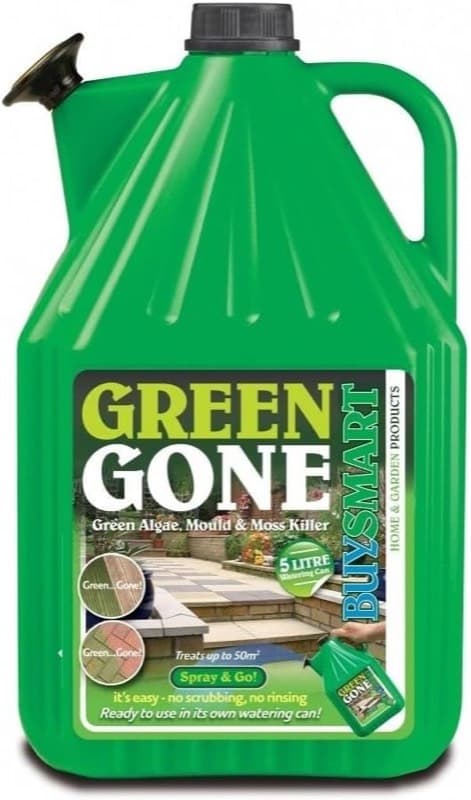
These sources give no kill rate, and this page does not invent one. Green Gone is the leave-on hard-surface listing: 5 litres, up to 50 square metres, £12.80, claiming no acids or bleach, with pets back once it is dry. The active is not a chemical name, the raw file shows no MAPP number, and one review said the watering can was missing, so we do not call it authorised. Resolva Path and Drive, 3 litres at £18, names pelargonic acid for weeds and moss on paths and patios, with no coverage figure. Do not spray the grass. If the label allows concrete and excludes sandstone, keep the spray off that step.
Lift dead moss without scoring the face
Dead moss still trips you. It sits proud of the joint and holds water. On Indian sandstone the lift is a plastic brush, after the treatment has had the time on the label. A wire brush is what those sandstone cautions tell you to leave in the shed. Wire cuts a soft face and leaves scratches that catch dirt.
Block paving and wide concrete joints are a fairer job for a long-handled brush. You are lifting moss and silt, not polishing a riven face. The weed brush comparison is that hardware. The angled TDBS brush there is wire on a wooden handle, listed at £9.99, with a scraper, and 4.5 from 289 amazon.co.uk reviews. The listing states no handle length, and reviews say the metal spike wears. Use it in block-paving gaps. Keep it off the sandstone face.
Brush along the joint in short passes. If you have to lean hard, you are into the arris. Sweep the waste up. Hosing it about spreads silt back into the joints, and hosing lawn-iron dust onto stone starts a rusty mark. If block-paving sand leaves with the moss, top the joint up or the slabs will rock and hold the next puddle. Bruised moss greens again from the base. A joint that fills again within a few weeks is a shade or standing-water problem, not a weak brush.
When standing water brings it back
A brush cannot tip a patio. If rain still sits in a dish in the flags an hour later, the moss is using a puddle you can see. Clearing the green shows the hollow. It does not give the water anywhere to go. Check the simple faults first: a gully full of leaves, a downpipe that shoots onto the path, or a channel blocked by last year's joint sand.
Drainage fleece is not a moss killer. It is a filter felt for a trench, a crate or a base. A white sheet over the slabs neither kills the growth nor creates fall. The drainage fleece comparison is the right table only when you are building a drain or separating stone from soil. It is the wrong basket when the patio is already the finished surface.
You can lift a slippery film, reset joint sand, and turn a downpipe into a gully that already works. You are past a weekend cleaner when the patio has no fall, when water runs towards the house, or when the outfall would be a new soakaway and a digger. Fleece in a trench still needs a gradient and somewhere for the water to go. Shade remains after the levels are right, so brush that strip more often. The lawn or patio guide keeps lawn iron off the slabs. We used amazon.co.uk listings and these public notes. We did not run a patio trial, and a star line is not a kill rate.
Common questions
Can I use bleach on sandstone?
Is vinegar safe on limestone?
Will a pressure washer pit the slabs?
How do I stop moss coming back on a patio?
Does shade matter?
Should I fix the drainage before I clean?
What tool lifts the dead moss?
Which comparison covers a moss treatment for paving?

Peter F. is the editor for DIY & tools at productscompared.co.uk. Comparisons in this category are checked against amazon.co.uk listings, review evidence and public UK sources.
Related articles

When a garden drain needs a contractor
A digger, buried services, or a soakaway is past a weekend with fleece. Know when a wet path stops being a bottle of cleaner.
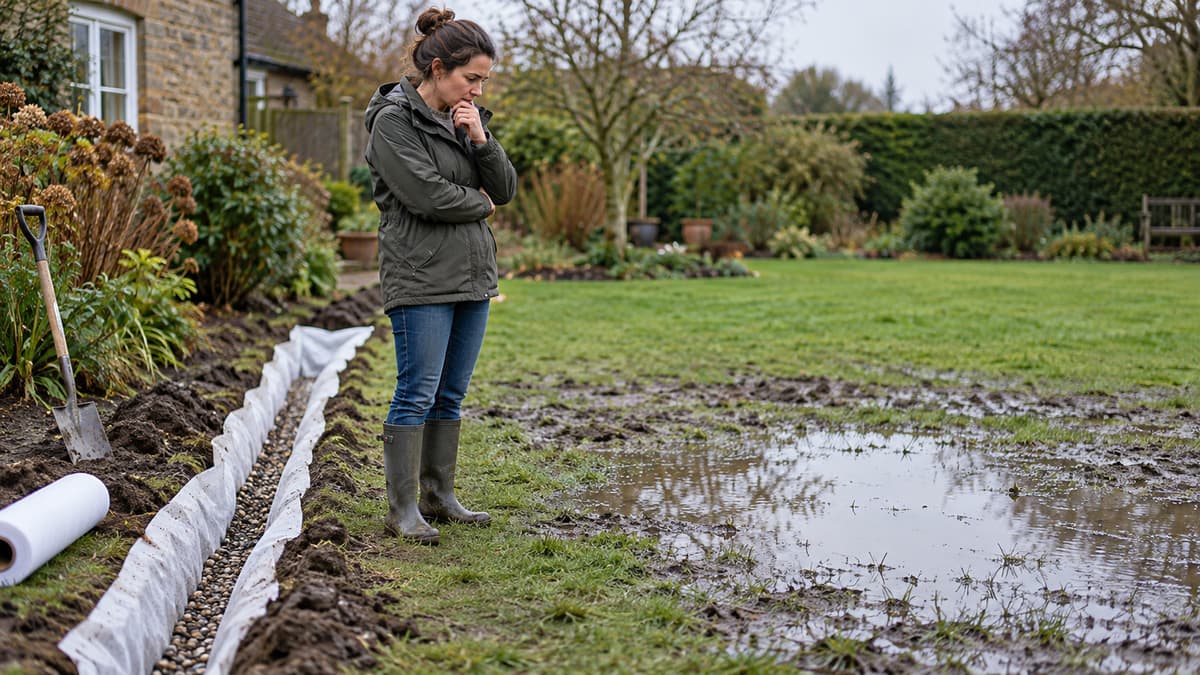
A wet lawn on clay
Fleece does not create fall or an outfall in clay. A lawn that holds water after rain needs a route for that water.

Weeds coming through decorative gravel
Drainage fleece and weed membrane are both sold for gravel, and they are not the same job. Match the sheet to light or to water.