Clay soil garden drainage: give the water an outfall
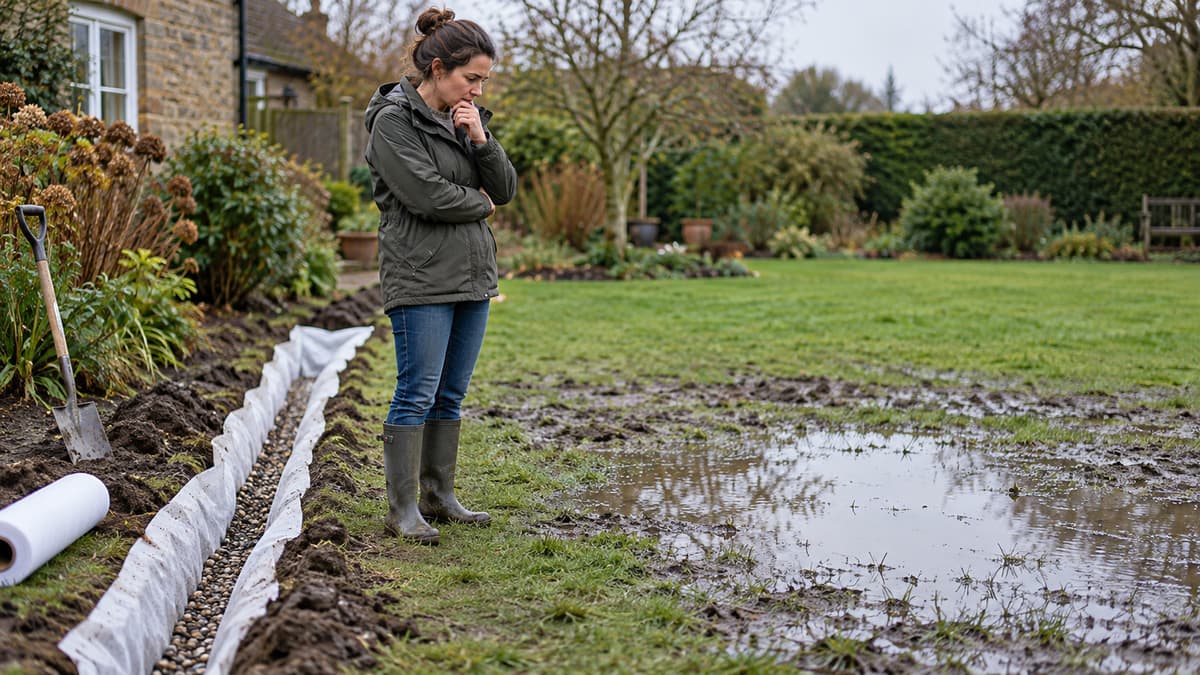
A wet lawn on clay needs fall and an outfall after rain. Fleece filters a trench. It does not empty the soil, and a soakaway in clay is a different job.
On this page

You walk the lawn two days after rain and your shoes still sink. The grass looks fine. The low corner holds a puddle that never leaves. Clay soil garden drainage is the job of getting that water off the lawn, and a roll of white fleece will not do it alone. Clay lets water move slowly, and a flat garden gives that water nowhere to go.
Updated in October 2026, this page uses the amazon.co.uk listings in the drainage fleece set, a Spudulica note on French drains, EasyMerchant and BuildWiz notes on geotextile weight, a Draintex note on stone, and individual UK reviews. No drainage trial or lab test was run. A qualifying purchase through the links can earn a commission at no extra cost to you.
In short
A wet lawn on clay stays wet until the water has fall and an outfall. Non-woven fleece belongs in the trench as a filter around clean stone, and around a perforated pipe if you are using one. The same fleece under the turf, or a pit in the clay with no percolation test, leaves the standing water where it was.
Why a lawn stays wet on clay
Clay is a fine soil. After a shower, a British lawn on it can still squelch on the second morning. A standing water garden of this kind is a levels problem as well as a soil problem. The rain had no route off the grass.
Spiking the lawn and brushing sharp sand into the holes opens the top few centimetres. On clay those holes close. If the only slope runs back towards the house, sand will not change where the water wants to rest.
A non-woven membrane on clay is a filter. It lets water through and holds soil back. Under the grass, with no stone voids and no fall, it is only another layer. The drainage fleece comparison is where the cuts and review notes live, and it assumes the water already has somewhere to go. If the lawn is still wet long after the rain, plan the exit first.
What a French drain in clay can do
A French drain in clay soil is a trench that collects water and carries it away. The useful version sits at the low point, falls in one direction, and ends at an outfall. Spudulica's note runs in that order: trench at the low point, non-woven fabric, clean stone, then somewhere for the water to leave. The fall is the part you cannot buy in a roll.
One UK review of the Spudulica 1.1 m by 8 m trench fleece, ASIN B06ZYB3XDK, describes a trench of about 300 mm in clay, then the fleece, about 20 mm rounded gravel and a perforated pipe. That is one household account, not a test repeated here. The listing shows 8.8 m² at a stated 100 gsm, listed at £29.55, with 4.9 stars from 45 reviews, a small sample. The technical row says plastic while the bullets say non-woven geotextile, so read the live page before you treat the material line as settled. In this set that narrow cut is the top pick for a short slot. A 2.25 m sheet in the same slot is mostly spare. Widths and prices sit on the best drainage fleece page. On wet clay, line and stone a length in the same session. An open trench left overnight slumps.
Stone, weight, and the sheet
The stone has to stay clean. Draintex's note asks for clean stone that is not limestone. The review above used about 20 mm rounded gravel, which leaves gaps for water. Soil, clay lumps and dusty scalpings fill those gaps. Tip the trench spoil back in, and you have a clay-filled ditch with a pipe in it.
EasyMerchant's geotextile explainer treats non-woven fabric as the sheet for land drains, and it points to a heavier weight when the subgrade is weak. BuildWiz describes a 200 gsm band where puncture on a weak subgrade matters. The garden cuts in the set are mostly stated at 100 gsm, with no puncture figure and no opening size. In a short hand-dug trench that 100 gsm non-woven is what reviewers describe. Under a car, a printed gsm is only a starting point. The drainage fleece buying guide is the specification check.
A woven weed sheet blocks light under a mulch and is a poor filter in a wet trench. The fork is on drainage fleece vs weed membrane. One reviewer of the 1.1 m piece needed a sharp knife. Another, on a wider cut, used scissors around perforated pipes. Leave a lap at every join. Overlap, pipe and stone order are on how to lay drainage fleece.
Where the water has to go
Check the fall before you buy the roll. The trench should be deeper at the outfall than at the head. A level trench stores water until it is full. A trench that falls the wrong way moves the puddle towards the house. Mark the low end while the standing water is still there.
The outfall has to be a real place. A lower border that already drains, a ditch, or an existing pipe that leaves the site can take a short run from a lawn. A pit in the same clay is a soakaway. The BRE and CNC notes used here treat infiltration as something clay often will not do. This page does not publish a pass rate, a pit size or a legal threshold. If the only plan is into the clay, run the soakaway test, or choose another outfall.
Keep the discharge off the house wall. A pipe against the foundation trades a drier lawn for a wetter wall. Clearance for a crate pit is not the same sentence in every UK nation. A short trench is reasonable when you can see the low point, the dig misses services you have located, the fall is in the ground, and the water arrives somewhere that can take it.
A patio sub-base on wet clay
A patio on clay fails when the sub-base sinks and mixes with the soil, and the slabs start to rock. A weed membrane is the wrong tool if the failure was water and mixing, because that sheet is there to block light. One UK review, Alan Hazlett on the Spudulica Caisse piece B06ZZR2QKZ, said the fleece held a patio sub-base on wet clay where a weed membrane had failed. That is one review. It is not a structural test, and it does not grade the fabric.
That wider cut is 2.25 m by 8 m, 18 m² at a stated 100 gsm, listed at £37.55, with 4.5 stars from 87 reviews. Other reviews mention wrapping perforated pipes and laying the sheet under MOT Type 1. This page will not invent a base thickness, and there is still no puncture figure. Most of a 2.25 m width is spare in a narrow lawn trench. On a patio it is the reason to choose it. If the load is a car on wet clay, a 100 gsm garden fleece is a light sheet. Left in the sun, you are testing exposure, not drainage.
When you stop and get help
Stop when the water has nowhere practical to go, or when the dig is no longer a spade job. A failed percolation test means the clay will not take the soakaway you hoped for. More crates and another wrap of fleece in the same hole repeat the failure. Buried services, a mini digger, or a base that already carries vehicles are the same kind of edge. The fleece does not locate cables, design an infiltration pit, or give a base a published strength.
The short trench is still a fair DIY job when the outfall is obvious. Use the narrow non-woven, clean non-limestone stone, and a perforated pipe if the run needs one. Lap the fleece, and stone and cover it in the same visit if the clay is wet enough to slump. If the puddle returns in the same corner, the water is still missing a route.
Common questions
Will fleece drain clay by itself?
What stone should I use in a clay trench?
Where does the water go?
Is 100 gsm enough on clay?
Can I discharge the drain next to the house?
Why did my patio sub-base disappear into the clay?
Do I need a percolation test?
What belongs on the drainage fleece comparison?

Peter F. is the editor for DIY & tools at productscompared.co.uk. Comparisons in this category are checked against amazon.co.uk listings, review evidence and public UK sources.
Related articles

What a French drain costs in the UK
Published per-metre prices disagree. The fleece is the small line. Price the trench, the stone, and where the water goes.
How far a soakaway should sit from the house
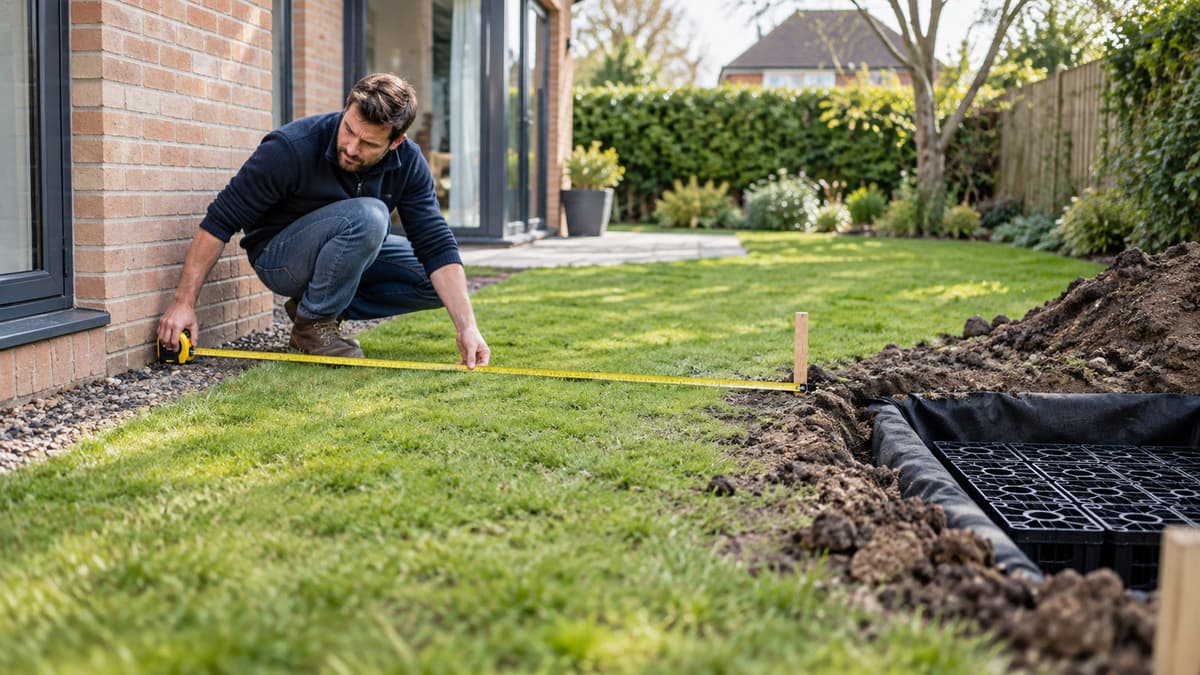
A soakaway that has to sit clear of the house is a different job from a short lawn trench. Check the clearance before you dig.

When a garden drain needs a contractor
A fleece roll does not cover buried services, a failed percolation test, or a digger. This is where a contractor takes over.