Soakaway distance from house: measure before you dig
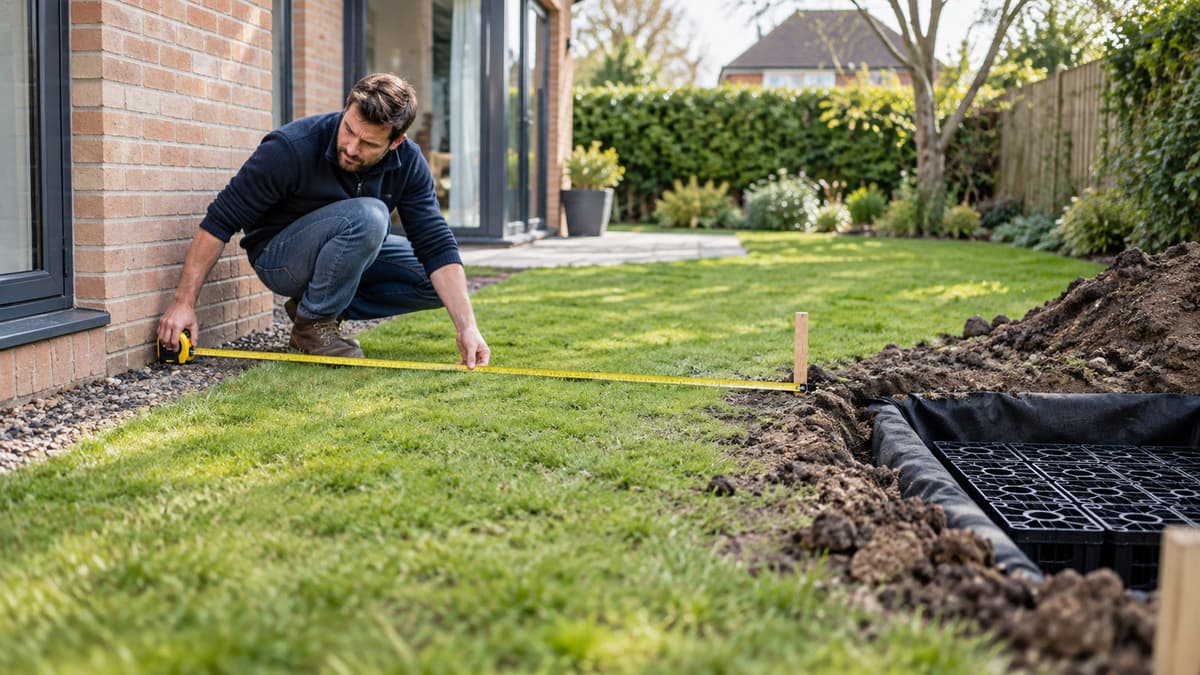
English building-control notes keep a soakaway at least 5 m from a building or road. The figure is not every UK nation, and fleece does not move the pit.
On this page

You have marked a crate pit a couple of paces from the new extension, because that corner is the only spare ground. Soakaway distance from house is the measurement that decides whether the mark is even a candidate. In England, Approved Document H says an infiltration device should not be built within 5 m of a building or a road. Council notes then add a boundary, a chalk rule, or a test. The fleece in the basket answers none of those.
We read Approved Document H, 2015 edition, for use in England, plus notes from CNC Building Control, Horsham, and Wiltshire. We did not design a pit, run a percolation test, or test a sheet. Prices are those recorded on our drainage fleece comparison. A qualifying purchase through our amazon.co.uk links can earn us a commission at no extra cost to you.
In short
In England, Approved Document H says do not build an infiltration device within 5 m of a building or road, on unstable land, or where the water table reaches the bottom of the device at any time of the year. CNC prefers an extra 2.5 m from a boundary. Horsham uses 5 m from buildings and boundaries. Wiltshire moves to 10 m on chalk or unstable fill. Those notes are not a licence to copy one number into Scotland, Wales, or Northern Ireland, and none of them shrinks because you bought geotextile.
What English notes say
Approved Document H is the English guidance for rainwater drainage under the Building Regulations 2010. Requirement H3 sends roof water first to an adequate soakaway or other infiltration system where that is reasonably practicable, then to a watercourse, then to a sewer. Water entering the ground should be spread so that it does not damage the foundations of the building or of any adjacent structure.
Paragraph 3.25 is the sentence people shorten to "5 metres". Infiltration devices should not be built within 5 m of a building or road, or on unstable land. They should not be built where the water table reaches the bottom of the device at any time of the year, or so close to another soakaway or a drainage field that the ground's soakage is used up. Polluting runoff is a separate stop. A tape that reads 5.1 m does not make the pit adequate.
Soakaways should be designed for a once-in-ten-year storm. Serving 25 m² or less, the document allows 10 mm of rain in 5 minutes. Larger areas go to BS EN 752-4 or BRE Digest 365. CNC's shortcut, only where soakage is already good, turns a 50 m² roof into 0.84 m³ of crates. That figure is not a volume for your extension. Measure to the nearest edge of the device. A stack whose centre is 5 m out still has a near face inside the clearance.
Why 5 m is not every UK nation
The 2015 edition says it is for use in England. Scotland uses technical handbooks, and a local verifier checks domestic work. Northern Ireland publishes its own technical booklets. Wales publishes its own approved documents. This research did not find a provision that pastes the English 5 m sentence onto all four nations, and this page will not invent the missing distances.
If the house is in Glasgow, Cardiff, or Belfast, ask which handbook applies and whether the job is notifiable. "Any building" in the CNC wording includes the extension, and it can include a neighbour's wall. Another design can still meet Requirement H3, which needs evidence such as BRE Digest 365. If your body names a later text than the 2015 PDF, use that text.
Boundaries, chalk, and the extra distances
The boundary is where the notes diverge. CNC prefers at least 2.5 m from any boundary. Horsham says 5 m from buildings and boundaries. Paragraph 3.25 prints no boundary distance. It does tell you not to crowd another soakaway or a drainage field. A crate already sitting beyond the party fence is that problem, and a tape on your side does not settle it.
Chalk can drain quickly and still be unstable. Horsham describes rubble pits as suitable in sand or chalk, and rings or crates where the ground is less porous, such as clay. Wiltshire's developer note keeps 5 m from buildings, roads, and structure foundations, then asks for at least 10 m on chalk or other fill prone to instability, in line with CIRIA C574. If that 10 m cannot be achieved, it asks for specialist geotechnical advice. A pit that empties in an hour can still be the wrong pit.
A septic drainage field in the same document sits at least 15 m from a building. A roof crate is a different system, so do not copy either distance onto the other. Horsham also sizes pits with 40 mm of daily rain. That is not the 10 mm in 5 minutes assumption, and it is not CNC's crate shortcut. The method that fits the flower bed is not the one you keep.
Crates, rings, and a pit that is still too close
Plastic crates do not buy a shorter clearance. CNC applies the same 5 m line to crate systems and to rubble pits. The crate changes how much void you get, which is why the rubble figure is divided by 0.3, and it changes the wrap. It does not change the tape. Measure the near face of the stack, not the centre and not the inlet pipe. Depth does not cancel a short gap.
BRE Digest 365 is where those notes send you when the shortcut runs out. Geotextile separates granular fill from the soil, and it is not wrapped around the outside of concrete ring units. Plastic infiltration crates take a permeable non-woven sheet on the outer faces, because the voids are open. That detail, including overlap and the pipe entry, sits on the soakaway crate membrane wrap page. An attenuation tank that must hold water for a controlled release often needs an impermeable liner instead. Clay that will not infiltrate turns a crate into a tank with nowhere to go. An overflow is only useful if it has a lawful destination.
What the fleece leaves alone
Drainage fleece is a filter. Water should pass, and soil fines should stay out of the stone, the pipe, or the crate. That job starts after the pit is in a lawful place, on ground that can take the water. A heavier sheet, a second layer, or a black weed membrane does not add metres. An excavation 3 m from the extension is still 3 m after you line it. The sheet also does not create fall or an outfall. Lining the trench that feeds the pit is a separate sequence on how to lay drainage fleece.
The garden cuts do not publish tensile strength or an opening size, so "100 gsm" is not a datasheet for a building-control soakaway. The comparison's top pick, Spudulica 1.1 m by 8 m (B06ZYB3XDK), is listed at £29.55 with 4.9 from 45 reviews, and reviewers used it in a trench. A crate usually wants a wider cut. Weed membrane blocks light under gravel, which is the wrong jacket, as set out on drainage fleece versus weed membrane.
Who to ask before you dig
Ask the building-control body for the nation and the district before you hire a machine. In England that is the local authority team or an approved inspector. Take a sketch with the extension, the nearest edge of the pit, and the distances to walls, the boundary, any road, and any other soakaway. Ask whether the work is notifiable and which test they accept. CNC asks for a soakage test when the area is large or the ground is poor. Approved Document H points larger soakaways to BS EN 752-4 or BRE Digest 365. Keeping the formula that happens to fit the gap is how a pit ends up against a footing.
Hand the design over when the ground is clay or made ground, the water table is unknown, chalk or unstable fill is in play, services cross the hole, or you cannot draw the clearance inside your land. A narrow garden can still hide a pipe. This page does not size your crates.
Common questions
Is a soakaway 5 metres from the house a law?
Does the 5 m soakaway distance apply in Scotland?
How far should a soakaway sit from a boundary?
What changes when the ground is chalk?
Do plastic crates let me dig closer to the house?
When do I need a percolation test?
Can drainage fleece make up for a soakaway that is too close?
Who do I ask before I dig a soakaway?

Peter F. is the editor for DIY & tools at productscompared.co.uk. Comparisons in this category are checked against amazon.co.uk listings, review evidence and public UK sources.
Related articles

What a French drain costs in the UK
Published per-metre prices disagree, and the fleece is the small line on the bill. Price the trench before you buy the sheet.
A wet lawn on clay
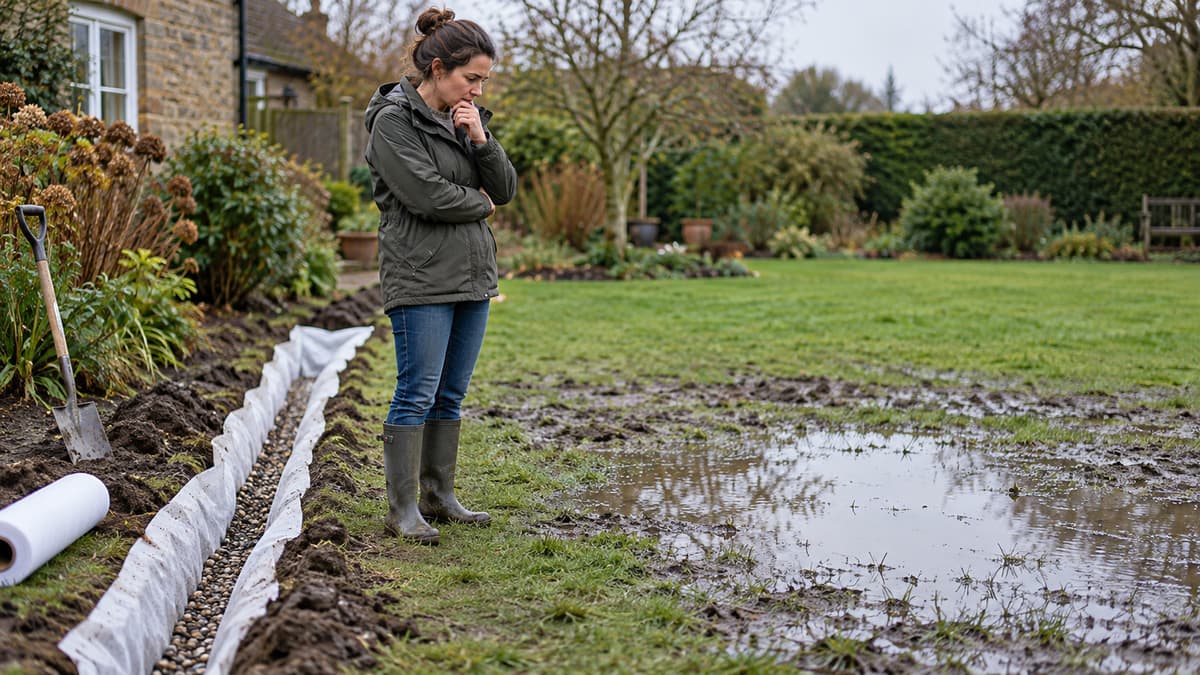
Fleece does not create fall or an outfall in clay. A lawn that holds water needs a route for the water, not only a sheet.

When a garden drain needs a contractor
Building-control soakaways, buried services, and a digger are not a fleece purchase. This is the point to stop digging.