Independent comparisons. We may earn from shop links. More info

How to fit a tree bench

Updated: October 2026

You have a tree on the lawn, a bench that claims to wrap it, and a weekend in which a tight ring or a bolt in the bark would do real damage. How to fit a tree bench comes down to two measurements, a hole that is larger than both, and a seat that stands on the ground rather than on the tree. This is the method. It is not a brand ranking. Which of the listings even prints a hole is on the [tree bench comparison](/hub/trees-and-palms/tree-bench). The Products Compared editorial team updated this in October 2026. The measuring rule is taken from UK specialist and magazine guidance, not from a lab test of these amazon.co.uk benches. A qualifying purchase can earn a commission at no extra cost to you.

You have a tree on the lawn, a bench that claims to wrap it, and a weekend in which a tight ring or a bolt in the bark would do real damage.

Our top picks

On this page

Measure the trunk in two places

Start with a flexible tape, not with the outer width printed on the bench. The English Garden, in its tree-seat guide, measures the circumference at about 90 cm above the ground, which is roughly hip to chest height on an adult, and divides by 3.14 to get a diameter. Chic Teak asks for the widest point, which on many trees is the flare at the base, and divides by about 3.143. Do both. A plane or a mature cherry can be much thicker at the buttress than at waist height, and the seat has to pass the thicker point as you lower it, or sit clear of it if the ring is built in sections around the trunk. Write the two diameters down and keep the larger one. If the circumference at 90 cm is 125 cm, the diameter is about 40 cm. If the base measures 160 cm around, the diameter is about 51 cm, and 51 cm is the number the hole must beat. Measure bark to bark, not a vine or a stake, and do not pull the tape so tight that it cuts into soft bark.

Match that number to an inner opening

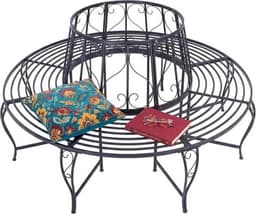
The hole you buy must be larger than the diameter you just kept. In this amazon.co.uk set, only Relaxdays B0H514B9N2 prints an inner opening, and it is 70 cm, inside an outer circle of 160 cm. If your larger trunk diameter is 50 cm, 70 cm leaves 10 cm of radius all round on day one, which is a starting gap rather than a lifetime promise. If your larger diameter is already 70 cm or more, that ring does not fit, however tidy the steel looks. The other six listings do not print a hole, so you cannot match them to the tape. A 40 cm cube, a 10 cm height, or a 1 kg package line is not an inner opening under another name. Those clashes are in the tree bench buying guide. When the listing is blank, do not invent a diameter from the photograph. Specialist rings often publish the hole because the product is useless without it. Barlow Tyrie’s Glenham, for example, is a full circle with a 100 cm inner opening, sold as two bolted halves. That is a different shop and a different price. It shows the sentence your amazon.co.uk page is missing. If you already own a half-round with no stated maximum trunk, offer it only to a trunk you have measured as clearly narrower than the curve you can see in the timber, and accept that you are guessing where the page should have been precise.

Leave a gap and never bolt the trunk

There is no statutory centimetre gap between bark and seat in the sources used here. The RHS does not publish a tree-bench clearance in those sources either. US build blogs sometimes prescribe 2 to 6 inches. Do not copy that into a UK rule. What the UK guides do say is to leave room for growth. The English Garden uses a hungry plane at King’s Inns in Dublin as a picture of a trunk that swells and lifts or splits whatever was built tight around it. That is an illustration, not a bylaw, and it is not a reason to pick one magic gap for every species. What you must not do is fasten the bench to the tree. No screw, bolt, strap or wire into the bark or through the cambium. The seat is furniture on the ground. The tree is not a fixing point, and a ring that relies on the trunk for stiffness is the wrong product. Do not pile soil, mulch or decorative stone against the bark to hide a rocking leg. If a listed growth gap is only the seller’s adjective and not a diameter, ignore the adjective and use your two measurements. Whether you need a semicircle or a ring is on half or full tree bench.

Level the seat without digging the roots

Old trees rarely stand in a billiard-table lawn. Barlow Tyrie says as much about the Glenham and suggests a brick or stone plinth where the ground is uneven. A plinth can be the right idea, and it can also become excavation in the root zone, which is where you stop being a weekend fitter. BS 5837, the British Standard used on development sites, sets a root protection area with a radius of about 12 times the stem diameter and expects no casual level change and no digging. A freestanding seat on a domestic lawn is not automatically a planning application. The same roots still break if you cut them to make a leg sit flat. Try the least invasive order. Assemble the seat away from the trunk if it comes in sections, then walk it into place. Put feet beside roots, not on top of them, and use broad pads or the manufacturer’s feet rather than spikes driven into the soil. If a short packer under one foot levels the seat without cutting anything, that is enough for a slight fall. If you would need to sever a root thicker than about 25 mm, or to dig a foundation under the canopy, stop. Cheltenham’s tree guidance for construction near trees makes that 25 mm point for building work, and it is a sound household limit too. Call an arboriculturist, or the council tree officer if the tree is protected or in a conservation area, before you excavate.

Common questions

Where on the trunk do I measure?
At about 90 cm above the ground, and again at the widest point near the base. The English Garden uses the 90 cm height. Chic Teak stresses the base because many trunks flare there. Keep both circumferences. The seat has to clear the larger one, not the prettier one.
How do I turn circumference into diameter?
Divide the circumference in centimetres by 3.14. A trunk that is 157 cm around is about 50 cm across. Chic Teak uses 3.143, which changes the answer by a few millimetres, not by a size of bench. Use the same divisor on both readings so you can compare them.
How much extra room should I leave?
Enough that the trunk can thicken for years without touching the seat. No UK source in this guide sets a single legal gap in centimetres, and an American inch range is not a UK rule. A hole that is only just larger than today’s diameter is already too tight for a young, fast tree.
Can I screw the bench into the tree?
No. Do not put screws, bolts or straps into the bark. The bench stands on the ground. The trunk is only the thing the hole must clear. Fixing into the stem wounds the tree and ties the furniture to growth you cannot stop.
What if the ground is sloped or roots stick up?
Move the feet off the roots and pack a low foot with a removable pad if the fall is small. A brick or stone plinth is what some teak makers suggest for seriously uneven ground. Digging that plinth out of the root zone is the point where you stop and get advice.
Is a 70 cm opening enough?
Only if the larger of your two diameters, plus the growth you are willing to allow, is under 70 cm. That 70 cm figure is the Relaxdays inner opening, the only one printed in this amazon.co.uk set. It is not a universal tree-bench size, and it is too small for a mature trunk that already measures more.
Does BS 5837 apply to a bench I stand on the grass?
The standard is written for development sites, so a freestanding seat is not automatically a planning case. The root advice still applies: do not change levels or dig through the root protection area for the sake of a flatter leg. If the tree is protected, ask the council before you excavate.

Related pages

Sources

Public UK sources from the research digest, last checked on 17 October 2026. Shelf prices and the review line are the amazon.co.uk figures in the display file. Load figures are seller claims, not a test run for this page.

  1. The English Garden: 10 of the best tree seats (retrieved 17 October 2026)
  2. Chic Teak: circular tree bench (retrieved 17 October 2026)
  3. BSI: BS EN 581-1:2017 (retrieved 17 October 2026)
  4. EN 581-2:2026 scope (retrieved 17 October 2026)
  5. GOV.UK: General Product Safety Regulations 2005 (retrieved 17 October 2026)
  6. Consumer Rights Act 2015, section 23 (retrieved 17 October 2026)
  7. RHS: maintaining garden seats (retrieved 17 October 2026)
  8. FSC UK: labels (retrieved 17 October 2026)