Independent comparisons. We may earn from shop links. More info

Mouse trap vs rat trap: droppings, width and title

Updated: 17 October 2026

The mouse trap vs rat trap decision is mostly about identification and usable dimensions, not the words in an amazon.co.uk title. A young rat seen at night can be mistaken for a large mouse, while a narrow 30 cm tunnel can look long enough for either animal. Start with droppings, body proportions and where the signs appear, then measure the cage in centimetres. Our [live trap comparison](/hub/traps/live-trap) lists each product’s dimensions and target claims. Compact plastic tunnels belong to mice, roughly 31 cm wire cages are the more credible rat class, and a 22 cm metal cage remains a compromise. A qualifying purchase can earn a commission at no extra cost to you.

The mouse trap vs rat trap decision is mostly about identification and usable dimensions, not the words in an amazon.co.uk title.

Our top picks

On this page

Signs to check before buying

House-mouse droppings are small and rice-like. The Biosecurity for Life guide gives roughly 4–8 mm long and around 2 mm thick, usually scattered around feeding or shelter. Brown-rat droppings are larger, around 13–19 mm long and 3–4 mm thick, and may be grouped. Use several fresh signs rather than one dried dropping, which can shrink or be confused with debris. Public UK sources put a house mouse at roughly 60–90 mm in body length and about 15 g, while an adult brown rat is around 15–27 cm head and body and may be about 300 g. A rat’s tail is nearly as long again. A fleeting sighting is less dependable than droppings, gnawing and tracks. Young rats are smaller than adults but generally have larger feet and a heavier head-to-body shape than a mouse. If the signs sit between the common ranges, do not assume a mouse tunnel will be adequate just because the animal looked small. The humane live trap buying guide explains the three product classes once the signs are clear.

What these traps can hold

The MSR pair shows why length alone misleads. Each plastic tunnel is 30 cm long, close to some wire rat cages, but only 6.4 cm wide and 8 cm high. The listing says it is for mice and that a rat needs a larger trap. Its two-door format and 1,375-review sample may make it a useful mouse product. Neither feature changes the cross-section. Jsdoin is also best treated as a mouse tunnel. It costs about £9.99 for two and uses a one-way door, but its details and bullets provide conflicting dimensions. The title mentions rats, while the compact ABS body gives no persuasive reason to rely on it for an adult brown rat. The CD cage is 27 cm long with a 14 x 12 cm cross-section and is listed for mice and small rats. It is wider than either plastic tunnel, but this comparison contains no amazon.co.uk reviews to confirm the trigger. The Anyhall cages are the clearest rat-class products: both colours measure 31.5 x 14.5 x 11.5 cm and use a large pedal. Kwaiyole lists cages around 31–32.5 cm long, although its material descriptions conflict. The roughly 35 x 15 x 15 cm UKRAT002 example is a ruler, not a test certificate for retail products. Skip both tunnel products when the droppings are rat-sized.

When a short metal cage still gets used

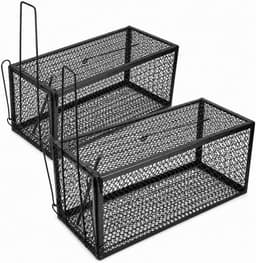
Cardys sells two 22 x 11.5 x 11.5 cm metal cages for about £14.95. Its listing names mice and rats, and some owners report rat catches. The bait-hook and spring-door arrangement can work when an animal enters far enough, so the product should not be dismissed as incapable of ever catching one. A 22 cm cage gives an adult brown rat less room to commit its body before reaching the bait than a 31.5 cm cage. It may pull food through the mesh or back away before the door clears its body. Reviews also split between easy and fiddly setting, with one comment describing the door hook as flimsy. The Ratkil is another low-cost metal option at about £14.99, but its details omit dimensions. Its listing claims mouse, rat and squirrel use, while review notes include bait taken without the plate firing. Without measurements, you cannot place it on the same ruler. If bait disappears from outside the bars, the how to set a live trap guide covers reach, placement and pre-baiting.

One decision, with limits

Choose a plastic tunnel when the evidence points to house mice: small scattered droppings, a slight animal and routes where a narrow washable body can sit flush against a wall. MSR has the deepest review sample, while Jsdoin is the cheapest pair. Both require frequent checks, and neither should be promoted as a rat solution from title wording alone. Choose a wire cage around 31 cm long when the evidence points to a brown rat. Compare width, trigger position, door travel and handling as well as length. Anyhall has the strongest review combination in this set, though it lacks a carry handle. Kwaiyole offers similar dimensions but contradictory material lines and thinner review samples. Treat 22–27 cm cages as compromises. They may work for mice or smaller rodents and may record rat catches, but they provide less entry length than the main rat class. If you are uncertain, a competent pest controller can identify signs and address access points. This decision does not cover squirrels, cats or foxes. The best live catch trap shortlist separates the named picks by job.

Common questions

How can I tell mouse droppings from rat droppings?
House-mouse droppings are commonly about 4–8 mm long and rice-like, while brown-rat droppings are roughly 13–19 mm and thicker. Compare several fresh examples beside a ruler. Size overlaps at the edges, so combine droppings with tracks, gnawing and body proportions before you buy.
Can a young rat fit a mouse trap?
A young rat may enter some larger mouse traps, but entry is not the only question. It must move far enough inside to activate the trigger without escaping. If the signs are ambiguous, choose a measured wire cage rather than relying on a narrow plastic tunnel.
Is a 30 cm trap automatically long enough for a rat?
No. The MSR tunnel is 30 cm long but only 6.4 cm wide, and its listing says mice only. Length, width, height and trigger position work together. A narrow tunnel can remain a mouse product even when its length resembles a short rat cage.
Is the 22 cm Cardys a rat cage?
Its listing names rats and reviews report some catches, but 22 cm is substantially shorter than the 31.5 cm rat cages in this comparison and the roughly 35 cm procedure example. It is better viewed as a compact compromise, particularly for mice or smaller rodent jobs.
Why does a rat take bait without entering?
The bait may be too close to the mesh, the cage may be too short, or the rat may be cautious around a new object. Fix bait beyond the trigger and pre-bait with the door secured open if necessary. Replace a cage whose trigger does not fire reliably.
Do mice and rats need different bait?
Not necessarily. Peanut butter, chocolate spread or food already being taken can work for both. Placement and access matter more than finding a species-specific flavour. Use a small fixed amount beyond the trigger and remove competing food.
Is a household rat likely to be a black rat?
Most household rat problems in Britain involve the brown rat. Black rats are much less common, and their release can require a licence. If identification has legal consequences or the animal does not match common brown-rat signs, seek professional advice rather than guessing.

Related pages

Sources

Public UK sources for glue traps, animal welfare, grey squirrels and fox cages. Listings are the amazon.co.uk captures for these twelve ASINs, not a live reload on 17 October 2026. Prices on amazon.co.uk move.

  1. BASC, grey squirrel live capture (retrieved 17 October 2026)
  2. GOV.UK, invasive non-native species rules (retrieved 17 October 2026)
  3. Glue Traps (Offences) Act 2022 (retrieved 17 October 2026)
  4. Animal Welfare Act 2006 (retrieved 17 October 2026)
  5. GOV.UK, foxes, moles and mink (retrieved 17 October 2026)
  6. UFAW, humane rodent control (retrieved 17 October 2026)
  7. RSPCA, injured rat or mouse (retrieved 17 October 2026)
  8. Mammal Society, brown rat (retrieved 17 October 2026)