Independent comparisons. We may earn from shop links. More info

How to use a Bosch angle grinder

Updated: 22 October 2026

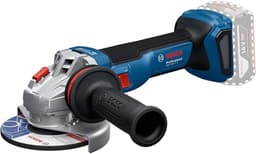
You have a Bosch Professional grinder on the bench, and the cutting disc is still a separate purchase. How to use a Bosch angle grinder, on the models in the [Bosch Professional angle grinder comparison](/hub/tools/bosch-professional-angle-grinder), starts with the plug or the battery out, the guard on, and a wheel whose marked speed is at least the tool's. A 115 mm GWS 7-115 that prints 11,000 rpm will throw a disc rated below that. Peter F. set this sequence from the amazon.co.uk box lines of 19 October 2026, Bosch's proper-use notes, and HSE's HSG17 guidance on guards. There was no lab test. A qualifying purchase can earn a commission at no extra cost to you.

You have a Bosch Professional grinder on the bench, and the cutting disc is still a separate purchase.

Our top picks

On this page

Before the disc goes on

Isolate the tool before the flange comes off. On a lead model the BS 1363 plug, or the yellow site plug, comes out. On an 18 V body, the pack comes off. Bosch's proper-use notes put isolation first, then the guard, then the side handle. HSG17 says that guard should stay on if the wheel bursts, and that it should not come off so a larger disc will fit. Check the disc for cracks, a missing label, or a speed mark below the tool. The 240 V GWS 7-115 prints 11,000 rpm. Where a row prints no revolutions figure, use the mark on the wheel and the manual for that part. Clamp the work. If the voltage fields on your listing disagree, stop and read the 110V Bosch angle grinder page before the first start.

Nut, spanner, or the GWX

Most corded rows in this set, and the named GWS 18V-8, change the disc with a two-hole spanner. The scope lines name a locking nut, a backing flange and that spanner. Press the spindle lock only when the spindle has stopped. Holding it in while the disc is still spinning damages the lock, then the spindle. Seat the flange, the disc and the nut in the order the manual shows. A quick-locking nut is named on two parts only: 06019N4000 and 06019N4100. If it sticks, the spanner is the tool, not a pair of pliers on the nut. The GWX18V-11PS bullets name a paddle switch, kickback control and an intelligent brake. They do not print X-LOCK. Non-UK reviews are the lines that say the discs click on and that older nut-type discs need an adapter.

Two hands, the right face of the disc, and a clamped job

A cutting disc cuts on its edge. Grinding on the face of a thin cutting disc is how that disc breaks. A grinding wheel or a flap disc is the face you use for grinding, and it still wants the guard for that job. Keep the side handle on, and keep your second hand on it. Kickback is the disc grabbing in the cut and throwing the tool. Where a listing names kickback control, as the GWX bullets do, that feature cuts power if the disc binds. The disc can still be spinning. The GWS 7-115 listings do not name KickBack Control. Let the wheel reach speed before it touches the work, and let it stop before you set the tool down. Eye protection is the point HSG17 ties to BS EN 166. These listings print no vibration or noise figure.

Heat, smell, and a dead lead

UK reviews of the GWS 7-115 describe a housing too hot to hold after about 10 to 15 minutes, a burning smell on more than one unit, and a stiff lead that kinks out of the box. That pattern is a stop. Unplug, or take the pack off, and let it cool. If the smell is there on a cold start, or the lead is nicked, the tool stays on the bench. At work, wheel changing and the choice of wheel are for someone trained on that kit. PUWER 1998 expects work equipment to be suitable and users to be trained. HSG17 treats mounting on a portable grinder as that kind of task. Concrete and masonry dust need a plan under COSHH. A wet shell, a damaged guard, or a lead you do not trust is a stop, whether the job is a house or a site.

Common questions

What has to be on the tool before the first start?
The plug is out, or the battery is off, while you fit the guard and the side handle. The guard sits between you and the wheel and stays on. The disc is intact, the bore matches without an adapter, and the speed marked on the wheel is high enough for the tool. The work is clamped. No scope line in this set includes a cutting disc.
How do I change a disc without damaging the spindle lock?
Wait until the spindle has stopped, then press the lock and use the two-hole spanner where the scope line names one. Release the lock before you start again. On parts 06019N4000 and 06019N4100 the scope line names a quick-locking nut instead. If that nut sticks, use the spanner rather than pliers. The GWX bullets do not describe this nut.
Can I grind on the face of a cutting disc?
Use the edge of a cutting disc for the cut, with the guard in place. The face of a thin cutting disc is the wrong surface, and it is a common way for the disc to shatter. Grinding belongs on a grinding wheel or flap disc rated for that tool's speed. If the guard will not cover the wheel you want to fit, the wheel is the wrong size.
What if the housing gets too hot or smells of burning?
Stop, isolate the tool, and let it cool. On the GWS 7-115, UK reviews report a housing too hot to hold after about 10 to 15 minutes and a burning smell during ordinary use. That is a fault pattern in the file, not a bedding-in stage. If the smell appears on a cold start, or the lead is scorched, leave it unplugged.
When is this a workplace training job?
When you are at work, changing the wheel and choosing it are tasks for a trained user under PUWER, which HSG17 treats as the mounting standard for portable grinders. The same line applies to concrete dust with no extraction plan, a damaged guard, a cut lead, or a wet tool. If you are unsure which, stop and get someone who is trained on that grinder. Part choice is the buying guide.

Related pages

Sources

Public UK sources used for this page in October 2026. Prices, stars and review counts are from the ten amazon.co.uk listings captured on 19 October 2026. A bare-tool price does not include a battery. PUWER and abrasive-wheel guidance apply at work. They are not a certificate for a domestic grinder. None of these scores is a laboratory test.

  1. HSE, PUWER overview (retrieved 19 October 2026)
  2. HSE, HSG17 Safety in the use of abrasive wheels (retrieved 19 October 2026)
  3. HSE, Electrical equipment (retrieved 19 October 2026)
  4. legislation.gov.uk, Control of Vibration at Work Regulations 2005 (retrieved 19 October 2026)
  5. legislation.gov.uk, Control of Noise at Work Regulations 2005 (retrieved 19 October 2026)
  6. Bosch Professional, X-LOCK (retrieved 19 October 2026)
  7. Bosch Professional, GWS 18V-11 manual (retrieved 19 October 2026)
  8. IET, Reduced low voltage systems (retrieved 19 October 2026)