Independent comparisons. We may earn from shop links. More info

Air angle grinder vs electric

Updated: 22 October 2026

You already own a compressor, or you are about to buy a small one, and the grinder is the tool that might justify it. An air angle grinder vs electric choice is really three power sources: a hose, a 230 V mains lead, and a battery. Air is sold as a light head that can run all afternoon. A mains or cordless grinder is sold as the tool that works the day it arrives. The useful test is whether your airline can hold about 6.3 bar at the tool while you grind. The [air angle grinder comparison](/hub/tools/air-angle-grinder) lists three captured air tools. This page does not pick among them. It says when the hose is the better power source, and when you should stay with mains or cordless. Peter F. updated this on 22 October 2026 from those amazon.co.uk listings and public UK sources. We did not run a lab comparison. A qualifying purchase can earn us a commission at no extra cost to you.

You already own a compressor, or you are about to buy a small one, and the grinder is the tool that might justify it.

Our top picks

On this page

Three ways to turn a disc

An air grinder is a vane motor on the end of a hose. A corded grinder is a 230 V motor with a BS 1363 plug. A cordless grinder is the same sort of head with a battery and a charger. All three can fit an abrasive wheel. They do not fail in the same way. The air tool stops being useful when the compressor cannot hold pressure. The corded tool stops being useful when the lead will not reach, or when you are away from a socket. The cordless tool stops being useful when the pack is flat or the motor is hot from a long heavy cut. The condition for air comes before any claim about weight or duty. Atlas Copco's installation guidance treats about 6.3 bar at the tool inlet as the design point. In this snapshot the only stated consumption is the ABAC G-202, at 2.5 litres per second, which is 150 litres per minute or about 5.3 cfm, up to 6.3 bar. If you cannot hold a figure of that kind at the inlet, the hose tool will not do the job the listing describes. The arithmetic sits on the air angle grinder compressor size page. UK workshop airlines are commonly 1/4 inch BSP. A fitting you cannot seal, such as NPT forced onto BSP, is a reason to stay electric even when the compressor is large enough.

When air is the better tool

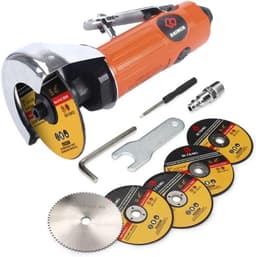
Air earns its place in a workshop that already has free air near the tool's stated need, and where the work is sustained cutting or weld dressing at a bench. Body shops and fabrication bays keep hose tools because the head can be small and the compressor, not a battery, is doing the endurance. Toolstation's buying guide makes the handling point in one line: pneumatic grinders are small and easy in a tight space, and the hose is what limits how far you walk. Heamar's grinder pages put the same condition on continuous metalwork: air is the case while flow and pressure hold. If they do not hold, the advantage disappears in the first few minutes. Compared with a cordless grinder on a long weld, the hose tool does not pause for a pack change, provided the pump keeps up. Compared with a corded 125 mm grinder, the head can be easier to get into a wing or a chassis rail, though you trade the lead for a hose that snags on the same rail. Captured weights, for the air tools only, are 1.44 kg for the ABAC, 1.53 kg for the ORAZIO and 905 g for the NuoDunco cut-off. Those numbers are not a comparison with an unnamed electric grinder, because this page did not capture one. Atlas Copco's UK article argues that air tools tolerate overload, avoid brushed-motor heat and remove shock risk from the tool head. That case stays the maker's claim. Sparks from the disc can still ignite material. No electricity in the head is not the same as no hazard.

When mains or cordless is the better tool

Mains or cordless is the better tool when you do not have the air, when the job moves, or when the cuts are short. A driveway, a roadside repair or a site with no airline is a cordless job, with a spare battery, and you accept that a long heavy load can heat the motor and empty the pack. A single socket and a 125 mm corded grinder is the simpler buy when you only need a few cuts and you do not want to own a compressor for one tool. The hose that helps at the bench becomes the problem as soon as you walk around a vehicle. A small compressor is the failure mode people underestimate. A UK MIG welding forum thread on air angle grinders records a workshop user saying rotary air tools are greedy, that a tool claimed at about 4 cfm can still stall a small compressor in a couple of minutes, and that a 600 W electric can be quieter and cheaper to live with. That is a forum report, not a lab test. It lines up with an amazon review of the ABAC that says the air use is too high for a household compressor. A pancake compressor that inflates tyres is in that disappointed group. If the gauge falls away as soon as you grind, the electric grinder you already own is the one that will finish the job. Who each captured air tool suits, once the hose is viable, is the best air angle grinder page.

What not to decide from the listing wattage

The ABAC listing field shows 800 W and the NuoDunco field shows 1,200 W, and both tools are marked air powered. Those numbers are not a mains input you can set beside a 230 V grinder's wattage, and they are not a compressor size. Atlas Copco's argument about how much of an electric tool's input reaches the spindle is the maker's industrial case. Do not apply it to these amazon fields, and do not treat a higher wattage line as a more powerful air tool. Power at the disc, on air, depends on the pressure and flow you deliver. Noise is the same kind of trap. UK action values are often discussed at 80, 85 and 87 dB(A). Only the ABAC states a figure in this set, 89.5 dB(A) from the maker's description. That does not make air quieter or louder than electric as a class. One UK review of the NuoDunco says the tool is neither light nor quiet, against a listed 905 g. If you already have free air around the tool's stated need, about 5.3 cfm at up to 6.3 bar in the ABAC's case, and a fitting you can connect, air is the workshop tool for sustained metal cutting and weld dressing. If you do not, a mains or cordless grinder is the one that will actually run. If a tool is not as described, the Consumer Rights Act 2015 is the UK route for a refund or a repair.

Common questions

Is an air angle grinder better than an electric one?
It is better only when the airline can hold about 6.3 bar at the tool for the consumption the maker states. In this set that stated figure exists for the ABAC G-202, at about 5.3 cfm. It is worse when the compressor is a small DIY unit, when you have to move around the job, or when the fitting will not seal on your hose. Air is not safer, quieter or more powerful as a class. Sparks and abrasive risk remain on both.
Do you still want air if you already own a cordless 125 mm grinder?
Keep the cordless grinder for work away from the compressor, and for jobs a spare battery can finish. Add air only if the workshop airline already holds the tool's stated flow at about 6.3 bar and you want a hose head for sustained bench work. A cordless tool can heat and stop on a long heavy cut. An air tool can sag just as fast if the pump cannot keep up. Owning one does not retire the other.
Why do body shops keep air grinders?
They already have an airline sized for rotary tools, and the work is sustained metal cutting and weld dressing in a bay where the hose can reach. The head stays small in a tight arch or rail, which is the point Toolstation's guide makes, while the compressor does the endurance. That case fails in a home garage whose compressor was bought for a nailer. The hose is an advantage at the bench and a limit as soon as the job moves.
What goes wrong with a small compressor?
The tank empties and the tool stalls or labours while you are still on the cut. A UK forum report describes a claimed 4 cfm rotary tool stalling a small compressor within a couple of minutes. An ABAC review says the air use is too high for a household compressor. Neither is a lab test of every oil-free unit. The practical sign is a gauge that looks fine at rest and falls as soon as you grind. A larger tank delays that fall. It does not replace free air delivery.
Is air safer because there is no mains lead?
The tool head has no mains voltage, so you do not get a shock from the grinder itself. You still get sparks, dust, noise and a disc that can burst. A lead you can trip over is replaced by a hose you can trip over. Employers remain under the work-equipment rules for training and suitable equipment. Hearing protection still matters. Only the ABAC states a noise figure here, at 89.5 dB(A) from the maker.
Are air grinders lighter?
The three captured air tools weigh 1.44 kg, 1.53 kg and 905 g on their amazon.co.uk listings. Toolstation describes pneumatic heads as small and easier in a tight space. That is not a weighed comparison with a particular corded or cordless grinder, because this page did not capture one. The hose and the side handle decide how the tool feels in a wing more than the kilogram on the listing. A light head on a starving compressor is still the slower way to finish a weld.
Can you use air outdoors with a pancake compressor?
A pancake compressor on a driveway is a poor match for sustained grinding. The same forum pattern and the ABAC review both describe small compressors falling behind a rotary air tool. Tyre inflation is a short burst. Dressing a weld is continuous. If the pump cannot hold about 6.3 bar at the inlet for the tool's stated consumption, use a cordless or corded grinder outside. Take the air tool back to a workshop airline that can.

Related pages

Sources

Public UK sources from the research digest, used for this page in October 2026. Prices, stars and review counts are from the three amazon.co.uk listings in that digest. Noise and vibration duties apply at work. They are not a certificate for a domestic compressor. Air consumption, noise and vibration are stated only where the ABAC maker line gives them.

  1. HSE, PUWER overview (retrieved October 2026)
  2. HSE, HSG17 abrasive wheels (retrieved October 2026)
  3. ISO 11148-7:2012 (retrieved October 2026)
  4. Control of Noise at Work Regulations 2005 (retrieved October 2026)
  5. HSE, hand-arm vibration duties (retrieved October 2026)
  6. Atlas Copco, air-tool installation pocket guide (retrieved October 2026)
  7. ABAC G-202, part 2809913206 (retrieved October 2026)
  8. Toolstation, angle grinder buying guide (retrieved October 2026)