Independent comparisons. We may earn from shop links. More info

How to use an air angle grinder

Updated: 22 October 2026

The grinder is on the bench, the compressor is already up to pressure, and the tempting order is to click the hose on and try the disc. An air tool punishes that order. How to use an air angle grinder starts with the airline isolated, a disc that is allowed on that spindle, and a guard in place, and only then with dry, regulated air. This page is the set-up, not a ranking of the three tools on the [air angle grinder comparison](/hub/tools/air-angle-grinder). Peter F. updated this on 22 October 2026 from those amazon.co.uk listings, maker sheets for the procedure, and Health and Safety Executive guidance on abrasive wheels. We did not run the tools in a lab. A qualifying purchase can earn us a commission at no extra cost to you.

The grinder is on the bench, the compressor is already up to pressure, and the tempting order is to click the hose on and try the disc. An air tool punishes that order.

Our top picks

On this page

Set the hose up before the disc turns

Dry, regulated air is the supply the motor can live on. Water in the line damages a vane motor, and Sealey's instructions for its SA152.V2 100 mm air angle grinder tell you to drain the compressor tank daily for that reason. The same sheet tells you not to exceed 90 psi on that model, inside a band often printed as 70-90 psi. Ninety psi is about 6.2 bar. That cap belongs to the Sealey model. Do not copy its free speed onto the ABAC, the ORAZIO or the NuoDunco, and do not treat 90 psi as permission to exceed a lower maximum printed on the tool you hold. The ABAC G-202 user guide asks for clean regulated air up to 6.3 bar maximum for that model. The ORAZIO and NuoDunco listings do not state a pressure, so you do not invent one by borrowing the ABAC cap. Where the tool is designed around a governor, HSE guidance in HSG17 expects a filter, a regulator and a lubricator, clean air, and a marked maximum inlet pressure. You do not disconnect a governor to make the tool faster. Blow the hose through before you connect it. How large a compressor has to be to hold that pressure is the air angle grinder compressor size page.

Oil, then the disc and the guard

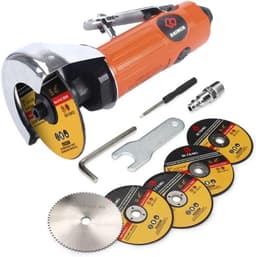
Air motors need oil in the way their maker specifies. Some US manuals say four or five drops of air-tool oil. That quantity was not measured on the ABAC, the ORAZIO or the NuoDunco, so this page will not prescribe a drop count. If the tool has an in-line lubricator, keep it filled with the oil the sheet names. If the sheet says to oil the inlet, do that with the airline off, then wipe the excess so it does not fling onto the disc. The disc comes next, still with the hose disconnected. Read the maximum speed marked on the wheel and the restrictions of use. BS EN 12413 is the buyer-facing point here: the wheel is marked with a maximum speed, and organic hand-held wheels carry a three-year use-by. The marked speed has to sit at or above the spindle. On these captures the ABAC description states 10,000 rpm, the ORAZIO states 11,000 rpm, and the NuoDunco states 20,000 rpm. A disc that was fine on a slower grinder can be over the line on the cut-off. Reject a wheel that has been dropped, cracked or stored past its use-by. Fit the guard and the side handle where the tool has them, with the airline off. Kobe's operator's manual says the disc cover stays on and that you adjust the guard only when the airline is disconnected. If the tool you received has no guard, do not run it open because a lever is present. The NuoDunco box includes an HSS saw blade. That line is not a licence to fit every blade that will mount.

Run it, then stop it

Connect the hose only after the wheel, the guard and the handle are on. Set the regulator at or below the maximum for that model, then run the spindle unloaded for a few seconds. The first trigger is a check that the wheel runs true and that nothing is loose. It is not the moment you offer the disc to the metal. Keep both hands on the tool where a side handle is fitted. Do not carry it with a finger on the lever. Sealey's sheet makes that point because the lever is a dead-man's control only while your hand can actually leave it. Use a light feed. Forcing the disc loads the motor, heats the wheel and hides a shortage of air. When the cut is finished, release the lever and wait until the disc has stopped before you set the tool down. A wheel that is still spinning will walk across the bench. Then disconnect the hose to store the tool. Leaving it coupled means the next knock can start it. The wattage fields, 800 W on the ABAC and 1,200 W on the NuoDunco, are not a mains input and they do not tell you how hard to push. If the tool feels down on power, Kobe's manual points at the compressor, moisture or a restriction in the hose. Whether air was the right power source is the air angle grinder vs electric question.

When you stop and get help

Some faults are not a home adjustment. Stop and get a competent person if a wheel has burst, the guard is cracked, or the spindle runs on after you release the lever. A governor that has stuck is an overspeed risk, and HSE guidance treats governor service as work for someone who is competent to do it. Stop as well if water has been through the vane motor. Drying the outside does not put the vanes back. If you employ people, the Provision and Use of Work Equipment Regulations 1998 require that work equipment is suitable and that users are trained. A householder using their own tool in their own garage is not an employer. An employee who has had no abrasive-wheel instruction should not be handed the grinder and told to read this page instead. Northern Ireland has its own health and safety texts. UK action values are often discussed at 80, 85 and 87 dB(A). In this set only the ABAC states a noise figure, 89.5 dB(A) from the maker's description, not from a test we ran. If you are near that tool for long, hearing protection is the sensible default. The other two listings leave noise blank, which is not the same as quiet.

Common questions

Do you oil an air angle grinder before every use?
Oil it the way the maker's sheet specifies, which may be an in-line lubricator or oil at the inlet before you connect the hose. HSE guidance expects clean, lubricated air where a governor is fitted, because poor lubrication is one cause of governor defects. A drop count printed in a US manual for a different brand is not a measured dose for the ABAC, the ORAZIO or the NuoDunco. If your sheet is silent, ask the maker rather than guessing a number of drops.
What pressure should you set?
Stay at or below the maximum marked for the tool you are holding. The ABAC G-202 manual caps clean regulated air at 6.3 bar for that model. Sealey's SA152.V2 sheet uses a 70-90 psi band and says not to exceed 90 psi, which is about 6.2 bar, on that model only. The ORAZIO and NuoDunco listings do not state a pressure, so you do not copy either cap across. Read the pressure as close to the tool as you can, under load, not only on the tank gauge.
When do you disconnect the hose?
Disconnect it before you change or adjust a disc, a guard or a side handle, and disconnect it again when you store the tool. Kobe's manual limits guard adjustment to a disconnected airline, and Sealey's sheet says the same about accessories. The wheel should be fitted, and the guard on, before the coupler clicks. Leaving the hose coupled while you reach for a spanner is how an accidental start happens.
How do you know the disc is allowed on that spindle?
The maximum speed marked on the wheel has to be at least the free speed of that tool, and the wheel must be within its use-by. Organic hand-held wheels under BS EN 12413 carry a three-year use-by. On these listings the spindles differ: 10,000 rpm on the ABAC description, 11,000 rpm on the ORAZIO, and 20,000 rpm on the NuoDunco. A disc bought for the slower head can be too slow for the cut-off. Do not fit a wheel that is dropped, damaged or unmarked.
Can you run it without the guard or the side handle?
No. Where the tool is supplied with a guard and a side handle, both stay on for the way you hold it. Kobe's manual says the disc cover is not removed. The ORAZIO states a side handle and a safety lever and does not state a guard. If the tool in your hand has no guard, wait rather than running the wheel open. The NuoDunco states an adjustable guard. Adjust it with the airline off, and do not treat the included HSS blade as permission to fit any blade that mounts.
How do you stop it safely?
Release the lever, keep the tool in both hands where a handle is fitted, and wait until the disc has stopped before you put it down. Do not carry the grinder with a finger resting on the lever. Then disconnect the hose for storage. A wheel that is still spinning will walk if you set it on the bench. The lever only stops the air. It does not stop the disc at the same instant.
What if it keeps spinning or surges?
Stop using it. A spindle that runs on after the lever is released, or a tool that surges, can be a governor or a vane fault, and HSE guidance treats governor failure as a cause of wheel breakage. Water, grit and poor lubrication are named reasons governors fail. Loss of power can also be the compressor, moisture or a restriction in the hose. Governor and vane service is for a competent person. Drying the casing is not that service.

Related pages

Sources

Public UK sources from the research digest, used for this page in October 2026. Prices, stars and review counts are from the three amazon.co.uk listings in that digest. Noise and vibration duties apply at work. They are not a certificate for a domestic compressor. Air consumption, noise and vibration are stated only where the ABAC maker line gives them.

  1. HSE, PUWER overview (retrieved October 2026)
  2. HSE, HSG17 abrasive wheels (retrieved October 2026)
  3. ISO 11148-7:2012 (retrieved October 2026)
  4. Control of Noise at Work Regulations 2005 (retrieved October 2026)
  5. HSE, hand-arm vibration duties (retrieved October 2026)
  6. Atlas Copco, air-tool installation pocket guide (retrieved October 2026)
  7. ABAC G-202, part 2809913206 (retrieved October 2026)
  8. Toolstation, angle grinder buying guide (retrieved October 2026)