Independent comparisons. We may earn from shop links. More info

Air angle grinder cfm

Updated: 22 October 2026

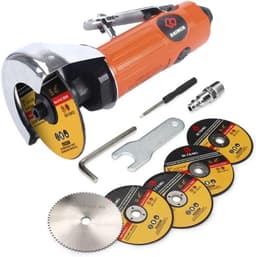
The compressor in the garage already runs a nailer or a tyre inflator, and you want to know whether the same machine will keep an air angle grinder at pressure. Air angle grinder cfm is the free air the tool uses while it is cutting, not the litre badge on the tank. UK charts disagree by a wide margin, from a few cfm on a named model to a class band of 18-25 cfm for a 4 inch grinder. This page sizes the supply to the figure printed on the tool, at about 6.3 bar at the inlet. The [air angle grinder comparison](/hub/tools/air-angle-grinder) lists the three captured tools. Only one of them states a consumption. Peter F. updated this on 22 October 2026 from those amazon.co.uk listings, the ABAC shop page and public UK and manufacturer guidance. We did not measure a compressor in a lab. A qualifying purchase can earn us a commission at no extra cost to you.

The compressor in the garage already runs a nailer or a tyre inflator, and you want to know whether the same machine will keep an air angle grinder at pressure.

Our top picks

On this page

Pressure at the tool, not the tank badge

Atlas Copco's installation guidance treats about 6.3 bar at the tool inlet as the design point for a pneumatic tool. That is the pressure in the hose where it meets the grinder, not the number painted on the tank and not the peak the gauge shows with the trigger closed. A long or narrow hose, a leaking coupler or a regulator set for a different tool can drop a bar before the air arrives. Atlas Copco's same guidance puts the cost of about a 1 bar drop at roughly 25-30 percent of productivity. The disc still turns. It just works less hard, and you lean on it to make up the difference. This page will not quote an unmeasured loss for a 10 metre hose, because that figure depends on the bore, the fittings and how tired the couplings are. Read the gauge at the tool, or as close to it as the set-up allows, while the grinder is under load. A healthy gauge at the compressor, with the tool sitting idle, flatters the supply. The ABAC G-202 shop page states a working band of 4-6.3 bar. The top of that band is a maximum for that model. The other two captures do not state a pressure, so 6.3 bar is not their setting until a maker sheet says so. Disc fitting, with the hose off, stays on the how to use an air angle grinder page.

The only consumption figure in this set

The ABAC shop page for part 2809913206 states 2.5 litres per second. That is 150 litres per minute. One cfm is about 28.3 litres per minute, so 150 litres per minute is about 5.3 cfm. Both numbers describe the same maker figure. They are not two different requirements, and they are not a site measurement. The amazon description matches that 150 litres per minute and a maximum of 6.3 bar. The tool is listed at £62.99 as a 125 mm head at 10,000 rpm. You can treat that 5.3 cfm as the air the G-202 is stated to use, if your delivery holds the pressure at the inlet while you grind. You should not multiply 5.3 by 1.2 and then call the result ABAC's requirement. A margin is a sizing idea from elsewhere. You should also not read the 800 W listing field as electrical power or as a compressor size. One amazon review says the air use is too high for a household compressor. That is a review, not a lab test. It is enough to stop this page claiming that a small oil-free DIY compressor will run the G-202. It is not enough to name a replacement tank. Free air delivery is what the pump can keep supplying. A larger tank delays the sag. It does not replace the pump.

Why the cfm charts do not match

UK pages often fold three different ideas into one number: the air a named tool uses, an average for a whole class, and the compressor someone thinks you should buy. Algar Air's consumption guide, written as averages with a liability note, says a 4 inch angle grinder needs 18-25 cfm at 70-90 psi, and a 7 inch needs 25-35 cfm. That band sits far above the ABAC's stated 5.3 cfm. It is a conflicting rule of thumb for a class, not a correction of the G-202. Air Supply's compressor guide suggests the compressor's cfm should be at least the tool's scfm times 1.2, and it says most angle grinders need a minimum of 7.2 cfm without naming a model. Do not paste 7.2 cfm onto a tool that already states 150 litres per minute, and do not paste it onto a listing that states nothing. A Mighty Seven manual for the QB-114 and QB-115, which are 4 inch and 5 inch lever grinders and not tools in this snapshot, states an average of 6.0 cfm at 90 psi (6.3 bar) and a 3/8 inch hose. That sits next to the ABAC figure, not next to 18-25 cfm. US PRO 8425, on amazon.co.uk at about £37.09, states 6 cfm. That is context for a different 125 mm listing, not a number to hang on the ORAZIO or the NuoDunco. If a chart and a maker plate disagree, the plate on the tool you are buying wins.

What to do when the listing is blank

The ORAZIO at £27.99 and the NuoDunco at £29.99 do not state air consumption. The ORAZIO is a 100 mm head at 11,000 rpm. The NuoDunco is a 3 inch cut-off at 20,000 rpm. Neither blank becomes 5.3 cfm because the ABAC is in the same comparison, and neither becomes 18 cfm because a class chart said so. A blank means you cannot tell whether your compressor will hold 6.3 bar at the tool. The practical choices are to wait, to ask the maker for the figure at a stated pressure, or to buy a tool whose listing already prints litres per minute or cfm at a stated bar. You can run the ABAC on the compressor you own only if free air delivery holds about 6.3 bar at the inlet under load, around that stated 150 litres per minute. If the gauge sags as soon as you dress a weld, the air tool is the wrong match for that compressor. A small oil-free unit that is happy inflating tyres is the case the review was warning about. If you do not yet have an airline that can do this, a mains or cordless grinder is the simpler power source, which is the air angle grinder vs electric choice.

Common questions

How many cfm does an air angle grinder need?
Use the figure on the tool, at the pressure the maker states. In this set only the ABAC G-202 publishes one: 2.5 litres per second, which is 150 litres per minute or about 5.3 cfm, at a maximum of 6.3 bar. The ORAZIO and the NuoDunco leave consumption blank. A class chart that says 18-25 cfm for a 4 inch grinder is an average for other tools, not a measurement of these three. If the listing is blank, do not borrow a number.
Is 150 litres per minute the same as about 5.3 cfm?
Yes. The ABAC shop page states 2.5 litres per second, which is 150 litres per minute. One cfm is about 28.3 litres per minute, so 150 litres per minute is about 5.3 cfm. Quote both if you are comparing a UK compressor plate in litres with a tool plate in cfm. Do not treat 5.3 and 150 as two different demands, and do not multiply 5.3 by 1.2 and call the product ABAC's requirement.
Why do some UK charts say 18-25 cfm for a 4 inch grinder?
Algar Air presents 18-25 cfm at 70-90 psi as an average for a 4 inch angle grinder, with a liability note, and a higher band for a 7 inch. That is a class range. It is not the ABAC's stated 5.3 cfm, and it is not a figure you can attach to a listing that prints nothing. Air Supply's 7.2 cfm line is the same kind of unnamed minimum. Compare cfm only when both numbers are taken at a stated pressure.
Does a bigger tank replace free air delivery?
No. Tank litres are a buffer. They let you make a short burst after the pump has filled the receiver. An angle grinder that you hold on a weld uses air the whole time, so the pump's free air delivery is what has to keep up. A tank that is fine for a nailer can sag under continuous grinding. This page does not recommend a litre size, because the missing number is delivery at about 6.3 bar, not the badge on the tank.
What if the amazon listing has no air-consumption figure?
Leave it blank. The ORAZIO and the NuoDunco do not state consumption, noise or, on the ORAZIO, a guard. Do not copy the ABAC's 5.3 cfm across, and do not fill the gap from a 4 inch class chart. Ask the maker for consumption at a stated pressure, or choose a tool that already prints it. A blank is a reason to wait, not a reason to guess.
Is 6.3 bar the pressure at the compressor gauge or at the tool?
Atlas Copco's design point is about 6.3 bar at the tool inlet. The compressor gauge, read with the trigger closed, can look healthy while the tool is starved once you grind. Hose bore, leaks and a regulator set for another tool are the usual reasons. The ABAC working band is 4-6.3 bar, and 6.3 bar is that model's maximum, not a setting to exceed. Do not apply that cap to a tool whose listing omits pressure.
Will a small oil-free DIY compressor run the ABAC G-202?
This page will not claim that it will. One amazon review says the air use is too high for a household compressor. That is a review, not a measured test of every oil-free unit in the UK. The stated need is about 5.3 cfm with pressure held near 6.3 bar at the inlet while you work. If your pump cannot hold that, the grinder is the wrong match. A larger tank alone does not fix a pump that is already behind.

Related pages

Sources

Public UK sources from the research digest, used for this page in October 2026. Prices, stars and review counts are from the three amazon.co.uk listings in that digest. Noise and vibration duties apply at work. They are not a certificate for a domestic compressor. Air consumption, noise and vibration are stated only where the ABAC maker line gives them.

  1. HSE, PUWER overview (retrieved October 2026)
  2. HSE, HSG17 abrasive wheels (retrieved October 2026)
  3. ISO 11148-7:2012 (retrieved October 2026)
  4. Control of Noise at Work Regulations 2005 (retrieved October 2026)
  5. HSE, hand-arm vibration duties (retrieved October 2026)
  6. Atlas Copco, air-tool installation pocket guide (retrieved October 2026)
  7. ABAC G-202, part 2809913206 (retrieved October 2026)
  8. Toolstation, angle grinder buying guide (retrieved October 2026)