Independent comparisons. We may earn from shop links. More info

Plastic tool shed buying guide

Updated: October 2026

You may be looking at an 800 litre box because the mower, spades and bins need somewhere dry. This plastic tool shed buying guide explains what the numbers mean, which contradictions deserve caution and when location rules need checking. Start with the [plastic tool shed comparison](/hub/tool-accessories/tool-shed-plastic), then use your measurements to rule products in or out. These are waist-high outdoor stores rather than walk-in workshops. Captured prices in this set ran from about £109.98 to about £147.37, and Amazon prices move. A qualifying purchase can earn a commission at no extra cost to you.

You may be looking at an 800 litre box because the mower, spades and bins need somewhere dry.

Our top picks

On this page

What counts as a plastic tool shed

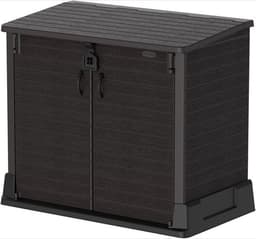
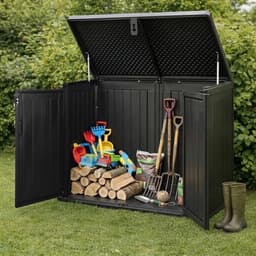
These products have a rigid resin or polypropylene floor, walls, doors and lid. They stand roughly 110–140 cm wide, 70–75 cm deep and 110–114 cm high, with claimed capacities from 775 to 880 litres. They suit bins, hand tools and perhaps a compact mower, but are not equivalent to an 8 × 6 ft walk-in shed. A fabric bicycle tent, tarpaulin cover or indoor utility cupboard may contain the word shed, but it will behave differently in wind, rain and daily use. Rejecting those alternatives early gives you a meaningful comparison.

What to measure before you trust the litres

Measure the widest, deepest and tallest object you plan to put inside, including handles, wheels and a closed lid. Then compare those figures with internal dimensions, not the footprint printed in the title. The Keter Store It Out Nova, for example, is 71.5 cm deep outside but 61 cm deep inside. That internal depth may suit a typical 120 litre bin around 55 cm deep, but it is too short for a 240 litre council bin around 73–74 cm deep and for most adult bicycles lengthways. Litres tell you total volume; they do not tell you whether a particular shape passes through the doors or clears the lid. Listing conflicts should stop the purchase until you can resolve them. One Olsen & Smith page prints 116 × 71 × 112.5 cm in the bullets and 70.9 × 115.8 × 109 cm in the dimensions table. For bin-specific measurements, see the plastic wheelie bin store guide.
Keter Keter Store It Out Nova

Testsieger

Keter Keter Store It Out Nova
9.2/10about £137.99

Claims that disagree with themselves

Lockable normally means there is a point where you can fit a padlock; it does not automatically mean a lock is supplied. The Nova is described as lockable, while a padlock is not listed in the box. Olsen’s bullets claim a four-digit combination padlock, but one UK review reports that it was missing. Water wording needs the same discipline. One Olsen listing says waterproof in its bullets and water resistant in an attribute, while UK reviews report rain entering. The Duramax makes a drain claim, yet reviewers describe water collecting in the rear channel. No product here carries a stated IP rating, so none should be treated as a sealed dry cabinet. The best plastic tool shed guide explains why the Nova is the conditional top pick and when a cheaper Olsen can still be rational. Do not store petrol or gas cylinders inside, and regard a small padlock as a deterrent rather than high security.

England and Scotland in one page

These stores are only about 1.1 m high and under 1 m² in floor area. In England, the usual householder Class E limits include placing an outbuilding behind the principal elevation, keeping it single storey and limiting the whole building to 2.5 m high when it stands within 2 m of a boundary. Outbuildings and additions must not cover more than half the curtilage around the original house. Scotland does not simply copy England’s 2 m boundary figure. Scottish guidance describes a 1 m boundary zone with a 2.5 m height limit. Wales and Northern Ireland have their own planning systems. A low plastic box will often fit the height limits, but that does not override restrictions for listed buildings, conservation areas or a position in front of the house. Prepare a flat base that supports the whole floor. The plastic storage box assembly guide covers levelling and anchoring without assuming that ground stakes are supplied.

Common questions

Should I buy on litres or centimetres?
Use internal centimetres for the actual buying decision. Litres compare total volume, but they do not reveal door width, usable depth or clearance beneath the lid. Measure your largest item in three directions, then allow room for getting it through the opening. Treat a litre figure as a secondary comparison once the fit has been established.
Does two bins mean two council bins?
No. Keter and Duramax name two 120 litre bins, while Olsen names two 180 litre slimline bins. Many councils issue 240 litre bins, which are commonly much deeper. Measure your own bin because manufacturers vary, and do not assume that two bins means every UK wheelie-bin format.
Is a waterproof claim enough?
Not in this comparison. One listing contradicts its waterproof bullet with a water-resistant attribute, and reviews mention rain ingress or water in channels. Without an IP rating or a specific tested claim, plan for weather resistance rather than a sealed environment. Put moisture-sensitive equipment in an additional closed container.
Does lockable mean a padlock is included?
No. Lockable can describe only a hasp or fastening point. Check the included-components line and current bullets. Olsen claims a combination padlock, while the Nova does not list one as supplied. Even when a lock arrives, these light plastic panels are not a substitute for secure tool storage.
Do I need planning permission in England?
A box of this size will often fall within householder permitted-development limits, but permission is not guaranteed. Position, listed status, the amount of curtilage already covered and local restrictions matter. The rights apply to houses rather than flats. Check Planning Portal and your local planning authority if any circumstance is unclear.
Is the boundary rule the same in Scotland?
No. English guidance uses a 2 m boundary zone for the 2.5 m overall-height limit, while Scottish guidance refers to 1 m. Other conditions also differ. Use mygov.scot for the Scottish starting point rather than applying an English retailer’s summary to a Scottish property.

Related pages

Sources

Public UK sources for planning, bases, security, and consumer rights. amazon.co.uk listings used as captured, with a live check of the Keter Nova on 16 October 2026. Prices move.

  1. Planning Portal, outbuildings (retrieved 16 October 2026)
  2. GPDO 2015, Class E (retrieved 16 October 2026)
  3. GOV.UK, permitted development technical guidance (retrieved 16 October 2026)
  4. Planning Portal, greenhouses and sheds (retrieved 16 October 2026)
  5. mygov.scot, build a shed, garage or greenhouse (retrieved 16 October 2026)
  6. Which?, how to buy a shed (retrieved 16 October 2026)
  7. Consumer Rights Act 2015 (retrieved 16 October 2026)
  8. amazon.co.uk, Keter Store It Out Nova listing (retrieved 16 October 2026)