Disc cutter kickback: why the saw throws back

Disc cutter kickback throws the saw when the upper rim grabs. See the cut-off saw kickback zone, a pinched concrete cut, and when you should stop the cut.
On this page

You are halfway through a concrete kerb, the engine note drops, and the saw climbs toward your shoulder before you have moved your feet. That throw is disc cutter kickback. Hilti’s UK operator manual puts the working rule in one place: cut only below the spindle axis, match the arrow to the rotation, and treat a stall in the kerf as a pull or a kick. A diamond rim follows the same rule. A fresh segment still grabs if the slot closes or the upper quarter of the wheel touches the work.
The geometry is Hilti’s UK cut-off saw manual. Twisting, cutting between two supports, and a wobbling blade follow the FEPA leaflet for diamond blades on petrol saws. Bore and run-true checks follow the oSa mounting sheet. Damaged arbors and missing segments follow HAE Bulletin 47. Peter F. did not run a lab trial. A qualifying purchase through our links can earn a commission at no extra cost to you.
In short
Disc cutter kickback throws the saw when the rim stalls or the upper blade grabs. Keep the work below the spindle axis, keep the kerf open, and match the direction arrow. A guard, water, or a diamond segment leaves that zone where it is, and a wobbling blade, a missing segment, or a damaged arbor means the cut is finished.
What disc cutter kickback feels like
The first sign is often the engine. The blade meets a closing slot, a twist, or the upper rim on the face of the kerb, and the revs fall. Then the machine yaws. On a hand-held petrol saw the reaction runs up the arms, because the rim is climbing out of the work and taking the saw with it. Hilti’s UK manual names that stall as a pull or a kick.
A labouring engine with the lower arc still in a straight, open slot is a warning you can sometimes leave by lifting the rim out along the cut. Kickback means that opening has gone. A saw carrying a 350 mm blade will not give you a slow push to steer, and a harder grip will not unwind the rotation. If the saw has already moved you, end the pass. Going back into the same closed slot repeats the bind.
You may feel a pull deeper into the cut, or a kick back toward your body. Both start from the stall, and which one arrives depends on where the rim is bound. Leaning on the handles to force the blade through answers neither.
The cut-off saw kickback zone
Picture the blade as a circle with the spindle at the centre, and a horizontal line through that centre. Hilti’s UK manual tells you to cut only on the half below the line. The half above it is the upper quadrant of a diamond blade.
The front of that half, where the segments move up and back toward you, is the cut-off saw kickback zone. If those segments bite, the wheel climbs and the saw follows. The lower arc is the part the manual expects in the work.
On a 350 mm blade that upper arc is large enough to drop onto a kerb if you roll your wrists or let the saw ride up. The usual mistake is finishing by rolling over the top, so the rim above the spindle becomes the contact. Let the lower arc enter, stay, and leave. Keep the top of the wheel clear for the whole cut.
The guard sits over that upper rim. Set it as the manual shows. Swinging it back until the upper quarter is bare removes the cover. A wet upper quadrant still kicks if it touches. If the work sits so high that you cannot keep it below the spindle, the hand-held saw is the wrong machine for that face.
A pinched cut and a twisted blade
A pinched cut in concrete is a slot that will not stay open. The offcut sags, the kerb rocks, or a pipe on two stands drops as the wall separates, and the faces of the kerf meet on the rim. The blade stalls. Hilti’s UK manual says that stall pulls or kicks the saw.
FEPA’s leaflet for diamond blades on petrol saws forbids cutting between two supports. The offcut needs something under it so it cannot hinge shut on the blade. A second person can be that support, or a block that takes the weight before the kerf closes. One cut through a pipe on two stands is the job to refuse.
The same leaflet tells you not to twist the blade. Operators twist when a cut slows, steering the rear handle to free the rim. The plate then rubs the side of the slot, the blade stalls, and you are back to a pull or a kick. Come out in the line you went in. If the line was wrong, start a new slot.
A heavy kerb makes a pinch more likely because the offcut drops into a narrow slot. These sources give no measured force for that, and they do not call a diamond blade gentler than an abrasive wheel. If the slot is closing and you cannot hold it open, stop. Extra feed from the shoulders turns the warning into the throw.
Blade faults that make a bind worse
A sound blade still kicks if you cut in the upper zone or let the kerf close. The diamond blade direction arrow has to match the saw. Hilti’s UK manual treats a mismatch as a fitting failure. Backwards segments scrub and grab. Refit the blade before you continue the cut.
The bore stays as it was made. The oSa mounting sheet says not to alter it. Packing a loose bore with a washer the maker did not specify lets the rim rub the kerf. Bore and diameter are on the saw-fit guide.
The top pick in our 350 mm diamond blade comparison is the PRODIAMANT 350 mm, 20 mm bore, about £54.78, for a saw that takes 20 mm. The listing names concrete and masonry and states wet or dry cutting. The 4.3 stars from 1,078 ratings are shared with the 25.4 mm variant, so they do not describe this bore in a bind. Run the blade clear of the ground and look. oSa asks you to check that it is true. FEPA says stop if it wobbles.
HAE Bulletin 47 names a damaged arbor and missing segments as reject conditions. Fitting order is on the how-to-use page, and the checks before you buy are on the buying guide. A true blade with a matched arrow still kicks if the upper quadrant enters the work.
When you put the saw down
Stop when the rim is no longer one flat wheel. Wobble on the run-up, a missing segment, or a damaged arbor are stop points in the FEPA leaflet and HAE Bulletin 47. Stop when the setup is wrong: the arrow faces the wrong way, the bore has been altered, or the only line you can reach sits above the spindle. Stop when the material moves, whether that is a kerb that rocks, a slab that settles into the slot, or a pipe that will drop as it parts.
A pass you can live with is plain. Fit the blade to the arrow, run it clear of the ground, then approach the line. The lower arc enters an open slot. Feed is the weight of the saw and a steady engine. If the note falls, ease out while the kerf is open. Support the offcut so it cannot hinge shut, and leave the guard over the upper rim.
Leave the job when you cannot keep the work below the spindle, you cannot support the offcut, the blade has already kicked in that slot, or the rim fails those reject checks. This page does not treat a named certificate as a legal requirement, and it does not set out an employer’s training duty. If the method has to change, get someone who can change it.
Common questions
What is disc cutter kickback?
Which part of the blade causes kickback?
Why does a closing cut grab the blade?
Does a diamond blade kick less than an abrasive wheel?
What if the diamond blade direction arrow points the wrong way?
Can I cut a pipe in one pass with a petrol saw?
Does the guard stop kickback?
When should I stop and get help?

Peter F. is the editor for DIY & tools at productscompared.co.uk. Comparisons in this category are checked against amazon.co.uk listings, review evidence and public UK sources.
Related articles

When a diamond blade is finished
A missing segment or a damaged arbor is a reject. Dressing will not put that metal back.
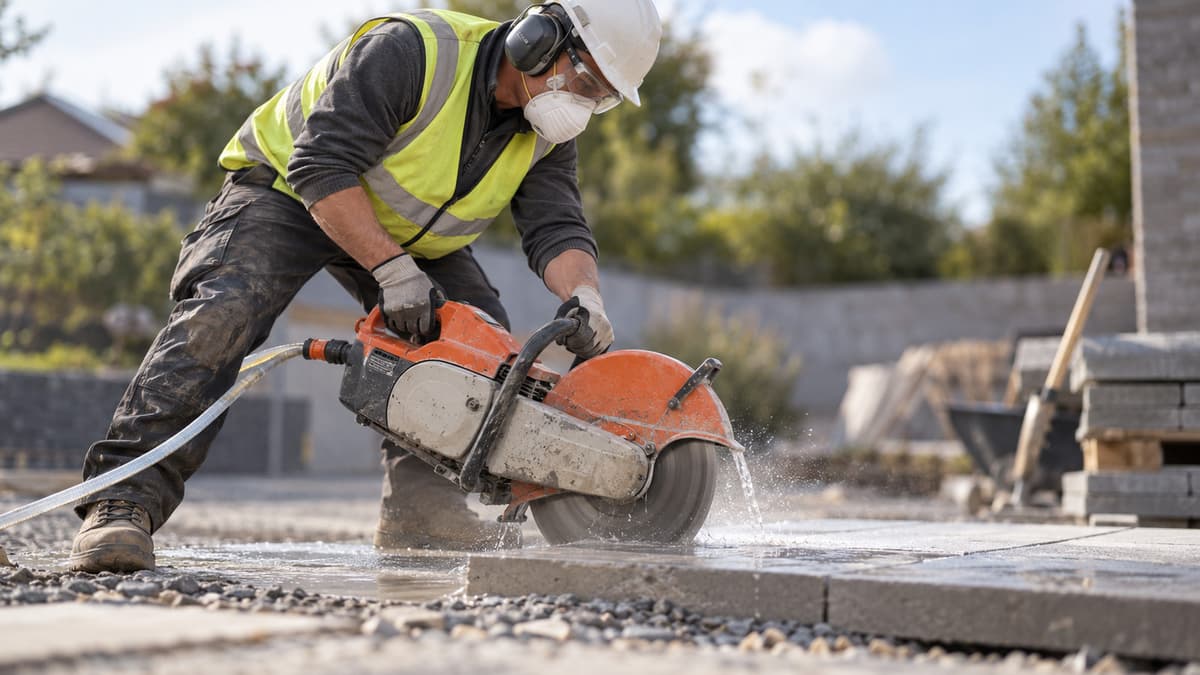
Wet cutting with a petrol disc cutter
Water cools the rim and holds dust down. A wet kerf can still close and grab the blade.

What EN 13236 means on a diamond blade
The mark is a safety standard for the wheel. It is not a claim that the blade cannot kick.