Independent comparisons. We may earn from shop links. More info

How to set a thermostat plug

Updated: October 2026

The plug is already in the socket, the heater is in the front, and the two numbers on the screen are easy to swap. Get them the wrong way round and a greenhouse heater sits off all night, or a cooler never starts. This is how to set a thermostat plug: choose heating or cooling with the start and stop figures, leave a gap so the relay does not chatter, and make sure you are not in a timer mode that ignores the probe. It is not a ranking of the twelve models. Those sit on the [thermostat plug socket comparison](/hub/thermostats/thermostat-socket). Frost targets for a greenhouse, and any animal’s temperature, stay off this page. The figures below are worked examples so the rule is visible. Listings were compared in October 2026. We did not run a lab test. A qualifying purchase through our links can earn a commission at no extra cost to you.

The plug is already in the socket, the heater is in the front, and the two numbers on the screen are easy to swap. Get them the wrong way round and a greenhouse heater sits off all night, or a cooler never starts.

Our top picks

On this page

Start, stop, and which way is heating

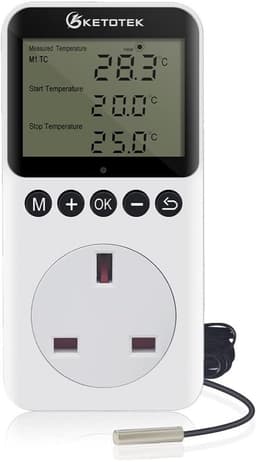
On the single-outlet plugs in this set, the two setpoints are the whole mode switch. If the start temperature is lower than the stop temperature, the socket is set to heat. The relay closes when the probe is cold and opens when the probe reaches the upper figure. If start is higher than stop, the socket is set to cool. A generic RUN and STOP sheet used by many of these white plugs says the same thing: heating if RUN is below STOP, cooling if RUN is above STOP, often after a long press of SET. Button labels differ. Do not copy a wall-thermostat sequence onto these plugs. Here is a heating example, not a target for your shed. Start 18 °C and stop 21 °C. The heater may come on when the probe is below 18 °C and go off when the probe reaches 21 °C, depending on how that model names the pair. A cooling example is the same pair reversed: start 8 °C and stop 5 °C. If your heater is on while the room is already warm, swap the two numbers before you blame the probe. One front socket still means one appliance. The KETOTEK KT99pro is the exception with two relays, and its cooling delay of 0 to 5 minutes is there for a compressor that should not restart instantly. That delay is not a heat-mat setting.

The gap between on and off

If start and stop are almost the same number, the relay can click every time a draught moves the probe by a fraction of a degree. That chatter is hard on the contacts and annoying at night. The gap is the hysteresis. On the KT3200PRO, reviewers describe a settable gap of about 1.5 °C, and that is a sensible illustration for air in a shed. It is a review note, not a rule for every animal or every fridge. The KT2000 lists the gap as 0.1 °C to 30 °C, plus calibration from −10.0 °C to +10.0 °C. The 0.1 °C end of that range is how you get chatter. The 30 °C end is how you get a heater that stays off until the probe has fallen a very long way. Pick a gap you can live with, then watch one full cycle. The raw bullets for the KT2000 do not state amps. If your heater is a fan motor rather than a resistive tube, the inductive figure is the one that binds. The Inkbird ITC-C216T and the KT3100 do not offer a day and night gap. They offer one pair, and a separate timer that you should not confuse with hysteresis. A wider gap saves a little switching. It does not replace choosing the right load, which is the subject of the buying guide.

Timer modes that drop the probe

This is the mistake that looks like a broken thermostat. You press MODE until the screen shows F01, F02, F03, or F04, or the Inkbird’s timing function, and the heater now follows the clock. The probe can still display a temperature. It is no longer deciding. On the KT3100 the bullets say the temperature function and the F01 to F04 timer cannot be used at the same time. The ITC-C216T listing says the same about temperature mode and the timing function. A later Inkbird, the C236T, can combine a timer with temperature. That manual does not apply to the C216T in this set. A HIADA review says the same thing in plainer words: in timer mode the heater follows the clock only. Day and night temperature is not F01. On the KT3200PRO, M2 is the mode with two temperature periods. M3 on that plug is timer only. The KT3500 uses M2 for schedule plus temperature and M3 for timer only. If the heater is on at a time of day you set, and it ignores a probe you have warmed in your hand, you are in a timer. Warm the probe gently, not on the element. Several plugs keep the settings. The KT3500 bullets say the clock may need a reset if power has been out for more than two weeks, even when the setpoints were stored.

Check the reading, then leave it

Before you walk away, prove one full cycle against a second thermometer. Put that thermometer next to the probe, not on the heater and not in a patch of sun. Let the heater come on, note the temperature, and wait until the relay clicks off. Then let the space cool until it clicks on again. If the plug’s screen and the second thermometer disagree by more than a degree or two, use calibration where the listing actually offers it. The Manillefu states −9.9 °C to +9.9 °C. The KT2000 states −10.0 °C to +10.0 °C. The Nerissa bullets do not list calibration, and one UK reviewer could not adjust the reading, so they offset the setpoint instead. That workaround moves the target. It does not fix a probe that has failed. Some appliances will not restart when the relay closes again. A Manillefu review says the socket only suits kit that comes back on when mains power returns. Test that once, in the room, before a cold night. Stop and unplug if the body smells hot, the plastic softens, the relay will not open, or the heat keeps climbing after the stop figure. One KT3100BL review says a plug caught fire on a 1,000 W greenhouse heater after three weeks. That is a customer report, not a rate. A damaged wall socket, a boiler circuit, or an outbuilding that already overheats is an electrician’s job, not another press of SET. The best thermostat plug page is where the review counts live if this plug never completes a clean cycle.

Common questions

Which number is on and which is off for a heater?
For heating, the lower figure is where the heater may start and the higher figure is where it should stop. The example start 18 °C and stop 21 °C is only an illustration. If your screen uses RUN and STOP, heating is RUN below STOP. If the room is already warm and the heater is still on, the pair is probably reversed.
What gap should I leave so the relay does not chatter?
Wide enough that a small draught does not click the relay, and narrow enough for the room you are in. A KT3200PRO review describes about 1.5 °C. The KT2000 allows 0.1 °C to 30 °C, and 0.1 °C is the chatter end of that range. Watch one real cycle before you leave the building.
How do I know I am in timer mode by mistake?
The heater follows the clock, and warming the probe in your hand does not change the relay. F01 to F04 on the KT3100, the timing function on the ITC-C216T, M3 on the KT3200PRO, and timer mode on the HIADA all do this. Go back to temperature mode, or to M2 if you needed day and night, and enter the setpoints again.
How do I check calibration without a lab?
Use a second thermometer beside the probe for one full on-off cycle. If the listing gives a calibration range, adjust inside it: Manillefu −9.9 °C to +9.9 °C, KT2000 −10 °C to +10 °C. If the listing has no calibration, as the Nerissa bullets do not, you can only shift the setpoint, and you should not pretend that is a calibrated probe.
What if the heater does not come back on by itself?
Some heaters wait for a button on their own panel after power returns. A Manillefu review calls this out. The thermostat can close the relay and the heater still stays off. Test one cycle while you are there. If the appliance cannot restart unattended, this style of plug will not run it overnight.
When should I stop and unplug?
Unplug if you smell hot plastic, see melting, or the heater keeps climbing after the stop temperature. Do not finish the night to see if it settles. Call an electrician for a damaged socket, boiler wiring, or an outbuilding circuit that already runs hot. A thermostat plug does not make a radiant heater safe to leave, and Norfolk’s guidance says not to add an external thermostat to a radiant heater unless it is part of the heater.

Related pages

Sources

Public UK sources for BS 1363 plug-in gear, fuses, and portable-heater fire advice. Listings are the amazon.co.uk captures for these twelve ASINs, not a live reload on 17 October 2026. Prices on amazon.co.uk move.

  1. Electrical Equipment (Safety) Regulations 2016, regulation 35 (retrieved 17 October 2026)
  2. Plugs and Sockets etc. (Safety) Regulations 1994 (retrieved 17 October 2026)
  3. Electrical Safety First, plugs and fuses (retrieved 17 October 2026)
  4. Norfolk County Council, portable heaters (retrieved 17 October 2026)
  5. Hertfordshire portable heater safety (retrieved 17 October 2026)
  6. Bio Green Thermo2 (retrieved 17 October 2026)
  7. GHE Direct Root+ (retrieved 17 October 2026)
  8. amazon.co.uk, KETOTEK KT3100 (retrieved 17 October 2026)