Independent comparisons. We may earn from shop links. More info

Thermostat socket for a greenhouse heater

Updated: October 2026

A mild night in October still costs money if a plug-in timer runs a greenhouse heater from dusk until dawn. The air may never have dropped to the point where the plants needed heat, and the socket still switched for eight hours. A thermostat socket for a greenhouse heater changes that only when the probe is in the air or the soil you mean to control, and only when the supply is fit to leave an electric heater switching. It does not make a wet shed safe, and it is not a vivarium guide. Model ranks stay on the [thermostat plug socket comparison](/hub/thermostats/thermostat-socket). This page is why a clock is the wrong control, where the probe goes, and what the wall must look like before you walk back to the house. Listings were compared in October 2026. We did not run a lab test. A qualifying purchase through our links can earn a commission at no extra cost to you.

A mild night in October still costs money if a plug-in timer runs a greenhouse heater from dusk until dawn.

Our top picks

On this page

Why a timer is the wrong control

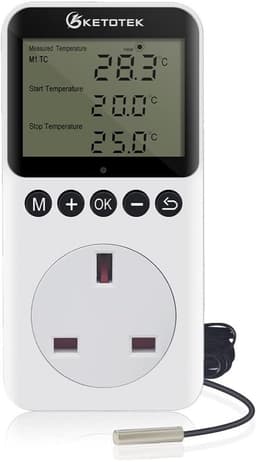
A segment timer, or F01 to F04 on many of these plugs, follows the clock. It does not know that tonight is milder than last Tuesday. On the KT3100 and the Inkbird ITC-C216T the timer cannot run at the same time as temperature control. If you leave the plug in that mode, the probe may still show a number while the heater ignores it. You then pay for heat on a mild night and, on a sudden frost, you may be off because the segment has ended. A thermostat closes the relay when the probe is cold and opens it when the probe reaches the stop figure. That advantage disappears the moment the probe is in the wrong place. One start-and-stop pair is enough if you only want a single threshold. Day and night setpoints are a different purchase. The KT3200PRO’s M2 mode holds two temperatures, at £22.99 and 4.4 from 65 reviews, if the day should sit warmer than the night. You do not get that by owning a KT3100 and hoping a timer mode will imitate it. How those buttons actually work is on the how to set a thermostat plug page. Frost is often talked about as a few degrees above freezing rather than a warm room. Treat any watt-per-glass table you find on a heater shop as that site’s rule of thumb, not as a measurement of your house.

Where to put the probe

Put the probe in free air, about halfway up the space you are heating, out of direct sun and out of a draught from the door. That placement comes from the Bio Green Thermo2 user guidance for an air sensor, and it transfers to these plugs because the probe must see the air the plants stand in, not the air in the plug’s own body. Do not copy a gas-heater manual that tells you to hang a sensor over a flame. There is no burner on an electric tube or an oil-filled radiator, and a probe strapped above a glowing element will switch the heater off while the rest of the house is still cold. Keep the probe off the heater itself and off the socket. A 3 m lead, as on the KT3100, is what lets you do that when the socket is by the door. The Nerissa’s 1.7 m lead can be enough if the socket is already on the wall you care about. It will not cross a 2.5 m house and still hang in free air. The HIADA’s 2.79 m figure is a control wire for a separate screen, not automatically a probe length. The KT3500 states both a 2.9 m panel lead and a 3 m probe, and this file has no reviews for it. Soil is the other place for a probe, and only when you are heating propagation rather than the air. Bio Green’s guidance says the sensor goes in the soil for that job, and the controller body must not get wet. A waterproof probe claim on a Vaileal or a KT2000 is not a waterproof plug. Sun on the probe is the daytime failure: the reading climbs, the heater stays off, and the shaded bench is colder than the screen suggests.

Socket, RCD, and heater type

A perfect setpoint still sits on a dangerous lead. Greenhouse Stores’ UK electricity guide treats a greenhouse as a wet location: sockets IP65 or better, a 30 mA RCD, and BS 7671 in the background. Extension leads are called unfit for a permanent run. Electrical Safety First makes the same point about reels: do not daisy-chain, and a coiled reel overheats. The pattern that fails is a heater, then this plug, then a reel left partly wound under the bench. A BS 1363 socket is 13 A. A 2 kW electric heater is about 8.7 A and can fit a reconciled 13 A thermostat if the heater is rated for external switching. A 3 kW heater is on the fuse with no headroom. Bullets that say 16 A or 3,680 W do not raise the socket. Norfolk’s portable-heater advice is to plug heaters straight into the wall, and not to control a radiant heater with an add-on thermostat unless that control is part of the heater. Hertfordshire’s guidance asks for about a metre of clearance from combustibles. Electrical Safety First notes that oil-filled radiators are the lower-risk portable if you do leave heat on, that overnight use is still not recommended, and that the plug in the heater must be a UK 3-pin. A new circuit to an outbuilding is an electrician’s job. Do not add a socket with a length of flex because the probe reach is short. The load sums, including resistive versus inductive, are on the buying guide.

What this comparison can and cannot promise

Reviewers in this file do use these plugs on greenhouse heaters. That includes Nerissa and Vaileal units, and a Manillefu review that describes a winter kept above freezing. Those are customer stories, not a frost-free guarantee, and the Vaileal page still writes both 10 A and 3,950 W, with a separate review of a unit that switched on and would not switch off. The KT3100, 4.4 from 508 at £19.99 with a 3 m probe and 13 A in the bullets, is the single-threshold plug with the largest record. The KT3100BL file includes a customer report of the plug catching fire on a 1,000 W greenhouse heater after three weeks. One report is not a rate. It is a reason not to leave that backlit sibling unattended, and a reason to unplug anything that smells hot. The Bio Green Thermo2, £89.99 on the manufacturer page, states up to 3,000 W and a 2.8 m sensor. It is not an ASIN in this twelve. None of these sockets promise a frost-free house. Glass area, leaks, and wind dominate the watts you need, and this desk did not measure your building. If the greenhouse job is one electric heater or a fan, stay with a single-outlet plug, a probe in free air or in propagation soil, and a socket you would trust with the heater plugged in directly.

Common questions

Where does the probe go if I am heating air?
Hang it in free air, around half the height of the space, out of sun and out of the door draught, and not on the heater. That follows the air-sensor guidance on the Bio Green Thermo2, applied here to a plug-in probe. A second thermometer in the shade tells you whether the screen is lying before you rely on a cold night.
Can I use a domestic oil radiator in the greenhouse?
Only if the radiator is suitable for that damp room, the maker allows it to be switched by an external control, and it plugs straight into a proper greenhouse socket. Oil-filled radiators are the lower-risk portable in Electrical Safety First’s heater advice if heat is left on, and overnight use is still discouraged. A radiant heater should not gain an add-on thermostat unless the control is part of the heater.
Is an extension lead acceptable?
Not as a permanent greenhouse supply, and not coiled under the bench. Greenhouse Stores calls extension leads unfit for a permanent run. A reel that is still wound heats up, and daisy-chaining is a separate Electrical Safety First warning. If the socket is too far from the plants, move the probe with a longer lead, or have a socket fitted. Do not lengthen the mains side with a reel.
Will a timer waste less electricity than a thermostat?
A timer wastes energy on mild nights because it cannot see the air, and it can miss a cold snap outside its segment. A thermostat wastes energy when the probe is in the sun, on the heater, or beside the socket, because it then controls the wrong air. Set the probe properly and the thermostat is the control that tracks the night you actually have. F01 mode is a timer, even if the word thermostat is on the box.
What size heater is a 13 A plug actually for?
Stay at or below 13 A, and inside the thermostat figure you trust. A 2 kW heater is about 8.7 A. A 3 kW heater consumes the fuse. Ignore 16 A and 3,680 W bullets. Electrical Safety First’s usual band for a 13 A fuse is roughly 700 W to 3,000 W, and a fan or a compressor may be limited much lower by an inductive rating.
Do I need an electrician for the greenhouse supply?
Yes, if you are adding a circuit, a consumer unit way, or a socket in a wet outbuilding. IP65 sockets, RCD protection, and BS 7671 are the backdrop Greenhouse Stores and the trade press describe for horticultural installations. An existing sound socket can take a plug-in thermostat. A warm, cracked, or tripping socket cannot.

Related pages

Sources

Public UK sources for BS 1363 plug-in gear, fuses, and portable-heater fire advice. Listings are the amazon.co.uk captures for these twelve ASINs, not a live reload on 17 October 2026. Prices on amazon.co.uk move.

  1. Electrical Equipment (Safety) Regulations 2016, regulation 35 (retrieved 17 October 2026)
  2. Plugs and Sockets etc. (Safety) Regulations 1994 (retrieved 17 October 2026)
  3. Electrical Safety First, plugs and fuses (retrieved 17 October 2026)
  4. Norfolk County Council, portable heaters (retrieved 17 October 2026)
  5. Hertfordshire portable heater safety (retrieved 17 October 2026)
  6. Bio Green Thermo2 (retrieved 17 October 2026)
  7. GHE Direct Root+ (retrieved 17 October 2026)
  8. amazon.co.uk, KETOTEK KT3100 (retrieved 17 October 2026)