Independent comparisons. We may earn from shop links. More info

How to fit a wireless dimmer switch UK

Updated: October 2026

You already have a mains plate or a wired receiver, and a shop guide has told you to drop the breaker and move the wires. That sequence never proves the tester, never mentions a borrowed neutral, and never mentions a bathroom zone. You should know which part is on 230 V, the order of the dead tests, and when to call a registered electrician. The listings stay on the [wireless dimmer comparison](/hub/swimming-pools/wireless-dimmer). The Products Compared editorial team set this order from public UK guidance on 16 October 2026. This is not a wiring diagram and not a lab install. A qualifying purchase can earn us a commission at no extra cost to you.

You already have a mains plate or a wired receiver, and a shop guide has told you to drop the breaker and move the wires.

Our top picks

SONOFF SONOFF Orb-DIM Matter

Best overall

SONOFF SONOFF Orb-DIM Matter
8.8/10about £25.63
On this page

What you are actually fitting

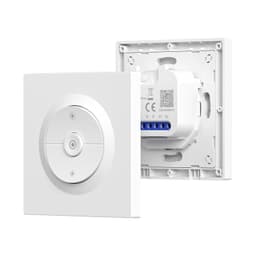
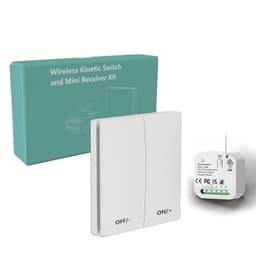
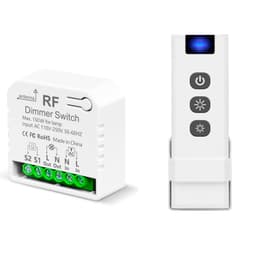
A SONOFF or BSEED plate replaces the switch and sits on the mains. A Tedeligo module is a small 433 MHz block, about 45 mm, with a separate remote, no Wi-Fi, and an IP00 mark. An ECO-NEWLEAF kit is a sticky kinetic pad plus a wired receiver. The pad does not isolate anything. The receiver is still a mains device. Another maker's sheet shows power off first, then live and neutral into that maker's receiver. It is not the ECO-NEWLEAF manual, and it is not a terminal map for this ASIN. UK reviews say the ECO-NEWLEAF receiver needs a neutral the bullets omit. SONOFF titles require a neutral. BSEED says the supply comes off before installation. Strip controllers are DC, after a driver, and they are not this job. They belong on the LED strip page.

Isolate, lock off, and prove dead

Switch the lighting breaker off, then treat that click as the start of the proof. NICEIC's note on safe isolation asks you to lock the isolator, prove the voltage tester, test line to earth, line to neutral, and neutral to earth, then prove the tester again. HSE guidance GS38 says a device used to prove dead can fail, so you prove it before and after, preferably on a proving unit. A volt pen is not that method. A lamp that stays dark is not that method either. The neutral stays a live conductor until those tests say otherwise, because a shared neutral can put voltage back on a circuit you believe is off. If you cannot lock the isolator or prove the tester, stop before the plate comes off. Do not bridge live and neutral to see what happens.
SONOFF SONOFF Orb-DIM Matter

Testsieger

SONOFF SONOFF Orb-DIM Matter
8.8/10about £25.63

Neutral, box depth, and pairing

SONOFF titles require a neutral. UK reviews of both Orbs describe a European plate and a deep box, not a flush fit on a standard metal pattress. One Matter reviewer used a 35 mm box. The Zigbee unit pairs with a press-and-hold on a button on the back, after the circuit is proved dead. A 10-second calibration hold on the Orb-DIM is not a reason to work live. The ECO-NEWLEAF bullets omit the neutral. The UK reviews do not. If there is no neutral at the receiver, do not invent one by joining conductors you cannot name. Two-way straps are the same stop. A wrong joint can leave a lamp live at the other switch. If you cannot see which wire is which, put the old switch back and call a registered electrician. This page does not draw Tedeligo's terminals. Pairing a Zigbee plate still needs a coordinator, and that step does not replace the dead test.

Bathrooms, Part P, and the point you stop

An IP65 bullet, or an IP66 line in the table, does not put a mains receiver inside a bathroom zone. One UK review of the ECO-NEWLEAF pad says it is not waterproof. The IET's note on plate switches puts a 230 V plate outside bathroom zones, at least 0.6 m from the bath or shower. Sticking the pad to a tile does not move the receiver. In England and Wales, Approved Document P treats a like-for-like replacement as often non-notifiable, and work in a bath or shower location, a new circuit, or the consumer unit as notifiable. The circuit still has to meet BS 7671. Scotland uses building standards. Northern Ireland has no Part P equivalent. Stop and call a registered electrician if the plate or receiver is in a bathroom zone, if two-way conductors are unclear, if the job is a new circuit, or if the breaker trips when you restore power.

Common questions

Is a volt pen enough?
No. GS38 treats the tester as something that can fail, and it wants the tester proved before and after the test, preferably on a proving unit. The tests themselves are line to earth, line to neutral, and neutral to earth. A pen that lights near a cable is a different tool, and retail guides that stop there leave the dangerous part unchecked.
Why does the neutral matter after the breaker is off?
Because a neutral can be shared with another circuit and can re-energise the one you think is dead. NICEIC says to treat the neutral as live until it is proved dead. On these products the practical point is earlier as well: SONOFF and BSEED state a neutral, and UK reviews say the ECO-NEWLEAF receiver needs one even when the bullets are silent.
Where does a kinetic receiver get wired?
At a mains position that can give it a live and a neutral, with the output going to the lamp, after the circuit is proved dead. The sticky pad only sends the 433 MHz press. Another maker's sheet shows that pattern for that maker's own controller. It is not a diagram of the ECO-NEWLEAF terminals, and it is not permission to guess the colours in your pattress.
Can I stick the pad in a bathroom because the listing says IP65?
No. The table on the same listing says IP66, and a UK review says the pad is not waterproof. The receiver is the mains part, and a 230 V plate belongs outside bathroom zones, at least 0.6 m from the bath or shower. A damp-room sentence in a bullet does not move that line.
Is a dimmer swap notifiable in England and Wales?
A like-for-like replacement away from a bath or shower is often non-notifiable, and it still has to comply with BS 7671. Work in a bath or shower location, a new circuit, or work in the consumer unit is the notification side of Approved Document P. Scotland and Northern Ireland are not Part P. Notification is not the same question as whether you can prove the circuit dead.
What if the old switch is two-way?
Stop. If you cannot tell switched live from a strap, leave the conductors as you found them and call a registered electrician. This page does not include a terminal diagram, because a guessed joint on a landing circuit is how a lamp stays live at the other switch. The same stop applies if restoring power trips the breaker.

Related pages

Sources

Public UK sources for electrical work, bathroom zones and connectable-product security. Listings are the amazon.co.uk captures for these nine ASINs on 16 October 2026, not a live reload. Prices on amazon.co.uk move.

  1. Approved Document P (2013) (retrieved 16 October 2026)
  2. GOV.UK: when you do not need building regulations approval (retrieved 16 October 2026)
  3. IET: BS 7671 frequently asked questions, plate switches and zones (retrieved 16 October 2026)
  4. Electrical Safety First: building regulations by nation (retrieved 16 October 2026)
  5. GOV.UK: product security and telecommunications infrastructure (retrieved 16 October 2026)
  6. NCSC: smart devices in the home (retrieved 16 October 2026)
  7. Efixx: dimming LED lamps (retrieved 16 October 2026)
  8. amazon.co.uk listings captured on 16 October 2026 (retrieved 16 October 2026)