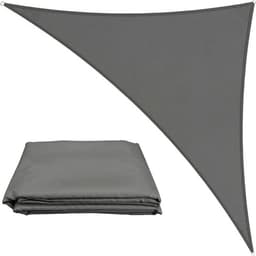
Right angle triangle shade sail
The patio meets the house on two walls, and you need to decide whether a right angle triangle shade sail will sit in that corner or whether equal sides are the honest shape. The title 3 × 4 × 5 m is a right angle only on paper. Curved edges stop a clean 90-degree fit against the brick. This page is from the Products Compared editorial team, updated on 16 October 2026. We compared the side lengths in the [triangle shade sail comparison](/hub/sun-shades/triangle-shade-sail). We did not survey your patio. A qualifying purchase can earn us a commission at no extra cost to you. Who rates which listing is on the [best triangle shade sail](/hub/sun-shades/triangle-shade-sail/sub/triangle-shade-sail-best) page.
The patio meets the house on two walls, and you need to decide whether a right angle triangle shade sail will sit in that corner or whether equal sides are the honest shape.
The patio meets the house on two walls, and you need to decide whether a right angle triangle shade sail will sit in that corner or whether equal sides are the honest shape. The title 3 × 4 × 5 m is a right angle only on paper. Curved edges stop a clean 90-degree fit against the brick. This page is from the Products Compared editorial team, updated on 16 October 2026. We compared the side lengths in the triangle shade sail comparison. We did not survey your patio. A qualifying purchase can earn us a commission at no extra cost to you. Who rates which listing is on the best triangle shade sail page.
Our top picks
| Badge | Product | Shape | Fabric | In the box | Note | Price | Offer |
|---|---|---|---|---|---|---|---|
| Best overall |  MissYolo MissYolo 3 x 3 x 4.3 m triangle | Scalene, longer third side | HDPE; gsm not stated | Parts list not stated; tensioners extra | 7.2 | about £11.90 | View offer |
| Alternative |  IOAOI IOAOI 3 x 4 x 5 m triangle | Right-angle 3 x 4 x 5 m | HDPE and polyester both printed | 3 ropes; brackets extra in reviews | 7.6 | about £29.99 | View offer |
 KAHEIGN KAHEIGN 3 x 3 x 3 m triangle | Equilateral 3 m | 180 gsm; HDPE and polyester both named | 4 ropes of 2 m; hooks extra | 8.0 | about £14.99 | View offer |


On this page
Start from the three spans you can actually use
Equal sides for a simple three-point span
A 3 × 4 × 5 m sail is a right angle until the edge curves
When a rectangle is the honest alternative
Common questions
Is a 3 × 4 × 5 m sail a right angle?
Will it fit a square corner of the house?
When is a 3 × 3 × 3 m sail the better shape?
What does a curved edge do to a right angle?
Which loaded sails are which shape?
Related pages
Sources
Public UK sources used for this comparison. Listing prices, stars and review counts are the amazon.co.uk figures saved in the comparison files, not a live re-check.
- NHS — sunscreen and sun safety (retrieved 16.10.2026)
- GOV.UK — ultraviolet radiation frequently asked questions (retrieved 16.10.2026)
- Class E, England — buildings incidental to a dwellinghouse (retrieved 16.10.2026)
- Greater Cambridge planning — external shading (retrieved 16.10.2026)
- Consumer Rights Act 2015, section 9 (retrieved 16.10.2026)
- CAP Code rule 3.7 — objective claims (retrieved 16.10.2026)
- Clara Shade Sails — installation guide (retrieved 16.10.2026)
- Shade Specialists — shade sail installation instruction (retrieved 16.10.2026)