How to install a triangle shade sail
How to install a triangle shade sail comes down to one low corner, cloth that can still be pulled, and anchors that will not bend. A flat hang holds a puddle. A fence panel is a weak place to learn that. This page is from the Products Compared editorial team, updated on 16 October 2026. We used the install lines on the amazon.co.uk listings in the [triangle shade sail comparison](/hub/sun-shades/triangle-shade-sail), plus public fitting notes from UK sail sellers. We did not install a sail on a house. A qualifying purchase can earn us a commission at no extra cost to you. If the spans are still a guess, use the [triangle shade sail buying guide](/hub/sun-shades/triangle-shade-sail/sub/triangle-shade-sail-buying-guide) before you mark the wall.
How to install a triangle shade sail comes down to one low corner, cloth that can still be pulled, and anchors that will not bend. A flat hang holds a puddle. A fence panel is a weak place to learn that.
How to install a triangle shade sail comes down to one low corner, cloth that can still be pulled, and anchors that will not bend. A flat hang holds a puddle. A fence panel is a weak place to learn that. This page is from the Products Compared editorial team, updated on 16 October 2026. We used the install lines on the amazon.co.uk listings in the triangle shade sail comparison, plus public fitting notes from UK sail sellers. We did not install a sail on a house. A qualifying purchase can earn us a commission at no extra cost to you. If the spans are still a guess, use the triangle shade sail buying guide before you mark the wall.
Our top picks
| Badge | Product | Suggested slope | In the box | Shape | Note | Price | Offer |
|---|---|---|---|---|---|---|---|
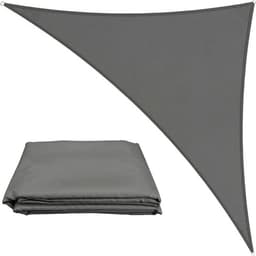
| Best overall |  MissYolo MissYolo 3 x 3 x 4.3 m triangle | Not stated | Parts list not stated; tensioners extra | Scalene, longer third side | 7.2 | about £11.90 | View offer |
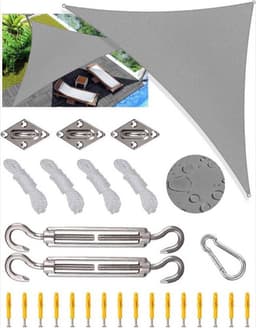
| Alternative |  MOXTOYU MOXTOYU 3 x 3 x 4.3 m triangle | 20–40 degrees | Ropes, pad eyes, tighteners and screws | Scalene, longer third side | 7.8 | about £28.99 | View offer |
 KAHEIGN KAHEIGN 3 x 3 x 3 m triangle | 20–40 degrees | 4 ropes of 2 m; hooks extra | Equilateral 3 m | 8.0 | about £14.99 | View offer |

On this page
Set one corner lower before you drill
Leave a tension gap and point the fixings inward
Ropes, then a way to re-tension
When a post or a wall is no longer a weekend job
Common questions
Can I fix it to a fence panel?
Do I need a turnbuckle if ropes are in the box?
How tight is tight enough?
When do I need planning permission for posts?
Should I take it down in a gale?
Related pages
Sources
Public UK sources used for this comparison. Listing prices, stars and review counts are the amazon.co.uk figures saved in the comparison files, not a live re-check.
- NHS — sunscreen and sun safety (retrieved 16.10.2026)
- GOV.UK — ultraviolet radiation frequently asked questions (retrieved 16.10.2026)
- Class E, England — buildings incidental to a dwellinghouse (retrieved 16.10.2026)
- Greater Cambridge planning — external shading (retrieved 16.10.2026)
- Consumer Rights Act 2015, section 9 (retrieved 16.10.2026)
- CAP Code rule 3.7 — objective claims (retrieved 16.10.2026)
- Clara Shade Sails — installation guide (retrieved 16.10.2026)
- Shade Specialists — shade sail installation instruction (retrieved 16.10.2026)