Independent comparisons. We may earn from shop links. More info

How to install a shade sail

Updated: 16.10.2026

A flat hang pools rain, and the screws in a kit are not a design for every wall. This is how to install a shade sail on a UK patio: check the sail is shorter than the span, fix only into something solid, drop one corner, tension a little at a time, then watch the first shower. The twelve listings in our [sun sail comparison](/hub/sun-shades/sun-sail) supply different hardware. The Products Compared editorial team did not hang these sails in a lab. Figures below are seller rules and stored listing notes from 16 October 2026. A qualifying purchase can earn us a commission at no extra cost to you.

A flat hang pools rain, and the screws in a kit are not a design for every wall.

Our top picks

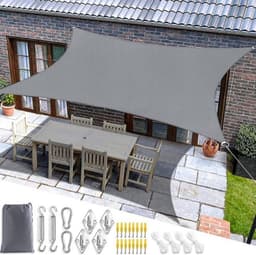
Mokani Mokani 3 x 4 m rectangle

Best overall

Mokani Mokani 3 x 4 m rectangle
8.0/10about £41.99
HEYOMART HEYOMART 2 x 2 m square

Preis-Tipp

HEYOMART HEYOMART 2 x 2 m square
7.0/10about £19.99
RICHIE RICHIE 2 x 3 m rectangle

Alternative

RICHIE RICHIE 2 x 3 m rectangle
6.4/10about £25.45
On this page

Check the gap before you drill

Lay the sail out and measure corner to corner, then measure the fixing points you intend to use. The cloth has to finish short of those points so ropes or turnbuckles can pull it tight. Sellers do not agree on the gap, and you should not merge their numbers into one official allowance. ManoMano’s UK guide uses about 30 cm. On the listings in this set, RICHIE and the Mokani 3 x 4 m sail say leave 1.5–2 ft, and Ghligna says 30–45 cm between the fixing points and the D-rings. A 3.0 m sail on two walls that are also 3.0 m apart has nowhere for a turnbuckle. KAHEIGN’s four ropes are only 1 m each, so they cannot bridge a wide allowance. If the sail is already longer than the span minus the hardware you actually own, stop and look at size on shade sail size for a patio rather than forcing the corners.

Fix to something that can take the pull

Mark the holes only after the gap works. Fit pad eyes or hooks into masonry or a beam that is obviously solid, using fixings meant for that material, then attach the sail. Look at what your box actually contains. The Mokani 3 x 4 m listing includes turnbuckles, pad eyes and plugs. The Mokani 3 x 3 m listing is ropes without that plug set. RICHIE and KAHEIGN do not include hooks. A general expansion plug in a cavity wall, a fascia board or crumbling mortar is how sails get ripped off in the first gale. A flat you do not own, and a listed building, are reasons to stop before the first hole.
Mokani Mokani 3 x 4 m rectangle

Testsieger

Mokani Mokani 3 x 4 m rectangle
8.0/10about £41.99

Slope and tension

These amazon listings that mention an angle usually say 20–40 degrees. Zephyr’s installation guide says a minimum of about 30 degrees if the sail is taut, and says to lower a corner further if water still sits. Those are seller rules beside each other, not one British standard. Do not average them into a single correct degree. Pick the steeper end of the range your own listing prints if the cloth is coated, because a coated sheet holds water and a flat belly becomes a pond. Hang opposite corners high and the other pair lower when you can. Tension a little at a time, and stop when the cloth is taut without the rings cutting into the hem.

After it is up

Watch the first proper shower before you call the job finished. If rain sits in the middle, lower one corner further or add tension at the high points. Do not cut a drain hole. A reviewer of the Mokani 3 x 4 m sail did that because the belly held rain. That is a torn sail, not a technique. Take the sail down before a gale. None of these listings prints a wind speed, and BS EN 13561 does not give these sails a wind class. If the masonry cracks as you tension the sail, stop and get a builder.

Common questions

What do I fix to the wall first?
Fit the pad eyes or hooks into a solid wall or beam first, at points that already leave a gap for ropes or turnbuckles. Attach the sail after those anchors exist. If the surface is a cavity, a fascia or soft mortar, choose a different anchor or stop.
How much gap do I leave for ropes?
Use the allowance your listing prints, and treat other guides as a range rather than a correction. In this set that means about 30–45 cm on the Ghligna page and 1.5–2 ft on RICHIE and the Mokani 3 x 4 m page. Wider UK seller guides run from about 30 cm to around 10 percent of the side. The sail must remain shorter than the span. A 1 m rope cannot invent a longer gap.
What angle sheds rain?
Listings in this set that state an angle say 20–40 degrees. Zephyr’s guide uses about 30 degrees if the cloth is taut, and a lower corner if water still pools. There is no single official degree for these amazon sails. Coated cloth needs the slope more than breathable cloth, because the coating is there to hold water out and will hold it in a belly if you hang the sail flat.
Can I use the supplied plugs in any surface?
No. Plugs in a Mokani or DAJAVE kit are for the kind of solid fixing the seller has in mind, not for every UK wall. A cavity, a timber fascia, a rendered surface you cannot identify, or a joint that crumbles, needs a different fixing or a different plan. If you do not know what the drill will hit, that is the moment to stop, not the moment to try a longer screw.
What if the middle still sags?
Check the slope and the tension before you blame the cloth. Edges can be tight while the centre hangs, which is what reviewers describe on the larger Mokani. Lower one corner, ease and re-tension, and consider proper mid-edge hardware if the sail has the rings for it. Cutting a hole to drain a pond is how one stored review ruined the sheet. If the cloth has already stretched and will not pull tight, more force will not reverse that.

Related pages

Sources

Public UK sources used for this comparison. Listing prices, stars and review counts are the amazon.co.uk figures stored on 16 October 2026.

  1. NHS — sunscreen and sun safety (retrieved 16.10.2026)
  2. Cancer Research UK — sun safety (retrieved 16.10.2026)
  3. GOV.UK — permitted development rights for householders: technical guidance (retrieved 16.10.2026)
  4. Planning Portal — gazebo or awning (retrieved 16.10.2026)
  5. Consumer Rights Act 2015, section 9 (retrieved 16.10.2026)
  6. BSI — BS EN 13561:2015 external blinds and awnings (retrieved 16.10.2026)
  7. Maanta UK — how to choose a shade-sail fabric (retrieved 16.10.2026)
  8. Shade Sail Boutique — wind (retrieved 16.10.2026)