Parasol base sand or water
The same plastic shell is printed with two weights, and they are not the same load. A parasol base sand or water choice is the difference between a hose fill you can drain and a heavier fill you may never pour back out. Fabric bags in this comparison are a third case: several reviews say they will not hold water at all. This page does not pick a best ASIN. The listings themselves are on our [fillable parasol base comparison](/hub/sun-shades/fillable-parasol-base). Products Compared used amazon.co.uk bullets and UK retailer notes on 21 October 2026. There is no lab weighing of a filled base. A qualifying purchase can earn us a commission at no extra cost to you.
The same plastic shell is printed with two weights, and they are not the same load. A parasol base sand or water choice is the difference between a hose fill you can drain and a heavier fill you may never pour back out.
The same plastic shell is printed with two weights, and they are not the same load. A parasol base sand or water choice is the difference between a hose fill you can drain and a heavier fill you may never pour back out. Fabric bags in this comparison are a third case: several reviews say they will not hold water at all. This page does not pick a best ASIN. The listings themselves are on our fillable parasol base comparison. Products Compared used amazon.co.uk bullets and UK retailer notes on 21 October 2026. There is no lab weighing of a filled base. A qualifying purchase can earn us a commission at no extra cost to you.
Our top picks
| Badge | Product | Fill | Water capacity | Sand capacity | Note | Price | Offer |
|---|---|---|---|---|---|---|---|
| Best overall |  Straame Straame 50 cm four-piece base | Water or dry sand | 60 kg (15 L each) | 80 kg | 8.1 | about £38.99 | View offer |
 VOUNOT VOUNOT four-plate 60 L base | Water or sand | 60 L | 100 kg | 8.4 | about £59.99 | View offer | |
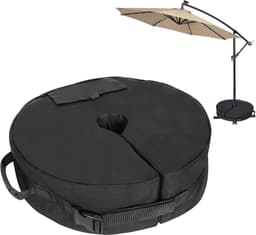
| Alternative |  Brislut Brislut round weight bag | Sand | – | Title 40 kg; bullet 85 lb | 7.8 | about £19.99 | View offer |


On this page
Two numbers on one listing
Water when you may move or drain it
Sand or gravel when it can stay put
A fabric bag is not a water tank
Common questions
Is 60 litres the same weight as 80 kg or 100 kg?
Which fill is heavier?
Will water freeze and crack the plastic?
Can you empty sand later?
Is gravel the same as sand?
Related pages
Sources
Public UK sources first, then the amazon.co.uk listings compared on this page. Prices and star lines are the stored figures, not a live re-check. Updated 22.10.2026.
- GOV.UK: General Product Safety Regulations 2005 (retrieved 22.10.2026)
- legislation.gov.uk: General Product Safety Regulations 2005 (retrieved 22.10.2026)
- legislation.gov.uk: Consumer Rights Act 2015 (retrieved 22.10.2026)
- Met Office: Beaufort scale (retrieved 22.10.2026)
- Royal Meteorological Society: Beaufort wind scale (retrieved 22.10.2026)
- Opal Retail: what size parasol base do I need (retrieved 22.10.2026)
- Jati: four-piece fillable cantilever weights (retrieved 22.10.2026)
- Bolton Council: parasol base build instructions (retrieved 22.10.2026)