Independent comparisons. We may earn from shop links. More info

LED tanning lamp or UV tubes: which light is on the listing

Updated: October 2026

You searched for a solarium and landed on a panel that prints 460 nm, then on a stand that prints 660 nm, then on a canopy of tubes. The titles all say tanning. The light does not. This page is the contrast between an LED tanning lamp or UV tubes, using the ten amazon.co.uk listings in our set. It is not a second buying guide and it does not pick a winner. The table is the [home solarium comparison](/hub/steam-baths/solarium). The Products Compared editorial team compared stored listings and public UK sources on 20 October 2026. A qualifying purchase can earn us a commission at no extra cost to you.

You searched for a solarium and landed on a panel that prints 460 nm, then on a stand that prints 660 nm, then on a canopy of tubes. The titles all say tanning. The light does not.

Our top picks

Funthy Funthy 001 LED panel

Best overall

Funthy Funthy 001 LED panel
6.2/10about £49.99
BTSAE BTSAE 460 nm panel

Alternative

BTSAE BTSAE 460 nm panel
3.9/10about £39.99
On this page

Ultraviolet is a definition, not a marketing word

The Sunbeds (Regulation) Act 2010 says a sunbed is an electrically powered device designed to tan skin by ultraviolet radiation. The explanatory notes pull in portable ultraviolet sun lamps and leave out a spray tan. That test is about the radiation the device is designed to use, not about the word solarium in a title. How to choose a type is the home solarium buying guide. The NHS states there is no safe ultraviolet tan. Cancer Research UK tells people not to use sunbeds as a vitamin D plan. Those sentences govern ultraviolet tanning. They do not, by themselves, reclassify a 460 nm LED as a sunbed, and they do not make a 660 nm stand illegal. The under-18 duty in the Act falls on a sunbed business away from a private home. An England sale restriction for under-18s is still a consultation.

What 460, 490, 660, and 850 nanometres are

Visible blue in this set is 460 nm, sometimes printed with 490 nm. Ultraviolet B, the band public-health pages tie to sunburn and the band a US National Institutes of Health fact sheet ties to vitamin D made in skin, is about 290–320 nm. 460 is not inside 290–320. BTSAE's panel at £39.99 states 460 nm, 45 W, and 225 LEDs. Jitesy's four-head stand at £109.99 states 460 nm and 490 nm, 60 W, and 432 LEDs, and it is the one with 3.1 from 90 reviews. That is the blue column. Axelrivet and Hocomay print 660 nm and 850 nm. Do not use either stand for vitamin D. Funthy at £49.99 and Jitesy's £39.99 panel print no nanometres. Matching watts with the BTSAE 460 nm panel does not assign them 460 nm.
Funthy Funthy 001 LED panel

Testsieger

Funthy Funthy 001 LED panel
6.2/10about £49.99

What the research does not prove about these lamps

One study exposed 33 volunteers with phototypes III and IV to 450 nm LED light over four days at a stated dose, and reported a rise in melanin and a change in colour. Another found that 415 nm could darken similar phototypes for up to three months. Those papers are not tests of these ASINs. A colour change at 450 nm on a laboratory LED is not evidence that a £39.99 panel tans, and it is not an ultraviolet tan. Vitamin D synthesis in that NIH summary is tied to ultraviolet B, not to 460 nm and not to 660 nm. On the Jitesy four-head stand at £109.99, the large file's repeated comment is that there was no tan.

The 12-tube tanner is the odd one out

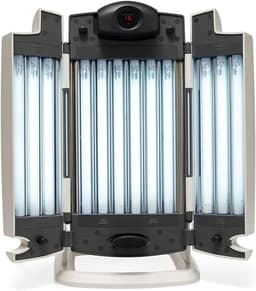
The Facial Tanner Eurosolar 9212, B003BF98MC, is £399, with 4.0 from 59 reviews in the stored file, 12 tubes, and a weight of 7 kg. The stored bullets say a turbo model with blue and red tubes. They do not print a nanometre or a wattage. A live amazon.co.uk description has claimed 12 UV tubes. That claim is outside the stored raw, so this comparison does not adopt it as the specification. This is the row a reader might still need to treat as ultraviolet, because it is built as a facial tanner of tubes rather than as a 460 nm panel. Treat it with the NHS warning: there is no safe ultraviolet tan. Printed blue, printed red and near-infrared, or tubes with the wavelength still unprinted: those are the columns. The two panels with no nanometres are a fourth case: unknown, not probably 460.

Common questions

Is a 460 nm LED lamp an ultraviolet sunbed?
Not on the definition in the Sunbeds (Regulation) Act 2010. A sunbed there is designed to tan skin by ultraviolet radiation. 460 nm and 490 nm are visible blue. A tanning title does not move 460 nm into the ultraviolet test by itself.
Can blue light still change skin colour?
It can, in some studies, on some skin types, at doses that are not these listings. Fair skin in that research often reddened instead. A paper is not a promise that your panel will do what the laboratory LED did.
What are 660 nm and 850 nm for, if not a tan?
They are red and near-infrared, printed on the Axelrivet stand at £24.88 and the Hocomay stand at £29.99. They are outside the sunbed definition. They are not a vitamin D lamp, because that synthesis is tied to ultraviolet B around 290–320 nm.
Does the Act cover a home LED panel?
Only if the panel is an electrically powered device designed to tan skin by ultraviolet radiation. A 460 nm or 660 nm listing does not pass that test merely because the title says solarium. Do not treat a tube tanner as suitable for a child because the sale law is still under consultation.
Are the 12 tubes ultraviolet even if the bullets do not say UV?
The stored bullets do not print a wavelength or the letters UV. They say blue and red tubes on the Eurosolar 9212. A live product description has claimed 12 UV tubes. That claim is outside the stored raw. The NHS warning on ultraviolet tanning is the one to carry if you treat the canopy as that kind of device.
Why do reviews say a blue lamp did not tan?
Because a printed wavelength is not a result. On the Jitesy four-head stand, 3.1 from 90, the stored texts mostly say colour did not change. Your front room and this lamp are not the laboratory protocol.

Related pages

Sources

Public UK sources used for this comparison. Listing prices, stars and review counts are the amazon.co.uk figures saved for these ten ASINs on 20 October 2026.

  1. Sunbeds (Regulation) Act 2010 (retrieved 20 October 2026)
  2. GOV.UK, sunbed safety advice (retrieved 20 October 2026)
  3. NHS, sunscreen and sun safety (retrieved 20 October 2026)
  4. Cancer Research UK, how sunbeds cause skin cancer (retrieved 20 October 2026)
  5. HSE INDG209, controlling the risks from UV tanning (retrieved 20 October 2026)
  6. ASA, beauty and cosmetics: sunbeds (retrieved 20 October 2026)
  7. NIH, vitamin D fact sheet for health professionals (retrieved 20 October 2026)
  8. DHSC, strengthening the regulation of commercial sunbeds in England (retrieved 20 October 2026)