Independent comparisons. We may earn from shop links. More info

Home solarium buying guide: the light the title hides

Updated: October 2026

You are on amazon.co.uk with a basket full of lamps all labelled solarium, and a £24.88 stand sits next to a £399 facial tanner as if they were the same machine. They are not. This home solarium buying guide separates visible blue LED, red and near-infrared LED, and a 12-tube facial tanner before you compare watts or stars. The [home solarium comparison](/hub/steam-baths/solarium) is the table of the ten listings. This page is the type choice. It does not crown a winner and it does not set a first session. A qualifying purchase can earn us a commission at no extra cost to you.

You are on amazon.co.uk with a basket full of lamps all labelled solarium, and a £24.88 stand sits next to a £399 facial tanner as if they were the same machine. They are not.

Our top picks

On this page

Three things the word solarium is hiding

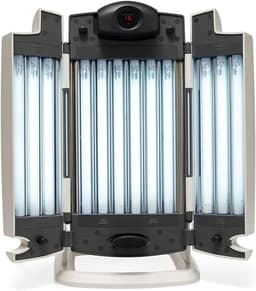
A UK search for a home solarium still mostly returns ultraviolet beds: salon-style canopies, hire units, and power figures in the kilowatt range. The amazon.co.uk shelf in this comparison is smaller and mixed. One family prints 460 nm, sometimes with 490 nm beside it. That is visible blue light. Another prints 660 nm and 850 nm, which is red and near-infrared. The third is the Facial Tanner Eurosolar 9212, twelve tubes in a canopy at £399, whose stored bullets say blue and red tubes and do not print a nanometre. Watts do not put those families on one scale. None of those watt figures is an ultraviolet dose. Wavelength is on LED tanning lamp or UV tubes.

What a useful listing prints

Start with the light, not the wattage. A useful page names a wavelength, or it describes tubes. Funthy's £49.99 panel and the Jitesy £39.99 panel name neither nanometre. You cannot assign them 460 nm because a neighbour at the same price prints it. The stored file for the £399 tanner also omits a wavelength. A live description elsewhere on amazon.co.uk has claimed 12 UV tubes; that sentence is not in the stored bullets, so this guide does not treat it as the specification. A timer with steps, a stated distance, and named eye protection are three different facts. Hocomay prints 5-minute steps up to 30 minutes, a stand height of 65–186 cm, and goggles. Three listings in this set print no distance. Those blanks stay blank. Review count comes before the star. A 5.0 from four reviews is a thinner file than a 3.1 from 90.
Funthy Funthy 001 LED panel

Testsieger

Funthy Funthy 001 LED panel
6.2/10about £49.99

How the ten listings split

The compact panels sit at about £40 to £50, and they are not one lamp. BTSAE's £39.99 panel prints 460 nm, 45 W, 225 LEDs, and goggles, with 2.8 from four reviews. Jitesy's £39.99 panel matches the wattage and the goggles, scores 3.8 from 12, and prints no nanometre. Funthy at £49.99 is 4.7 from 10, with an eye mask in the title rather than a wavelength. The four-head blue stands still light a zone, not a room. Jitesy at £109.99 prints 460 nm and 490 nm, 60 W, and 432 LEDs, at 3.1 from 90, and the repeated argument is that there was no tan. Axelrivet at £24.88 states 50 W at 660 nm and 850 nm, and has no review line. Hocomay at £29.99 states 20 W, the same wavelengths, and goggles, at 2.5 from two reviews. The £399 canopy is twelve tubes, 7 kg, 4.0 from 59.

Rules that change the buy

The Sunbeds (Regulation) Act 2010 defines a sunbed as an electrically powered device designed to tan skin by ultraviolet radiation. Portable ultraviolet sun lamps are included. A spray tan is not. A 460 nm title does not pass that test on its own, and a 660 nm stand is not made illegal by the Act. The under-18 offence in the Act falls on a sunbed business, on premises that are not a private home. The NHS also says it is illegal for under-18s to use sunbeds, including in salons. A Department of Health and Social Care consultation has proposed an England ban on sale or hire to under-18s. That is not the current offence. The NHS line that binds a tube tan is simpler: there is no safe ultraviolet tan. No raw file prints the plug. UK mains are 230 V and a domestic plug is BS 1363. That is the expectation for a UK socket, not a measurement from these boxes.

Common questions

Is every home solarium an ultraviolet sunbed?
No. In this amazon.co.uk set the word covers 460 nm and 490 nm blue LED panels, 660 nm and 850 nm stands, and one 12-tube facial tanner. A visible LED peak does not meet the sunbed test by itself.
What should I read on the listing before I compare watts?
Read the wavelength or the tube description, then whether a timer, a distance, and eye protection are actually named. Watts on a 20 W red-light stand and watts on a 45 W blue panel are not one scale. A 5.0 from four reviews is weaker evidence than a 3.1 from 90.
What is the difference between 460 nm, 490 nm, 660 nm, and 850 nm?
460 nm and 490 nm are visible blue. 660 nm and 850 nm are red and near-infrared, printed on the Axelrivet and Hocomay stands. Ultraviolet B sits around 290–320 nm. None of these LED peaks is that band, so a wattage on the box is not an ultraviolet dose.
Does the under-18 sunbed rule stop a private purchase?
The offence in the Act falls on a sunbed business, on premises that are not a private home. An England sale or hire ban has been proposed and is not the current offence. A tube tanner is still the wrong thing to switch on for a child at home.
When is a tube facial tanner the wrong type even if the stars look better?
When you wanted a visible LED lamp, a red-light stand, or a result you can call safe. The NHS says there is no safe ultraviolet tan. A stronger star line does not make twelve tubes a match for a 460 nm panel or a 660 nm stand.

Related pages

Sources

Public UK sources used for this comparison. Listing prices, stars and review counts are the amazon.co.uk figures saved for these ten ASINs on 20 October 2026.

  1. Sunbeds (Regulation) Act 2010 (retrieved 20 October 2026)
  2. GOV.UK, sunbed safety advice (retrieved 20 October 2026)
  3. NHS, sunscreen and sun safety (retrieved 20 October 2026)
  4. Cancer Research UK, how sunbeds cause skin cancer (retrieved 20 October 2026)
  5. HSE INDG209, controlling the risks from UV tanning (retrieved 20 October 2026)
  6. ASA, beauty and cosmetics: sunbeds (retrieved 20 October 2026)
  7. NIH, vitamin D fact sheet for health professionals (retrieved 20 October 2026)
  8. DHSC, strengthening the regulation of commercial sunbeds in England (retrieved 20 October 2026)