Low EMF infrared sauna claims: what the numbers mean

Learn what low-EMF infrared sauna claims mean in the UK, how milligauss converts to microtesla, and which test details to request before you buy.
On this page

A low EMF infrared sauna badge can look reassuring when one advert quotes 0–3 mG and another says near zero. The number may describe one chosen point rather than where you sit. You need the unit, distance, meter and test conditions, because low EMF is not a UK legal grade. A qualifying purchase through our links can earn us a commission at no extra cost to you.
On the infrared cabin comparison, the top pick is the CONLONS portable infrared sauna, ASIN B0DN68F85P, at about £219.99, with 4.7 from 25 amazon.co.uk ratings. The best value listing is the SereneLife AZSLISAU10BK at about £80.41, with 4.2 from 5,327 ratings. Neither product entry records a milligauss or microtesla figure, so an EMF badge is not part of that ranking.
In short
Low-EMF labels on infrared cabins are seller claims, not a standardised UK product class. Convert the units if you need to, then judge the evidence by where and how the cabin was measured. A milligauss figure without distance and operating conditions is not a useful comparison.
What low EMF means in the UK
EMF means electromagnetic field, covering more than one type of field and a wide range of frequencies. An infrared cabin advert that uses milligauss or microtesla is normally talking about a low-frequency magnetic field from powered equipment. That is more specific than the infrared energy that warms you. Do not treat the two as interchangeable.
The UK Government's public information on electromagnetic fields describes magnetic flux density in microtesla and notes that home readings vary with location and with proximity to appliances. That is background context, not a sauna pass mark. It does not support a claim that every cabin below one seller-chosen milligauss number has a UK safety grade.
Low, ultra-low and near zero mean little until the seller defines them. A bench maximum, a centre average and a reading a set distance from one panel can all be genuine and still impossible to compare. Ask for reproducible evidence alongside size, power and heater placement. The infrared cabin buying guide covers those practical choices.
Milligauss and microtesla
Milligauss (mG) and microtesla (µT) both describe magnetic flux density. The conversion is 1 µT equals 10 mG, so 3 mG equals 0.3 µT and 1 mG equals 0.1 µT. That stops a unit mismatch. It does not show whether the reading matches the place where you sit. These are unit examples, not readings from the cabins in this hub.
An advert claiming 0–3 mG can look smaller than 0.01–0.2 µT until you convert: 0.01–0.2 µT is 0.1–2 mG. That does not show the cabin was compared with household background. The 3 mG line is not a UK statutory limit for saunas. Sellers may take it from precautionary material rather than an appliance rule.
Check whether the meter reports a momentary maximum, an average or a range. A range can hide where the upper value occurred. An average can smooth a peak beside a cable. A small map of test points tells you more than a single badge.
Why distance changes the reading
A magnetic-field measurement belongs to a place. Moving a meter away from a heater, cable, relay or transformer can change the result, so a milligauss figure without a distance is incomplete. A few centimetres can matter when the source is close to the seat or backrest.
Ask for readings at the head, chest, lap, calves and feet, not only the open centre. If heaters sit behind, beside and beneath you, the test should cover all of them. It should also say whether every heater was on, whether the cabin was warming or cycling, and whether controls and lights were powered. A workbench test of one heater is not the finished cabin.
The room can change what a meter sees. A consumer unit, extension lead, underfloor heating circuit or another appliance may add to the local reading. A seller's controlled result and your installed result can differ without either being fraudulent. Product data can help you compare designs. It cannot promise the reading in every home.
What safety marks do not prove
A UKCA mark does not mean an infrared cabin has a defined low-EMF milligauss score. A low reading at one point does not prove the appliance is electrically safe, correctly wired or suitable for your room. Conformity and a marketing claim answer different questions.
BS EN 60335-2-53 sets particular safety requirements for sauna heating appliances and infrared cabins. It is not a scheme that awards low, ultra-low or near-zero EMF levels. If a seller cites a standard, ask for the exact identifier and what the paperwork covers.
UK mains are 230 V and plugs are BS 1363. Check voltage, watts, and whether the cabin plugs in or needs hard-wiring. An adaptor does not make a dedicated supply acceptable. If the supply is unclear, read when a home sauna needs an electrician before you install it.
How to assess a seller's evidence
Useful evidence can be repeated. The report should name the cabin model, heater layout, meter make and model, the field measured, the units, the settings, the test points, the distances and the test date. It should say whether every heater and accessory was running.
Prefer a table or a diagram to a marketing summary. A map of the occupied positions is worth more than a photograph of one low number. If the claim is a range, ask where the maximum occurred and whether the figure is instantaneous, averaged or rounded. Calibration does not repair a weak method. The meter has to suit the field and frequency. A phone app is not an identified instrument.
Manufacturer and retailer figures can inform a shortlist, but they stay seller evidence unless a named third party did the work. Read the method, and do not treat a graphic as certification. If one company reports the seat maximum with every heater on and another reports the centre after warm-up, do not rank them by the headline number. Where the methods cannot be matched, mark the comparison unknown.
Questions to send before buying
Send a short, model-specific request and keep the reply with your order records. You are establishing what the headline describes, not demanding a perfect laboratory study.
- Ask whether the figure concerns a magnetic field, an electric field, radiofrequency energy or a combined measurement, and request the units.
- Ask for the meter make and model, its settings, and the date or status of its calibration.
- Request every test point and distance, including where your head, torso, legs and feet will be.
- Confirm that the exact model was fully assembled and that all heaters, controls and supplied accessories were operating.
- Ask whether the quoted number is the maximum, minimum, average or range, and request the underlying results.
- Ask whether the manufacturer, the retailer or a named independent organisation completed the test.
If the reply only repeats under 3 mG and cannot say where it was measured, do not treat it as comparable evidence or pay a premium for it. Heater layout is separate: see carbon and ceramic sauna heaters. Format is separate too: steam rooms and infrared heat. Running cost uses wattage and your unit rate in the infrared cabin electricity cost guide.
Common questions
A non-zero display does not show that a cabin is defective. Check whether a claim is defined and relevant to where you sit. This article does not set a medical threshold. A consumer meter can compare positions if you record the model, units, distance, heater state and a background reading, then repeat the same grid. Do not match it to a seller's figure unless the methods match.
A magnetic-field figure does not tell you warm-up time or running cost. Ask for a model-specific report with a diagram, occupied-position readings, distances, operating conditions and the organisation that tested it. Peter F. checked seller terminology and public UK guidance. We did not laboratory-test a cabin or take EMF readings of these listings.
Common questions
Is low EMF a UK standard for infrared saunas?
What is 3 milligauss in microtesla?
Why does distance matter in an infrared cabin EMF test?
Does UKCA marking mean an infrared sauna is low EMF?
Are the infrared heaters the only EMF source in a cabin?
Should I buy an EMF meter for my infrared sauna?
Does sauna health research prove that low EMF is better?

Peter F. is the editor for DIY & tools at productscompared.co.uk. Comparisons in this category are checked against amazon.co.uk listings, review evidence and public UK sources.
Related articles
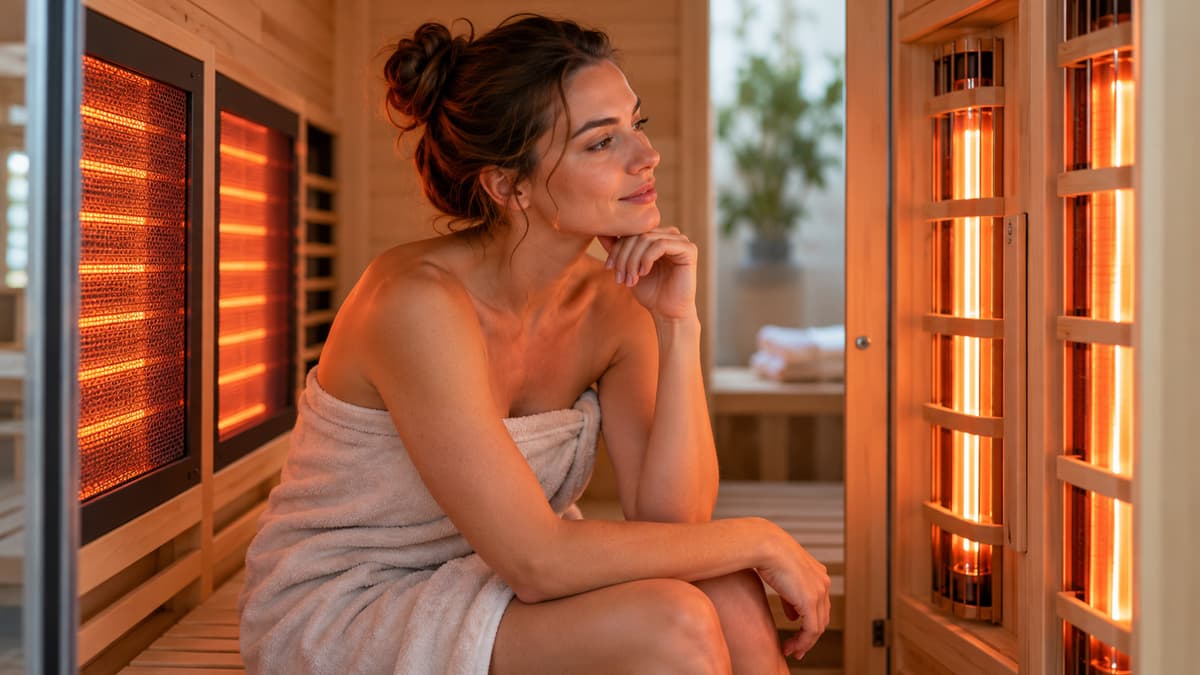
Carbon vs ceramic infrared sauna heaters: which suits you?
Heater type changes layout and how close the elements sit to you. It does not by itself set a cabin-wide EMF figure.

Infrared sauna running cost: pence per session
Running cost comes from wattage and your unit rate. A milligauss badge does not supply either figure.

Steam room vs infrared sauna: choose the right heat
Wet steam and dry infrared heat are different products. Settle the format before you judge one EMF badge.