Independent comparisons. We may earn from shop links. More info

How to use a hammer tacker

Updated: 21 October 2026

The first staple has bent, sat proud, or not left the magazine, and the instinct is to hit harder. How to use a hammer tacker starts earlier than the swing. You load the series the gun was built for, you support the timber, and you keep hands out of the nose when a stick jams. The seven tools in the [hammer stapler comparison](/hub/staplers-and-nail-guns/hammer-stapler) are manual. None has an airline to disconnect. A qualifying purchase can earn us a commission at no extra cost to you. Peter F. wrote this from those listings and from Health and Safety Executive guidance. We did not film a loading drill, and this page does not rank the guns.

The first staple has bent, sat proud, or not left the magazine, and the instinct is to hit harder. How to use a hammer tacker starts earlier than the swing.

Our top picks

Tacwise Tacwise 0322 A11

Best overall

Tacwise Tacwise 0322 A11
9.2/10about £21.99
Tacwise Tacwise 1793 ECO

Best value

Tacwise Tacwise 1793 ECO
9.0/10about £23.01
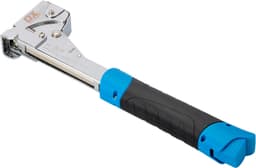
OX Tools OX Pro

Rank 3

OX Tools OX Pro
7.4/10about £24.00
On this page

Before the first staple

Put eye protection on before the magazine is full. The Health and Safety Executive expects a safe system when equipment is used at work, including protection when fragments can fly. A staple that splits or ricochets is a sharp projectile. Read the staple code against the tool. Type 140 sticks belong in the Tacwise A11 guns in this set. TRA706T belongs in the Stanley HT150. Type 13 or 53 belongs in the A19. The OX Pro needs the flat wire its manual names. Fire two staples into an offcut first. If they bend, change the staple before you change your swing. At work, the Provision and Use of Work Equipment Regulations 1998 apply to a tacker your employer provides. The tool has to be suitable, maintained, and used by people who have been shown how. If nobody has set that system of work, stop and ask.

Loading by design

The Tacwise guns use a magazine you release rather than a stick you force past a nose plate. The A11 models hold about 150 Type 140 staples. The A19 holds about 120 of Type 13 or 53. Open the quick-release, seat the stick the way the points need to face, and close it until it sits home. Tacwise, on the 1793 listing, recommends its own fasteners. If the stick stalls halfway, it is the wrong collation or it is upside down. Do not tap it in with a hammer. The Stanley HT150 loads two sticks of Type-G, 6–10 mm. Two sticks do not mean you can mix a Type 140 stick into the second channel. Keep both sticks at the same leg length. The OX Pro loads from the bottom, for flat wire the listing prints as 6–14 mm. Keep the nose pointed away. If the stick will not enter, stop and check the box code. Forcing a Type 140 stick because it says 10 mm is how magazines split. The codes are on the hammer stapler staple types page.
Tacwise Tacwise 0322 A11

Testsieger

Tacwise Tacwise 0322 A11
9.2/10about £21.99

Striking for a flush drive

Support the work. A hammer tacker drives by impact through the nose into the material and then into timber. If the board can bounce, the staple sits proud or folds. Hardboard on your knee, felt with no batten under the nose, and a scrap that overhangs the bench are the usual failures. Move the nose onto solid timber, or put a sacrificial board behind a thin sheet, and strike again on a fresh spot. Do not keep hitting the same proud crown until the wire snaps. Hold the face so both legs meet the surface together. A tilted nose sends one leg along the top and one into the timber. A heavier body, such as the 0322 at about 0.9 kg against the HT150 at about 449 g, changes the feel. It does not forgive a 12 mm staple in a gun built for 10 mm. On a roof, this page will not teach you where to stand. Spacing along felt courses is on the hammer stapler for roofing felt page.

Jams, and when to stop

Point the nose away from people, including your own legs, before you open anything. Release the magazine the way that gun is built: quick-release on the Tacwise models, the stick channel on the HT150, the bottom loader on the OX. Pull the stuck stick out along its normal path. Do not poke the nose with a screwdriver while a spring is still loaded, and do not look down the ejection slot. If the tool then fires loose or bent staples, stop using it. Stop when you cannot clear the jam without a hand in front of the nose, when the fixing has to meet a detail you cannot verify, or when people at work have not been shown the tool. A jam from the wrong series returns as soon as you reload the same box. The hammer stapler buying guide is the check for that box.

Common questions

How do I load Type 140 sticks?
Use a Tacwise Type 140 gun from this set, not the HT150 and not the A19. Release the magazine, seat a Type 140 stick in the orientation the points require, and close it fully. The A11 rows hold about 150. The A54 accepts the same family and adds a 12 mm maximum. If the stick buckles, it is likely Type-G, Type 13 or 53, or upside down. The 1793 listing tells you to prefer Tacwise fasteners. Try two staples in scrap timber before you load a whole stick for the job.
How hard should I strike?
Hard enough for both legs to close on supported timber, and no harder. Test on an offcut. A heavier blow will not straighten a staple from the wrong series, and it will not pull a 12 mm leg through a gun whose limit is 10 mm. The HT150 at about 449 g and the 0322 at about 0.9 kg feel different. Set the blow to the gun you are holding, on the timber you are fixing, rather than copying someone else’s swing.
What if the staples sit proud?
Check support, leg length and whether the nose is on timber. An unsupported board lets the staple bounce. A leg that is too long for the sheet stands up. Felt with no batten under the strike often does the same. Move to solid timber or shorten the leg to a length the gun allows. Do not keep striking the same crown until the wire breaks and leaves a sharp end in the surface.
How do I clear a jam safely?
Point the nose away from you and from anyone else. Release the magazine or the bottom loader and draw the stick out along its normal path. Keep fingers off the ejection slot. These tools have no airline to shut off, so the stored energy is the spring and the half-fired staple. If staples keep leaving bent or loose after you reload the correct series, retire the tool instead of carrying on.
Do I need goggles?
Yes. HSE guidance on work equipment includes eye protection where material can fly, and a staple that splits is that case. Wear them for DIY as well as on site. Glasses do not replace a supported strike or the correct staple, and they do not make jam-clearing with the nose toward your face acceptable.
Should I oil the tool?
Not from any schedule printed on these seven listings. They are manual hammer tackers, not air tools, and an oil drop borrowed from a coil nailer is a step we will not invent. Keep the magazine path free of grit if the instructions say so. If the gun still jams on the correct staple, the fault is the stick, the length, or a damaged magazine, not a dry hinge you have guessed at.

Related pages

Sources

Public sources listed below, plus the amazon.co.uk prices, stars and review counts on these seven listings. Page updated 21 October 2026.

  1. Leitz (Rapid), Choosing the right staple gun (retrieved 21 October 2026)
  2. Advanced Fasteners, How to staple roofing felt and breathable membrane (retrieved 21 October 2026)
  3. Rapid UK, Hammer tackers (retrieved 21 October 2026)
  4. HSE, Introduction to machinery safety (retrieved 21 October 2026)
  5. HSE, UK law on design and supply of products (retrieved 21 October 2026)
  6. HSE, PUWER overview (retrieved 21 October 2026)
  7. Roof Giant, Tacwise A11 hammer tacker (retrieved 21 October 2026)
  8. Stanley, HT150 heavy-duty hammer tacker (retrieved 21 October 2026)