Independent comparisons. We may earn from shop links. More info

Hammer tacker for roofing felt

Updated: 21 October 2026

You are on a pitched roof with a roll of bitumen felt or a breathable membrane, and a hose would catch on every batten. A hammer tacker for roofing felt is the manual tool trade articles describe for that situation. It still has to fire the staple the felt or membrane maker allows, into timber, at a spacing you can defend. The seven amazon.co.uk guns in the [hammer stapler comparison](/hub/staplers-and-nail-guns/hammer-stapler) are the only shortlist here. A qualifying purchase can earn us a commission at no extra cost to you. Peter F. matched them to public UK trade guidance. We did not certify a roof, and this page does not replace the manufacturer’s fixing schedule or a building-control detail.

You are on a pitched roof with a roll of bitumen felt or a breathable membrane, and a hose would catch on every batten. A hammer tacker for roofing felt is the manual tool trade articles describe for that situation.

Our top picks

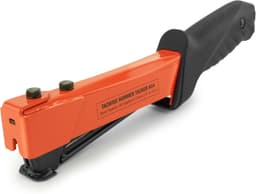
Tacwise Tacwise 0322 A11

Best overall

Tacwise Tacwise 0322 A11
9.2/10about £21.99
Tacwise Tacwise 1793 ECO

Best value

Tacwise Tacwise 1793 ECO
9.0/10about £23.01
Tacwise Tacwise A54 1173

Rank 3

Tacwise Tacwise A54 1173
8.6/10about £31.16
On this page

Why hammer tackers stay on pitched roofs

A hammer tacker drives one staple each time you strike. There is no compressor and no hose across the slope. Advanced Fasteners, writing for UK roofing felt and membrane, treats that as a normal way to fix on a pitch. That article is not a test of these seven listings. A pneumatic stapler fits better when the deck is flat and a compressor is already there. None of these rows is an air tool. Weight still matters for a day on the roof. The Tacwise 0322 is about 0.9 kg. The Stanley HT150 is about 449 g, which is easier overhead only if Type-G staples at 6–10 mm suit the felt. Working at height is a separate duty. The Health and Safety Executive expects a safe system for work equipment. This article does not tell you which ladder, which edge protection, or which weather to accept. If the roof is your job and that system is missing, the staple gun is not the first decision.

Staple length and the metal

Heavy felt in that Advanced Fasteners guidance is a Type 140 job, and the leg lengths they cite run about 12–16 mm. In this comparison, only the Tacwise A54 1173 states a Type 140 range of 6–12 mm. Every other Type 140 gun stops at 10 mm: the 0322, the 1793 and the 1783 bundle. A 16 mm leg is outside all seven listings. If the schedule demands 16 mm, you need a different tool, not a harder swing with a 10 mm gun. Breathable membrane is not automatically the same leg as bitumen felt. Follow the membrane maker. A lighter sheet can accept a shorter Type 140 leg when that sheet says so. It does not make the A19 Type 13 or 53 staples a roofing staple. Stainless steel is the outdoor preference in the same trade article where moisture reaches the fixing. Galvanised staples are not enough outside just because they are sold for general use. If the roll specifies stainless, a galvanised box is the wrong saving, including a galvanised 10 mm stick that happened to come with a bundle. The Stanley HT150 can fix felt only when you are already on Type-G and the detail accepts 6–10 mm. Its bullets name TRA705T, TRA706T and TRA708T. A 12 mm Type-G stick is a buyer trap on this model. The OX Pro prints 6–14 mm flat wire, and that range is only useful if the manual’s flat wire is the staple you buy. Do not treat it as a Type 140 gun. The series codes are on the hammer stapler staple types page. Buying 140/12 for the 0322, which stops at 10 mm, is the concrete miss.
Tacwise Tacwise 0322 A11

Testsieger

Tacwise Tacwise 0322 A11
9.2/10about £21.99

Courses, overlaps and spacing

Stretch the felt or membrane so it lies taut, then staple along the courses rather than in a random scatter. Trade articles describe fixings about 150–200 mm apart on the main lines, and closer at edges and overlaps. Treat that as a rule of thumb from those articles, not as a figure in the Building Regulations and not as permission to ignore a schedule that says something tighter. The nose has to land on a batten or a rafter. A staple that only pinches felt to felt will pull through in the first wind. Overlaps get their own row. If you only staple the field, the lap the maker told you to fix can work loose. Edges and ridges take the closer spacing, and the crown should sit flush. How to support the strike and how to clear a jam is the how to use a hammer stapler page. Some details specify clout nails, not staples. This page does not claim that every UK roof accepts staples. When the drawing names a nail, use the nail.

Which of the seven to take up

If 6–10 mm Type 140 is what the schedule allows, the Tacwise 0322 at about £21.99 is the gun-only listing, with 4.6 from 1,000 reviews, a magazine of about 150, and staples not included. You buy the leg and the metal, stainless or galvanised, as a separate box. If you need 12 mm Type 140, take the A54 at about £31.16. It shows 4.3 from 415 reviews, names a surface buffer plate, and prints a one-year warranty line against three years on the 0322. The extra money is for the 12 mm ceiling. The 1783 bundle at about £49.95 ships 60,000 Type 140 staples at 10 mm. That is a small-roof convenience only when 10 mm is correct. It is the wrong bundle for heavy felt that wants 12 mm. The 1793 at about £23.01 includes 500 staples plus 500 Type 180 10 mm brads, which are not clouts. Check the staple leg before you felt a shed. The A19 does not take Type 140. The HT150 at about £27.81 stays on the list when the van already holds Type-G at 10 mm or under and the felt maker agrees. It drops off when the drawing says 12 mm Type 140. The OX stays off until the flat-wire code is confirmed. The best hammer stapler page puts the same guns against underlay and kit buyers, which is a different job.

Common questions

Is a hammer tacker or a pneumatic stapler better on a pitched roof?
The hammer tacker is the practical choice when a hose would trail across the pitch and you can meet the staple spec by hand. Trade writing treats that as normal for felt and membrane. A pneumatic stapler fits better on a flat deck where a compressor is already set up and you want air-driven depth. These seven listings are all manual. The staple series and the leg length still have to match the sheet.
What staple length should I use for bitumen felt?
Use the length the felt maker states. UK trade guidance aimed at heavy felt cites Type 140 legs around 12–16 mm. In this table only the A54 reaches 12 mm on Type 140. Nothing here fires 16 mm. Guns that stop at 10 mm, including the 0322 and the 1783 included staples, are for schedules that accept 10 mm. Do not substitute a longer stick the gun cannot take.
Which gun in the table takes 12 mm legs?
The Tacwise A54 1173, listed at about £31.16, states Type 140 from 6–12 mm. The 0322, the 1793 and the 1783 stop at 10 mm on Type 140. The HT150 stops at 10 mm on Type-G. The OX prints 6–14 mm flat wire, which is a different system until the manual says otherwise. If you need 12 mm Type 140, the A54 is the row.
Are galvanised staples enough outside?
Not by default. The same UK trade article that sets Type 140 for heavy felt prefers stainless steel where the fixing gets wet. If your membrane or felt pack specifies stainless, buy stainless in the series the gun accepts. Galvanised staples that came in a bundle are only acceptable when the product sheet allows that finish.
How far apart should the staples be?
A trade rule of thumb is about 150–200 mm along the courses, with closer centres at edges and overlaps, driven into battens or rafters. That is not a regulation you can quote as a maximum gap, and it loses to any tighter spacing on the felt or membrane instructions. A staple that misses the timber and only catches the sheet is a miss at any spacing. Keep the sheet taut and fix the laps, not only the middle of the bay.
Which listing includes staples for a small roof?
The 1793 at about £23.01 includes 500 staples, and the 1783 at about £49.95 includes 60,000 Type 140 staples at 10 mm. For a small roof, 500 may be enough if the leg on that pack suits the felt. The 1783 is only a match when 10 mm is the specified leg. Neither box removes the need to buy stainless separately if the sheet asks for it. The other five listings include no staples.

Related pages

Sources

Public sources listed below, plus the amazon.co.uk prices, stars and review counts on these seven listings. Page updated 21 October 2026.

  1. Leitz (Rapid), Choosing the right staple gun (retrieved 21 October 2026)
  2. Advanced Fasteners, How to staple roofing felt and breathable membrane (retrieved 21 October 2026)
  3. Rapid UK, Hammer tackers (retrieved 21 October 2026)
  4. HSE, Introduction to machinery safety (retrieved 21 October 2026)
  5. HSE, UK law on design and supply of products (retrieved 21 October 2026)
  6. HSE, PUWER overview (retrieved 21 October 2026)
  7. Roof Giant, Tacwise A11 hammer tacker (retrieved 21 October 2026)
  8. Stanley, HT150 heavy-duty hammer tacker (retrieved 21 October 2026)