Independent comparisons. We may earn from shop links. More info

Electric vs cordless nail gun: which suits your job?

Updated: October 2026

You can fit trim in one room beside a socket or move between a staircase, loft and garden structure, and that difference often decides the tool before brand or star rating. In an electric vs cordless nail gun comparison, electric is confusing because both mains and battery tools use electricity. Here, electric means a corded 230 V gun with a plug; cordless means a gun powered by a removable or built-in battery. Choose corded when the work stays within safe reach of one UK socket and its fastener range fits. Choose cordless when the socket is absent or the lead would obstruct the job. The [main electric nailer comparison](/hub/staplers-and-nail-guns/electric-nailer) covers the seven mains listings.

You can fit trim in one room beside a socket or move between a staircase, loft and garden structure, and that difference often decides the tool before brand or star rating.

Our top picks

NEU MASTER NEU MASTER NTC0040

Best overall

NEU MASTER NEU MASTER NTC0040
9.2/10about £75.99
STANLEY Stanley TRE550

Preis-Tipp

STANLEY Stanley TRE550
8.8/10about £19.99
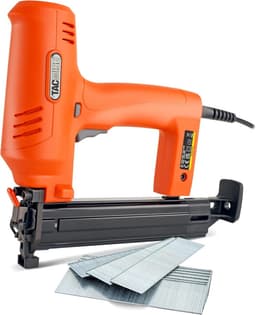
Tacwise Tacwise 181ELS

Alternative

Tacwise Tacwise 181ELS
8.4/10about £79.95
On this page

The same label covers two power systems

A corded nail gun draws power continuously from the mains. You do not buy, charge or carry a battery. The trade-off is reach: the lead must stay behind you and outside the firing path. A cordless gun stores energy in a battery pack. It can move around stairs, outbuildings and rooms without a live socket, but the pack adds weight and has a limited run time. Some listings are bare tools, so the price may exclude a battery and charger. Neither power source is automatically stronger. Drive depends on the mechanism, fastener, material and tool class. A corded tacker limited to a 14 mm staple is not more capable than a cordless second-fix nailer. Match the fastener first with the electric nailer buying guide.

When the lead is the better compromise

Corded suits stationary work near a socket: re-covering chairs at a bench, fastening sheeting in one room or pinning light trim along a wall with power nearby. These mains tools cost from £19.99 for the Stanley TRE550 to £79.95 for the Tacwise 181ELS, so you can buy a short tacker or a longer 18-gauge brad nailer without a battery ecosystem. Power lasts as long as the socket stays live, but the manual’s cooling and duty limits still apply. Inspect the UK plug and keep the cable away from the nose. The Tacwise 140EL states 2 m and the 181ELS 2.4 m; Stanley reviews describe roughly eight feet and a stiff cable, while several other listings do not state a length. Measure the route from socket to work. If the cable would cross a doorway or pull taut, the low price is no longer the only consideration.
NEU MASTER NEU MASTER NTC0040

Testsieger

NEU MASTER NEU MASTER NTC0040
9.2/10about £75.99

When cordless is worth the battery

Cordless is the clearer choice in a loft without a socket, when you move between floors, or when you fix timber away from the house. It avoids dragging a cable around corners. That mobility can matter more than battery weight on short, dispersed tasks. Corded is not illegal outdoors and cordless is not automatically the outdoor tool. The risks depend on the equipment, the weather, supply protection and the maker’s instructions. Do not use either tool in rain unless the instructions permit it. If you already own a compatible 18 V pack and charger, a bare cordless nailer may be economical. If you own none, compare the complete kit price and the working weight. Battery models stay on the cordless nailer comparison, so a bare body is not mixed into this mains table.

Extending a corded nailer safely

An extension can close a modest gap, but it should not turn a stationary mains tool into a roaming site gun. Electrical Safety First advises one suitable lead or reel, fully unwound, with no daisy-chaining. Use RCD protection when the consumer unit does not already provide it, and weatherproof equipment only where outdoor use is permitted. The NEU MASTER NTC0040 listing tells you not to use an extension lead because driving force may drop. That warning still applies when the reel is electrically suitable. Use a closer socket, a model whose instructions allow the lead, or go cordless. Route the lead where it cannot be nailed, cut or tripped over, and stop if the plug or reel becomes hot. A two-metre figure is a planning length, not a lead to stretch taut.

A conditional recommendation

Choose a corded electric nailer when the whole job stays near a suitable UK socket, you want to avoid battery cost and the fastener fits one of these mains tools. The Tacwise 181ELS can make sense for straight 18-gauge trim brads up to 35 mm in one room. The Stanley is a low-cost choice for short staples and pins. Choose cordless when the work moves, the socket is missing, or a safe cable route would be awkward. Existing batteries can make that easier, but compare the complete kit and the loaded weight. If skirting is the job, power source is only part of the answer: the skirting-board guide checks gauge, substrate and maker exclusions.

Common questions

Will a corded nail gun run all afternoon?
It has no battery to discharge, but that does not promise unrestricted continuous operation. Follow the manual’s duty and cooling instructions, use the correct fastener and stop if the tool overheats or behaves unusually. Continuous mains power removes charging pauses, not mechanical limits.
Is a cordless nail gun more powerful?
Not by definition. Driving performance depends on the model, mechanism, fastener length and material. Compare stated fastener ranges and intended applications rather than power source alone. A battery second-fix gun and a corded upholstery tacker belong to different classes.
Can I use a corded nailer outdoors?
Only when the tool’s instructions permit the conditions and the electrical setup is suitable, dry and protected. Use appropriate RCD protection and weatherproof outdoor equipment where required. Do not work in rain or treat a household travel adaptor or indoor extension as outdoor protection.
What if the supplied lead is only two metres?
Measure the working route before purchase. One suitable fully unwound extension may be possible if the manufacturer permits it, but do not daisy-chain leads. The NTC0040 listing warns against extensions because driving force may fall, making a closer socket or cordless tool preferable.
Should I buy corded if I already own batteries?
Not automatically. Price a cordless bare tool against a complete corded bundle, then compare weight, fastener range and movement. Existing compatible batteries remove a major cordless cost. Corded can still be attractive for fixed bench work where a lead causes little inconvenience.
Where are the battery models compared?
Battery-powered products are covered on the site’s cordless nailer comparison rather than in this mains set. Keeping the categories separate prevents a bare 18 V body from being compared directly with a corded bundle whose plug, lead and starter fasteners are included.

Related pages

Sources

Public UK sources for nail-gun safety, plugs, and consumer rights. Listing prices and specs are the amazon.co.uk pages for these seven ASINs. Checked 17 October 2026. Prices move.

  1. HSE, Nail guns (retrieved 17 October 2026)
  2. HSE, PUWER overview (retrieved 17 October 2026)
  3. Electrical Safety First, Nail guns (retrieved 17 October 2026)
  4. Electrical Safety First, Plugs and fuses (retrieved 17 October 2026)
  5. GOV.UK, Supply of Machinery (Safety) Regulations 2008 (retrieved 17 October 2026)
  6. GOV.UK, Electrical Equipment (Safety) Regulations 2016 (retrieved 17 October 2026)
  7. Consumer Rights Act 2015 (retrieved 17 October 2026)
  8. Screwfix, Nail gun buying guide (retrieved 17 October 2026)