Independent comparisons. We may earn from shop links. More info

Air nailer for skirting and architrave

Updated: 21 October 2026

You have cut the architrave, or the skirting is stacked against the wall, and the compressor is still in its box. Before you connect air, you need to know whether an 18-gauge brad is the right nail, how long it has to be, and which amazon.co.uk gun in this set reaches that length. This page is about an air nailer for skirting and architrave only. Prices and scores are on the [air nailer comparison](/hub/staplers-and-nail-guns/air-nailer). Peter F. used the listings checked on 19 October 2026. There was no lab test. A qualifying purchase can earn a commission at no extra cost to you.

You have cut the architrave, or the skirting is stacked against the wall, and the compressor is still in its box.

Our top picks

On this page

Eighteen gauge is the usual nail for this trim

Ordinary painted skirting and architrave on timber grounds are the job UK trade pages assign to an 18-gauge brad nailer. ITS names architrave and lighter skirting on decent grounds. CNS Power Tools puts 18 gauge on general second-fix trim and reserves 16 gauge for heavier boards. If the board must stay on the wall when someone catches it with a hoover, you are in brad territory, not pin territory. A pin might leave a neater hole on a bead. It is the wrong default for a full skirting board that has to stay up without relying on glue alone. Paint-grade work usually means you fill a small brad head and paint over it. That is normal on skirting. One reviewer on the meite F50C kit reported interior skirting with nails set below the face. That is one amazon.co.uk review, not a trial of every board thickness. If you are still choosing between a brad and a pin, read brad nailer or pin nailer first. The MP635B is 23-gauge pins only. Coil guns such as the CN55 and CN65 are for fencing or sheathing, not for brads along painted hallway skirting.

Length has to reach the substrate

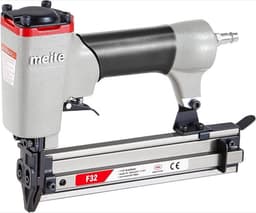
The rule of thumb is that the brad must pass through the skirting or architrave and bite into solid timber or a fixings block behind the plaster line. If the nail stops in the hollow, or blows through a thin architrave, you change length or pressure on scrap, not on the hallway wall. The meite F32 accepts 18-gauge brads from 10 mm to 32 mm. That can be short for a thick board even though the gauge is correct. The F50C, the WORKPRO, and the Tacwise 1804 state brad lengths up to 50 mm. Fifty millimetres is the top of that window, not a number we can prescribe without measuring your board and the ground behind it. CNS quotes typical second-fix lengths in the 15–50 mm band. Your scrap test still wins. The F50C kit includes 32 mm and 50 mm brads. The Tacwise kit includes 30 mm nails. The WORKPRO includes a spread from 15 mm upward.
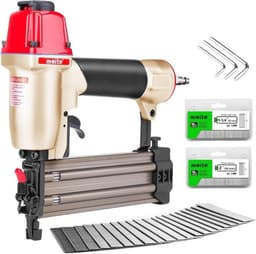
meite meite F50C with 2,000 brads

Testsieger

meite meite F50C with 2,000 brads
8.4/10about £44.90

Pressure, edges, and glue

Start at the low end of the band printed on the gun, often 60–100 PSI or 70–100 PSI on these listings, and raise in small steps on scrap until the head sits just below the surface. A Garden Review note suggests around 60–70 PSI on MDF and softwood as a start. That figure is their guidance, not a measurement of these ASINs. Do not copy a coil-nailer setting onto a brad gun. Do not nail into the feather edge of architrave or the top arris of skirting, where the section is thinnest. The Health and Safety Executive warns that fasteners too close to an edge can deflect and split the timber. UK reviewers describe the F32 as having no safety foot, so the trigger is live whenever air is connected. Many fitters spread glue on the back of the board and use nails to clamp it while the adhesive cures on a wavy wall. The connection and scrap-test order is on how to use an air nailer. The F50C states tool-free depth adjustment. WORKPRO reviewers report depth that is not always accurate.

When this is the wrong gun

Very heavy skirting, thick oak, or a board that flexes when you hand-press it may need a thicker nail than 18 gauge. That is when the 16-gauge Jovant enters, up to 2-1/2 inch in the listing, with four amazon.co.uk ratings and no stated pressure. It is the step up when an 18-gauge brad feels too light in the scrap test, not the default for standard MDF or softwood skirting. A brad into plaster alone will not hold skirting. Masonry, dot-and-dab without a timber ground, and structural fixings sit outside this page. You need a mechanical fix into solid material, not a longer brad from the F50C magazine. If the job is only invisible pins on glued beads, you are on the wrong page. If the job is ordinary skirting, pick a gun whose length window covers your test nail, and sort the hose coupler before you start if you bought the WORKPRO.

Common questions

Will an 18-gauge brad hold skirting?
On a sound timber ground or fixings block, yes, that is the usual second-fix approach trade pages describe. On hollow plaster with no block, no nail gun in this set replaces a proper fixing. Test length and pressure on an offcut before you fix the visible board. A pin is a smaller hole, not a stronger hold for a board the hoover will catch.
How long should the nail be?
Long enough to pass through the board and bite the substrate, without blowing through the face. Use that rule of thumb, then the scrap test. The F50C and WORKPRO list up to 50 mm. The F32 stops at 32 mm, which may be tight on thick skirting. Fifty millimetres is the top of the window in this set, not a length prescribed for every board.
Is a pin nailer neat enough for painted architrave?
It can look neat because the hole is small, but pins are not the default hold for architrave that must stay on its own. Use pins on glued fine trim, not as a substitute for a brad on a door architrave taking knocks. Paint-grade architrave usually means a filled brad head, which is normal on this job.
Do I still need adhesive?
Often yes on uneven walls, to fill gaps while nails clamp the board. Adhesive plus brads is common second fix. Adhesive without mechanical bite into timber is not enough on its own for heavy boards. Nails alone on a wavy wall can leave gaps. Glue alone can slip before it sets.
What if the nail sits proud or blows through the face?
Adjust pressure in small steps, change nail length, or use depth adjustment if the gun has it. Proud heads can be set with a nail punch after testing. Blow-through means the nail or the pressure was too much for that section. Do the first board as an offcut, not as the visible hallway length.
When should I step up to 16 gauge?
When scrap testing shows an 18-gauge brad does not bite enough in heavy timber, or the board is thick and stiff enough that trade guides would choose 16 gauge. The Jovant is the 16-gauge listing in this set, with four ratings and no printed operating pressure. Read the comparison before you buy on that sample alone.

Related pages

Sources

Public UK sources used for this comparison. Listings were checked on 19 October 2026.

  1. HSE: Nail guns (woodworking) (retrieved 19 October 2026)
  2. PUWER 1998 (retrieved 19 October 2026)
  3. Control of Noise at Work Regulations 2005 (retrieved 19 October 2026)
  4. BOHS: Vibration exposure from nail guns (retrieved 19 October 2026)
  5. Protrade: Nail gun buyers guide (retrieved 19 October 2026)
  6. CNS Power Tools: Second-fix nails buying guide (retrieved 19 October 2026)
  7. Advanced Fasteners: 23-gauge pin nailers explained (retrieved 19 October 2026)
  8. Air Supply: How to use a nail gun with an air compressor (retrieved 19 October 2026)