Independent comparisons. We may earn from shop links. More info

Air nailer buying guide

Updated: 21 October 2026

You have a length of skirting, a fence panel, or a bead that has to stay almost invisible, and the search has collapsed that into air nailer. This air nailer buying guide is the decision before brands. An air nailer here drives a brad, a pin, a finish nail, or a coil nail from a compressor and hose you buy separately. None of the amazon.co.uk listings in our [air nailer comparison](/hub/staplers-and-nail-guns/air-nailer) includes that compressor. Pick the fastener and the contact safety first, then the price. Peter F. checked those listings on 19 October 2026. There was no lab test. A qualifying purchase can earn a commission at no extra cost to you.

You have a length of skirting, a fence panel, or a bead that has to stay almost invisible, and the search has collapsed that into air nailer. This air nailer buying guide is the decision before brands.

Our top picks

On this page

Start with the job, not the brand

The job tells you the gauge, and the gauge tells you which gun can take the nail. Ordinary architrave and lighter skirting on a sound timber ground are the usual 18-gauge brad job. Protrade and CNS Power Tools put 18 gauge on delicate second-fix trim, 23 gauge on fine work with less hold, and 16 gauge on heavier trim. Advanced Fasteners describes a pin of about 0.6 mm against a brad of about 1.0 mm. The hold is meant to come from glue or from a light piece, not from the pin alone. A bead that must not show a filled hole points at 23 gauge. A board that has to stay on the wall points at an 18-gauge brad. Hundreds of fencing nails are a coil magazine, not a 100-brad trim gun. The hold-versus-hole split is on brad nailer or pin nailer.

What has to be true on the listing

The length window has to cover the nail that passes through the board and into the ground. The meite F32 stops at 32 mm. The F50C and the WORKPRO run from 15 mm to 50 mm. Tacwise type 180 brads run from 20 mm to 50 mm. The MP635B takes pins from 12 mm to 35 mm. A short window is fine for short brads and the wrong gun if the board is thicker than the nail can bite. The Health and Safety Executive describes a nose that must be pressed before the trigger fires. The F50C listings state a safety switch lock. The WORKPRO states a contact safety switch. The Tacwise states contact-trip firing. Reviewers of the F32, including UK reviewers, say there is no safety foot and the trigger fires whenever air is connected. A high star rating does not replace that line.
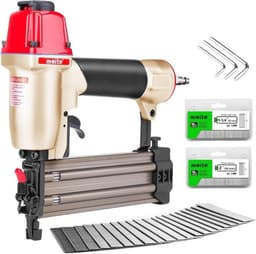
meite meite F50C with 2,000 brads

Testsieger

meite meite F50C with 2,000 brads
8.4/10about £44.90

The compressor and the coupler are a second purchase

Every listing expects a compressor that is not in the carton. We are not quoting a tank size, because none of these guns was measured against a compressor. Brad listings cluster around 60–100 PSI or 70–100 PSI. The plate on the gun wins. The meite CN55 states 85–120 PSI, a coil-gun band. WORKPRO reviewers often found the male connector did not match a common UK hose. They name PCL, BSP, or a Euro 1/4 inch fitting, and some found it hard to remove from the oil-chamber cover. Several meite guns state a 1/4 inch NPT inlet. If the coupler will not click, change the fitting. Do not keep raising the regulator. Connecting and disconnecting sit on how to use an air nailer.

Price after the checks

Entry 18-gauge listings run from about £39.90 for the bare F50C to £49.99 for the Tacwise kit. The pin kit is £65.00. The Jovant 16-gauge gun is £79.99. Both coil guns are £139.90. The F32 at £39.99 stops at 32 mm, and reviewers report no safety foot. Spending less there does not buy the F50C length window. Coil nailers are not a longer brad gun. The CN65 runs to 65 mm, and the one UK review in a file of five ratings describes the gun keeping on firing after about 30 fence-panel nails. Five ratings are not a failure rate. They are a reason to treat a repeat fire as a stop.

If you already know the job

If you want an 18-gauge gun with nails in the box and a stated safety lock, the comparison is the next read. If you are still choosing between a hole you will not see and a nail that has to hold, stay with the versus page. If the boards are already cut, length belongs on the skirting page. Trade-counter 18-gauge guns, including a DeWalt listed well above £200 away from amazon.co.uk, only show that this cluster is the cheaper end. That is not a lab score.

Common questions

Is 18 gauge enough for most DIY?
For architrave, ordinary skirting, and light assembly, 18 gauge is the default in the UK second-fix guides used here. It is not enough when the board is heavy, when the nail must do structural work, or when you are driving coil nails by the hundred. The F32 stops at 32 mm, so a thick board can outrun it even though the gauge matches.
When do I need a pin nailer instead?
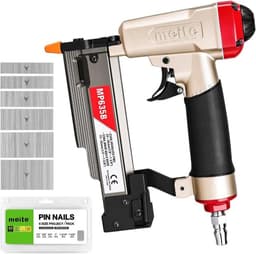
Choose a pin when the hole has to disappear and glue, or a very light piece, is doing the holding. The meite MP635B is the pin listing here, at £65.00, for 12–35 mm pins, and the page says it will not take 18-gauge brads. The file has 4.8 from 15 reviews and no UK-labelled review text, so treat that as a small sample, not a British verdict.
When is 16 gauge the next step?
Sixteen gauge is the step up when an 18-gauge brad is too light, not a third everyday nail for architrave. The only 16-gauge gun here is the Jovant at £79.99, listed for 3/4 inch to 2-1/2 inch nails, with a 6 m hose and no operating pressure printed. It has 4.6 from four reviews, a first impression.
Are nails included at this price?
Only when the listing says so. At £44.90 the F50C kit includes 2,000 brads. At £46.99 the WORKPRO includes 400 nails and 300 staples. At £49.99 the Tacwise kit includes nails, staples, a case, and oil. The bare F50C at £39.90 does not include brads. The Jovant and the two coil guns do not list nails.
What if the listing prints no pressure?
Do not copy another model. The Jovant and the meite CN65 do not print an operating pressure. Brad listings that do print one cluster around 60–100 PSI or 70–100 PSI, and the CN55 prints 85–120 PSI. The number on your own gun overrides a generic figure. Several meite inlets are stated as 1/4 inch NPT.

Related pages

Sources

Public UK sources used for this comparison. Listings were checked on 19 October 2026.

  1. HSE: Nail guns (woodworking) (retrieved 19 October 2026)
  2. PUWER 1998 (retrieved 19 October 2026)
  3. Control of Noise at Work Regulations 2005 (retrieved 19 October 2026)
  4. BOHS: Vibration exposure from nail guns (retrieved 19 October 2026)
  5. Protrade: Nail gun buyers guide (retrieved 19 October 2026)
  6. CNS Power Tools: Second-fix nails buying guide (retrieved 19 October 2026)
  7. Advanced Fasteners: 23-gauge pin nailers explained (retrieved 19 October 2026)
  8. Air Supply: How to use a nail gun with an air compressor (retrieved 19 October 2026)