Independent comparisons. We may earn from shop links. More info

Brad nailer or pin nailer

Updated: 21 October 2026

You are looking at two nail packs, or the same job keeps appearing under both 18 gauge brad and 23 gauge pin. The question is not which brand looks tougher. It is whether the nail has to hold the board on its own, or whether the hole has to stay almost invisible and glue or a light piece is doing the real work. This page compares brad nailer or pin nailer for that split. Prices and scores are on the [air nailer comparison](/hub/staplers-and-nail-guns/air-nailer). Peter F. used the amazon.co.uk figures checked on 19 October 2026. There was no lab test. A qualifying purchase can earn a commission at no extra cost to you.

You are looking at two nail packs, or the same job keeps appearing under both 18 gauge brad and 23 gauge pin. The question is not which brand looks tougher.

Our top picks

On this page

The nail, not the brand

A brad nailer drives a thin nail with a small head, usually 18 gauge. Advanced Fasteners put the shank at about 1.0 mm, while MyToolkit’s fastener table lists 18 gauge at about 1.25 mm. Treat both as approximate guides, not a calliper measurement of every strip. A pin nailer drives a headless pin, often 23 gauge, described at about 0.6 mm or 0.64 mm. The pin’s point is the smaller hole. There is no head to resist pull-out the way a brad head can. If the joint has to stay when someone catches the board, you want a brad. If the piece is light, pre-finished, or glued, and you would rather not fill a head, you want a pin. CNS Power Tools puts 18 gauge on general trim and 23 gauge on fine work with less holding power. Neither gun replaces a structural fixing. Gauge before a model name is the air nailer buying guide.

Choose a brad when the joint has to stay

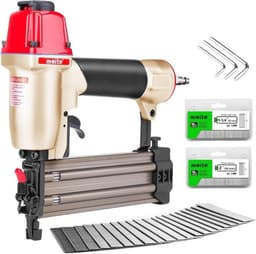
Architrave around a door, ordinary skirting on timber grounds, and a cabinet back that must not rattle loose are the jobs trade pages such as ITS assign to an 18-gauge brad. The nail passes through the trim and bites into the stud, block, or floor plate behind it. On paint-grade work you usually fill the small head and paint over it. The F32 stops at 32 mm, which can be short for thick skirting even though the gauge is right. The F50C, WORKPRO, and Tacwise state brad lengths up to 50 mm, the top of the window in this set, not a prescription for every board. If the board must stay on the wall without relying on glue alone, start with 18 gauge. Length for painted interior trim is on air nailer for skirting. The F50C kit states a safety switch lock and includes 1,000 brads at 32 mm and 1,000 at 50 mm. The WORKPRO adds staples, and UK reviewers often report a hose coupler mismatch. None of that changes the gauge.
meite meite F50C with 2,000 brads

Testsieger

meite meite F50C with 2,000 brads
8.4/10about £44.90

Choose a pin when the mark matters more than the hold

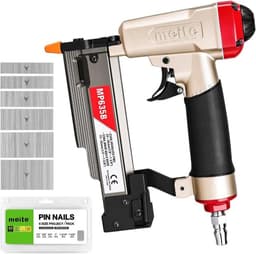
Beads, small mouldings, pre-finished trim, and glued mitres are where a pin nailer earns its keep. The hole is described as near invisible, and the hold comes from adhesive or from the lightness of the piece. A pin can hold two glued faces together while the glue cures. It is the wrong default for a skirting board that must stay up when the vacuum hose catches the edge. The meite MP635B is the pin option here. It takes 12–35 mm pins only, includes 6,000 galvanised pins across six lengths, and states 70–100 PSI on a 1/4 inch NPT inlet. The amazon.co.uk file has fifteen ratings and no UK review text, so themes such as a stiff safety spring come from other marketplace text on the same listing. Longer strips at 30–35 mm can sit crooked, the follower then fails to feed, and the gun dry-fires. Short pins around 16–19 mm seat more reliably when the compressor is regulated.

You cannot load one gun with the other nail

The MP635B page is explicit: 23-gauge pins only, not 18-gauge brads. The magazine, driver, and nose are sized for a headless pin. Feeding brads through a pin nailer is not a workaround, and feeding pins through an 18-gauge brad gun is not supported on these listings either. Sixteen gauge is the heavier step when an 18-gauge brad is too light, not a third equal choice. The Jovant in this set is a 16-gauge finish nailer for 3/4 inch to 2-1/2 inch nails, with four amazon.co.uk ratings and no stated operating pressure. If you must pick one gun first for a UK interior, the brad usually comes first, because holding trim beats invisibility on a wall line. If your first job is beads and glued mitres, the pin kit can come first, as long as you accept it will not load brads.

Common questions

Which one leaves the smaller hole?
The pin nailer, because the pin is headless and roughly half the diameter of an 18-gauge brad in trade explainers. The brad leaves a small head you often fill on paint-grade trim. If the hole size is the deciding factor and glue is doing the hold, choose the pin. If the board must stay without filler carrying the joint, choose the brad.
Will pins hold skirting on their own?
Not reliably. Trade guidance treats pins as helpers for glue or light stock, not as the main fix for a board that takes bumps. Use an 18-gauge brad for ordinary skirting, and use the skirting page for length. Use pins only where the trim is light and glued, or where you accept that hold is secondary.
Can I use glue with pins and skip brads?
Yes, when the piece is light and the glue line is doing the work, such as a bead or a small moulding. Glue plus pins is a common pattern. Glue plus pins is not a substitute for a brad on a full-height skirting board that must stay on an uneven wall without pulling away.
What lengths do the guns in this set actually take?
18-gauge brads: the F32 from 10 mm to 32 mm; the F50C and the WORKPRO from 15 mm to 50 mm; Tacwise type 180 brads from 20 mm to 50 mm. Pins: the MP635B from 12 mm to 35 mm only. Pick the gun whose window covers the nail you need after the scrap test, not the longest nail printed on the box.
Can I put brad nails in a pin nailer?
No on the MP635B listing, which states it is not compatible with 18-gauge brads. The magazine is sized for 23-gauge headless pins. Buy the gauge that matches the nail strip you already have, or return the wrong pack. A harder push will not resize the driver.
Do I need two guns?
Only if you do both jobs: brads for holding trim, pins for invisible tacks on glued fine work. One gun cannot fire both nail types in this set. Many people start with one 18-gauge brad gun and add a pin nailer when beads and pre-finished pieces pile up. Sixteen gauge is a heavier finish nail, not a middle ground between the two.

Related pages

Sources

Public UK sources used for this comparison. Listings were checked on 19 October 2026.

  1. HSE: Nail guns (woodworking) (retrieved 19 October 2026)
  2. PUWER 1998 (retrieved 19 October 2026)
  3. Control of Noise at Work Regulations 2005 (retrieved 19 October 2026)
  4. BOHS: Vibration exposure from nail guns (retrieved 19 October 2026)
  5. Protrade: Nail gun buyers guide (retrieved 19 October 2026)
  6. CNS Power Tools: Second-fix nails buying guide (retrieved 19 October 2026)
  7. Advanced Fasteners: 23-gauge pin nailers explained (retrieved 19 October 2026)
  8. Air Supply: How to use a nail gun with an air compressor (retrieved 19 October 2026)