Independent comparisons. We may earn from shop links. More info

Soldering iron for electronics repair on hobby boards

Updated: 21 October 2026

The board is already out of the case, a pad is smaller than the tip you used on a speaker wire last year, and the connector you also need to replace will suck the heat out of a cheap pencil. Electronics repair on this page means that mix: PCB joints, wire ends, and plugs, on hobby and domestic kit, not house wiring and not hot-air chip removal. The full price grid is the [soldering iron comparison](/hub/soldering-and-welding/soldering-iron). The notes are amazon.co.uk listings and review notes, not a repaired-board lab. Match the iron to the joint in front of you, then prove the tip on scrap before you touch the device you hoped to save.

The board is already out of the case, a pad is smaller than the tip you used on a speaker wire last year, and the connector you also need to replace will suck the heat out of a cheap pencil.

Our top picks

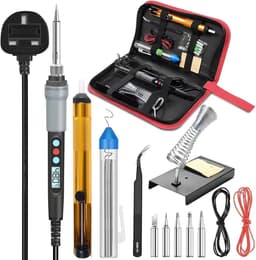
HANDSKIT HANDSKIT SI Series 90W

Best overall

HANDSKIT HANDSKIT SI Series 90W
9.0/10about £13.50
YIHUA YIHUA 926LED-IV 110W

Alternative

YIHUA YIHUA 926LED-IV 110W
8.2/10about £57.99
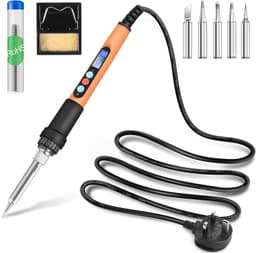
HANDSKIT HANDSKIT 926 series 90W

Alternative

HANDSKIT HANDSKIT 926 series 90W
8.4/10about £13.99
On this page

Three jobs that do not want the same iron

A wire joint wants heat and a clean tip. Reviewers tin speaker wires, repair a radio lead, and redo e-bike connections with pencils and the XODMAO gun. You still seat the tip, because a HANDSKIT tip that does not touch the heater will not tin anything. A PCB joint wants a repeatable temperature and a tip that fits the pad. One SI Series reviewer worked around 320°C with a fine chisel on small SMD and moderate boards. The Beizkna’s finest tip would not hold solder while the broader tips did. Needle tips often starve the pad, so you stay longer and lift copper. A connector or a ground plane wants recovery. The YIHUA 926 buyer who could not get past about 300°C struggled with TX60 and EC5 plugs. Do the wires with the pencil and admit the plug may need a bigger tip or a station. Tinning and fume habits are on how to use a soldering iron.

Heat recovery, tips, and what the listing can mean

None of these amazon.co.uk pages publishes a measured recovery time. PID is named on the £13.99 HANDSKIT, on the YIHUA 926, and on the WEP station. It is not named on the SI Series, which is still the top pick for ordinary mains work because 3,165 reviews at 4.5 and about £13.50 beat an unproven headline. For board work, the PID wording is a reason to look at the £13.99 HANDSKIT or the YIHUA, then to read the limits. The £13.99 kit lists six 900M tips, wick, and a pump. A car-electrics buyer treated it as a portable stand-in for a station and thought the gauge was within about 10%. One unit died after a year. The YIHUA 926 at about £57.99 is the bench option when repairs are weekly: 110 W, a Type-G plug, helping hands, and 878 reviews at 4.4. A year of heavy use with no trouble sits beside a station that would not rise above 90°C. Test the tip on scrap before you touch the device.
HANDSKIT HANDSKIT SI Series 90W

Testsieger

HANDSKIT HANDSKIT SI Series 90W
9.0/10about £13.50

Which rows fit hobby repair, and which do not

For occasional PCB and wire repair, start with the HANDSKIT SI Series if you will reject a tip that stays cold, or with the £13.99 HANDSKIT if you want the PID claim and the pump. The L series has more reviews and a worse stand-and-display story. More comments do not make it the repair pick. The XODMAO at about £11.99 is a reasonable wire iron and the one to leave in the drawer when the pad is small. The dial, heating at maximum first, and the weak stand are the wrong trio for a board. Leave LeaderPro and Seesii out: no star line in this capture, and the Seesii’s 16 W cap will not recover a connector. Leave the BILIPLE 21-in-1 as a gadget bundle with 15 reviews and a poor stand.

Flux, a pump, and the repairs you hand back

Extra flux is what makes an old joint wet again. If you are clearing a chip leg or a filled hole, a desoldering pump or wick, plus flux from the soldering flux comparison, will do more than another 30 W on the title. The £13.99 HANDSKIT lists both wick and a pump. Check them on scrap before you need them. A tip iron can do a single leg or a through-hole part. It is a poor way to lift a multi-pin chip. Stop when the device is mains-live, when you are into a battery pack you do not understand, or when the pad has already lifted. Keep your head out of the rosin plume; HSE SR20 still applies on a spare-room bench.

Common questions

What soldering iron should I use on circuit boards?
For occasional boards, a 90 W pencil with a chisel tip you have proved will wet, at a temperature around the low 300s °C rather than at the top of the dial. The SI Series is the reviewed cheap option if you will swap a dead tip. The £13.99 HANDSKIT is the one whose listing names PID and includes wick and a pump. For weekly repair, the YIHUA 926 station is the bench choice, after you confirm it actually heats.
Is 60 W enough for electronics?
It can be enough for wires and small through-hole joints. The XODMAO at 60 W has 1,437 reviews and a dial, and buyers use it for light repairs. It is marginal on connectors and ground planes, where a 90–110 W iron with better control recovers faster. Wattage without tip contact does nothing: a badly fitted tip on a 90 W HANDSKIT stays cold.
Can I use a gun-style iron on a PCB?
You can, and it is easy to overshoot. The XODMAO’s fast heat-up, in one review, meant starting at maximum and then turning down. That sequence is hostile to a small pad. Prefer a pencil or a station for boards, and keep the gun for wires and plugs you can redo. The HANDSKIT LCD gun has only 34 reviews, which is too few to recommend for repair.
Do I need a desoldering pump as well?
Yes if you are removing parts rather than only adding solder. Some kits include a pump and wick, notably the £13.99 HANDSKIT, and those included tools are often the weak pieces. Try them on scrap. If they clog or the wick is dry, use a separate pump and flux rather than forcing the joint with a hotter tip.
Why did the pad lift?
The tip was too hot, too small, or left in place too long, or the board was old and the adhesive was already tired. Feeding solder onto a cold pad and then pressing is the usual path. Clean and tin the tip, heat pad and lead together, and leave as soon as the solder flows. If a station seems stuck near 300°C and the connector still will not wet, stop. A hotter guess is how the next pad comes off.

Related pages

Sources

Sources taken from the research digest. Listings were scored on 20 October 2026. This page did not run a lab test.

  1. HSE — SR20 Rosin-cored solder (retrieved 20.10.2026)
  2. HSE — INDG248 Solder fume (retrieved 20.10.2026)
  3. HSE — Solderers and asthma (retrieved 20.10.2026)
  4. Grove Sales — How to choose a soldering station (retrieved 20.10.2026)
  5. Maker UK — Soldering iron for electronics (retrieved 20.10.2026)
  6. RS Online — Soldering irons guide (retrieved 20.10.2026)