Independent comparisons. We may earn from shop links. More info

Soldering iron buying guide for this UK set

Updated: 21 October 2026

You are looking at a basket of irons on amazon.co.uk and the titles all promise adjustable temperature, from about £9.99 to about £84.99, while the jobs in front of you are a loose speaker wire, a cracked PCB pad, or a connector that soaks heat. This soldering iron buying guide puts the decision in order before you sort the [soldering iron comparison](/hub/soldering-and-welding/soldering-iron): what you are joining, whether you need a pencil or a station, and whether the number on the screen is a real temperature. The figures below are amazon.co.uk listings in this batch, not a lab test.

You are looking at a basket of irons on amazon.co.uk and the titles all promise adjustable temperature, from about £9.99 to about £84.99, while the jobs in front of you are a loose speaker wire, a cracked PCB pad, or a connector that soaks heat.

Our top picks

HANDSKIT HANDSKIT SI Series 90W

Best overall

HANDSKIT HANDSKIT SI Series 90W
9.0/10about £13.50
XODMAO XODMAO 60 W gun kit

Best value

XODMAO XODMAO 60 W gun kit
8.5/10about £11.99
YIHUA YIHUA 926LED-IV 110W

Alternative

YIHUA YIHUA 926LED-IV 110W
8.2/10about £57.99
On this page

Start with the joint, not the wattage

The wattage in the title is the last number you should trust, and only after you know the joint. A speaker wire does not need the same recovery as a ground plane or a TX60 plug. In this table the mains rows run from the XODMAO 60 W gun at about £11.99 to the YIHUA 926LED-IV at 110 W and about £57.99. Those figures are listing claims. A Beizkna buyer who measured the draw saw about 80 W, which matched that listing. Maker guidance aimed at UK electronics hobbyists often talks about 60–75 W when the iron can actually hold temperature. A 120 W headline on the LeaderPro at about £9.99 does not beat that advice, because this capture has no star line for that ASIN. Scenario picks sit on best soldering iron.

Pencil, gun, or station

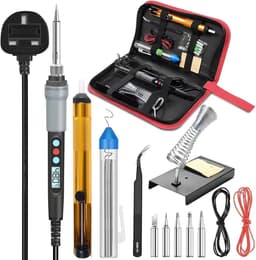
Format changes how you work, more than an extra 20 W on a sticker. A mains pencil such as the HANDSKIT SI Series at about £13.50 is what most occasional buyers mean by a soldering iron: you hold it like a pen and put it away. A gun such as the XODMAO is clearer for some people and clumsier between tight components. A bench station such as the YIHUA 926LED-IV or the WEP 926LED V3 leaves the control box on the bench. The YIHUA 928D-IV at about £39.99 is the awkward row. The table files it as a bench station, but the bullets describe an 18.5 cm USB-C iron that needs a 60 W or higher Type-C supply. Without that supply you have a handle, not a bench station. The format fork is on soldering station vs soldering iron.
HANDSKIT HANDSKIT SI Series 90W

Testsieger

HANDSKIT HANDSKIT SI Series 90W
9.0/10about £13.50

What adjustable temperature means

Adjustable on a £12 kit is often a power dial or a set-point the listing never proves with closed-loop control. PID is marked only where the listing says so. The HANDSKIT SI Series does not state PID. The HANDSKIT at about £13.99 does: the bullets name PID, PWM, a calibration offset from -99°C to +99°C, and six 900M tips. That wording is still a claim. One buyer called the gauge accurate to about 10%, which is a personal check, not a certificate. Closed-loop control matters when you move from leaded wire to lead-free, or from a thin pad to a connector. On the YIHUA 926, the instructions say to tin at 250°C; one buyer found that too cool and only melted solder nearer 350°C. Another said the station seemed to max out around 300°C and struggled with TX60 and EC5 plugs.

Plug, fuse, stand, and the box

UK mains are 230 V and the plug should be BS 1363. The XODMAO listing names a UK plug. The YIHUA 926 states a Type-G plug rated for 230 V. Several other rows, including the top-pick HANDSKIT, do not state the plug in this capture, so check the live amazon.co.uk gallery before you assume you can plug in. A 13 A fuse is the wrong default for a 60 W or 90 W iron, which draws well under an amp at 230 V. Where the leaflet is silent, a 3 A fuse is the usual small-appliance choice. One HANDSKIT L-series review describes a flash and a blown fuse on first switch-on, so test the iron while you can still return it. The stand fails more often than the heater in this file. Beizkna’s is compared to a matchbox. XODMAO’s is unsteady. The L-series stand topples with the iron in it.

Fumes, and when you stop

Rosin flux fume is not a smell you tough out. The Health and Safety Executive’s soldering guidance, SR20, treats colophony fume as a cause of occupational asthma and expects local exhaust where soldering is regular work, plus the lowest temperature that still makes the joint. A hobby bench is not a factory. Open a window and keep your head out of the plume. Stop and call a qualified person for fixed wiring, for high-voltage work inside a product the maker says you must not open, and for any repair where a lifted pad would scrap a board you cannot replace. The iron you buy here is for wires, connectors, and hobby boards. It is not a hot-air rework station.

Common questions

Do I need a station or is a pencil kit enough?
A pencil is enough when the joints are small and the session is short. The HANDSKIT SI Series at about £13.50 is the top pick in the main table for that pattern, with the caveat that some tips do not touch the heater. A station such as the YIHUA 926 at about £57.99 is the better spend when you solder most weeks and want the iron to stay set up. If you only tin a connector twice a year, the station price is hard to defend.
What does adjustable temperature mean on cheap kits?
It means the listing offers a dial or a screen, not that the tip is under closed-loop control. PID is marked in this comparison only where the bullets say so, as on one HANDSKIT pencil and on the YIHUA and WEP stations. Even then, UK reviews show panels that do not match the joint. Treat 180–480°C as a range claim until you have tinned the tip and watched real solder melt.
How many watts do I need for hobby electronics?
For ordinary through-hole and wire work, a stable 60–90 W mains iron is the band this table actually supports with reviews. The XODMAO at 60 W and the HANDSKIT pencils at 90 W sit there. Higher titles help only if the iron recovers on a big pad. A 16 W cordless pen does not stand in for that work, and a 120 W claim with no reviews does not either.
Which HANDSKIT listing should I trust?
There are four HANDSKIT rows, not one product. The SI Series at about £13.50 has 3,165 reviews and is the top pick. The L series at about £15.97 has 4,255 reviews but a stand that topples and a title temperature that disagrees with the stored 450°C field. The £13.99 pencil is the one that names PID and includes a pump. The LCD gun has 34 reviews. Match the ASIN, not the brand banner.
Is lead-free solder harder on a cheap iron?
Yes, in the practical sense that the joint needs more sustained heat and a clean, well-fitted tip. The YIHUA 926 includes 35 g of lead-free wire, and one buyer could not tin at the suggested 250°C until the panel was nearer 350°C. A £12 iron can still do small lead-free joints if the tip contacts the heater. It will struggle on large connectors, which is a reason to move up to a station rather than to turn a dial to maximum and hope.

Related pages

Sources

Sources taken from the research digest. Listings were scored on 20 October 2026. This page did not run a lab test.

  1. HSE — SR20 Rosin-cored solder (retrieved 20.10.2026)
  2. HSE — INDG248 Solder fume (retrieved 20.10.2026)
  3. HSE — Solderers and asthma (retrieved 20.10.2026)
  4. Grove Sales — How to choose a soldering station (retrieved 20.10.2026)
  5. Maker UK — Soldering iron for electronics (retrieved 20.10.2026)
  6. RS Online — Soldering irons guide (retrieved 20.10.2026)