Independent comparisons. We may earn from shop links. More info

Solder seal vs crimp connectors

Updated: 21 October 2026

You can join two wires with a crimp butt and a separate heat-shrink tube, or you can slide on a solder-seal sleeve and melt everything in one pass. Both show up in UK trailer, caravan and workshop repairs, and marketplace listings push solder-seal kits hard on amazon.co.uk. This page compares the methods so you can choose before you open the [solder connectors comparison](/hub/soldering-and-welding/solder-connectors) or the [buying guide](/hub/soldering-and-welding/solder-connectors/sub/solder-connectors-buying-guide). The decision is about the tool you will actually use well. It is not a brand ranking, and neither method replaces an enclosure for concealed mains under BS 7671.

You can join two wires with a crimp butt and a separate heat-shrink tube, or you can slide on a solder-seal sleeve and melt everything in one pass.

Our top picks

On this page

What you are joining

The decision is about process, not brand logos. A crimp butt splice needs a crimper that deforms a metal barrel onto stripped conductors. You then add insulation with heat-shrink or tape. A solder-seal sleeve combines a solder preform, a heat-shrink body and adhesive rings so one controlled heating cycle wets the copper and seals the ends. Both fail if the wire size is wrong or the workmanship is rushed. Neither method replaces a proper junction enclosure for concealed mains conductors under BS 7671. The comparison here assumes accessory circuits, outdoor lighting and vehicle looms where an inline splice is common and you can inspect it.

When solder-seal wins

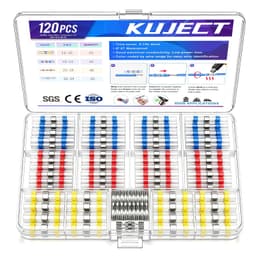
An integrated solder-seal connector earns its place when you want speed and a compact joint. You strip, insert and heat from the centre out until the solder flows and adhesive tracks onto the insulation. For a trailer lamp at the roadside, that can mean fewer tools in the bag if you already trust the heat gun. Kits in this table from about £3.49 to £19.99 supply assorted colours without a crimp die, which suits occasional DIY when you do not want a crimper for three joins. Solder-seal also helps when space is tight and a bulky crimp barrel plus a separate sleeve would be awkward under a deck or inside a mirror housing. Dual-wall adhesive listings aim at moisture resistance. The outcome still depends on heating, not on the word waterproof in the title. The trade-off is reversibility. Removing a soldered splice means cutting it out and re-stripping. If you expect to rework the harness often, a crimped joint can be faster to replace once you own a crimper matched to the terminal.

When crimp-plus-shrink wins

Crimping shines when you have the correct tool for the terminal size and you inspect the deformation before you insulate. A good crimp leaves no air gap between barrel and copper, and you can tug-test before the shrink goes on. In a vibrating loom, some workshops prefer a crimp because it avoids overheating nearby insulation or neighbouring connectors if the heat wanders. Crimping also avoids a hot airflow, which matters near fuel vapour, sensitive plastics or a battery compartment, where air at several hundred degrees needs more care. If your only heat source would be a naked flame, crimp-plus-shrink is usually safer than charring polyolefin on a solder sleeve. Basic crimp terminals plus loose shrink can be cheap per joint if you already own the crimpers. Solder-seal kits bundle sleeves at roughly five to twenty pounds, which is competitive when you value one heating cycle. Under a dashboard, fewer tool changes matter. Solder-seal notes often describe a ring that never melted. Crimp failures often trace to the wrong die. Start with the tool you will use well.

Tooling and heat profile

Solder-seal needs a capable heat gun for all but the smallest sleeves. Captures cite gun temperatures roughly between 230 and 450 °C. Yellow sizes punish a weak mini gun. Crimping needs a ratchet or die sized to the terminal, plus optional shrink and a lighter or gun for the insulation only. If you own neither tool, one bundle in this comparison pairs four hundred sleeves with a mini 300 W gun at about £29.99. A crimp-first buyer might spend on a ratchet crimper and loose terminals instead. The toolbox you already have should steer the method. The heating sequence is on how to use solder-seal wire connectors. Vehicle context is on automotive and marine repairs.

UK rules snapshot

Sound termination matters under Regulation 526 regardless of method. Enclosure rules bite on fixed mains, not on a 12 V lamp feed you can inspect under a trailer. Choose the method you can execute cleanly. A poor crimp and a cold solder joint both fail in salt spray.

Common questions

Do I need a crimp tool with solder-seal sleeves?
Not for the solder-seal kits in this table. Heat replaces the crimp step. A crimp tool stays relevant if you choose the two-step method of a metal barrel plus a separate sleeve.
Which colour fits 1.5 mm² cable?
Both methods need the correct terminal or sleeve size. Follow the AWG colour chart on the packaging. Do not guess from a domestic lighting cable you happen to have in the shed.
Can I use these on mains wiring in a wall?
A concealed mains joint needs an approved enclosure and method. Inline accessory repairs are the realistic scope for either technique on this page.
What heat gun temperature do listings cite?
Solder-seal listings often cite several hundred degrees Celsius on the gun, commonly about 230 to 450 °C. A crimp-only workflow may need no gun until you shrink the insulation.
Are IP67 kits truly waterproof?
Ingress claims on this comparison apply to solder-seal products. A crimped joint depends on the shrink and adhesive you add yourself. Technique beats the badge on either method.
Solder seal or crimp for trailer lights?
Either can work on common small gauges. Solder-seal is faster with a gun you already handle well. Crimp-plus-shrink can be easier to rework if you practise the crimp first. Anchor the loom so vibration does not flex the join.
Is a kit with a mini heat gun worth it?
It tilts the decision toward solder-seal when you lack heat tooling. A crimp-first buyer may invest in crimpers instead. Five reviews on the 300 W bundle in this set is a thin file, so practise on scrap before a harness.
Why did my solder not melt?
That failure pushes some owners back toward crimping. If heat keeps failing, check gun power and sleeve size before you abandon solder-seal. A ring that never wets is a cold joint, even when the tube looks tight.

Related pages

Sources

Sources taken from the research digest. The digest also points at the stored amazon.co.uk listings. Those are the product rows, not an extra public article.

  1. IET Wiring Matters: terminal blocks (retrieved 21.10.2026)
  2. BuildWiz UK: heat-shrink and enclosures (retrieved 21.10.2026)
  3. Voltimum: termination of conductors (retrieved 21.10.2026)
  4. Professional Electrician: enclosing connections (retrieved 21.10.2026)
  5. HSE: electricity (retrieved 21.10.2026)
  6. Haisstronica: heat shrink and solder-seal connectors (retrieved 21.10.2026)